-
Carbon Fibre Anodes for Al & Zn Batteries - Cornell University, 2021
May 20, 2026 | ACS MATERIAL LLCZheng, J., Bock, D. C., Tang, T., Zhao, Q., Yin, J., Tallman, K. R., Wheeler, G., Liu, X., Deng, Y., Jin, S., Marschilok, A. C., Takeuchi, E. S., Takeuchi, K. J., & Archer, L. A. (2021). Regulating electrodeposition morphology in high-capacity aluminium and zinc battery anodes using interfacial metal–substrate bonding. *Nature Energy*. https://doi.org/10.1038/s41560-021-00797-7
Nature Energy · 2021
Cornell researchers use carbon fibre substrates with Al-O-C interfacial bonding to achieve 99.6-99.8% Coulombic efficiency in high-capacity aluminium batteries.
About this research
Researchers at Cornell University, working with collaborators at Brookhaven National Laboratory and Stony Brook University, used patterned carbon fibre substrates engineered for strong interfacial Al-O-C chemical bonding to achieve highly reversible aluminium and zinc electrodeposition for next-generation rechargeable batteries, reporting Coulombic efficiencies of 99.6-99.8% sustained for more than 3,600 hours at areal capacities up to 8 mAh cm-2. Published in Nature Energy in April 2021, the work, led by Lynden A. Archer, identifies fragile electron transport pathways as the root cause of poor metal anode reversibility and shows how surface chemistry on a conductive carbon scaffold can solve it. The approach lifts the practical performance ceiling of aluminium batteries by nearly two orders of magnitude.
Post-lithium battery chemistries based on aluminium and zinc metal anodes are attractive because of their low cost, intrinsic safety, abundance and high theoretical energy density. In practice, however, these systems suffer from severe reversibility problems: aluminium plated on conventional planar substrates forms coarse, heterogeneous deposits 20-50 μm in size, dead metal accumulates in the separator, and cells short-circuit in under 20 hours at relevant areal capacities. Prior literature reports areal capacities of just 0.01-0.18 mAh cm-2, roughly 100× lower than commercial Li-ion electrodes. Closing this gap is essential if aluminium batteries are to serve grid-scale backup storage for intermittent renewables, where cost and scalability dominate the technical requirements.
The team built electrodes from fibrillar carbon substrates and pretreated them with an imidazolium chloride/AlCl3 ionic-liquid electrolyte to functionalize the carbon surface with oxygen-containing groups. During aluminium plating, these groups form covalent Al-O-C bonds with depositing Al atoms, as confirmed directly by X-ray photoelectron spectroscopy. The strong metal-substrate bonding raises the nucleation driving force and produces a dense, uniform distribution of small nuclei. Aluminium then grows laterally along the carbon fibre surface as a compact nanocrystalline layer rather than vertically into the glass-fibre separator. Once the available carbon surface is fully covered, subsequent Al deposits fill in as microsized particles embedded between fibres, maintaining short electron transport length L and a small electron transport timescale τ ≈ L²/D throughout cycling. Control experiments on stainless steel and 3D nickel foam substrates - which lack the Al-O-C bonding chemistry - reproduced the conventional coarse, dendritic morphology, confirming that geometry alone is insufficient and the surface chemistry is the decisive variable.The dendrite-free cycling demonstrated by Cornell researchers is directly attributed to the high specific surface area and structural integrity of the 3D carbon host. ACS Material provides highly conductive, robust Carbon Fibre arrays and Carbon Cloth tailored for next-generation energy storage. Explore our Carbon Fibre and Carbon Cloth materials to build safer, dendrite-free battery architectures.
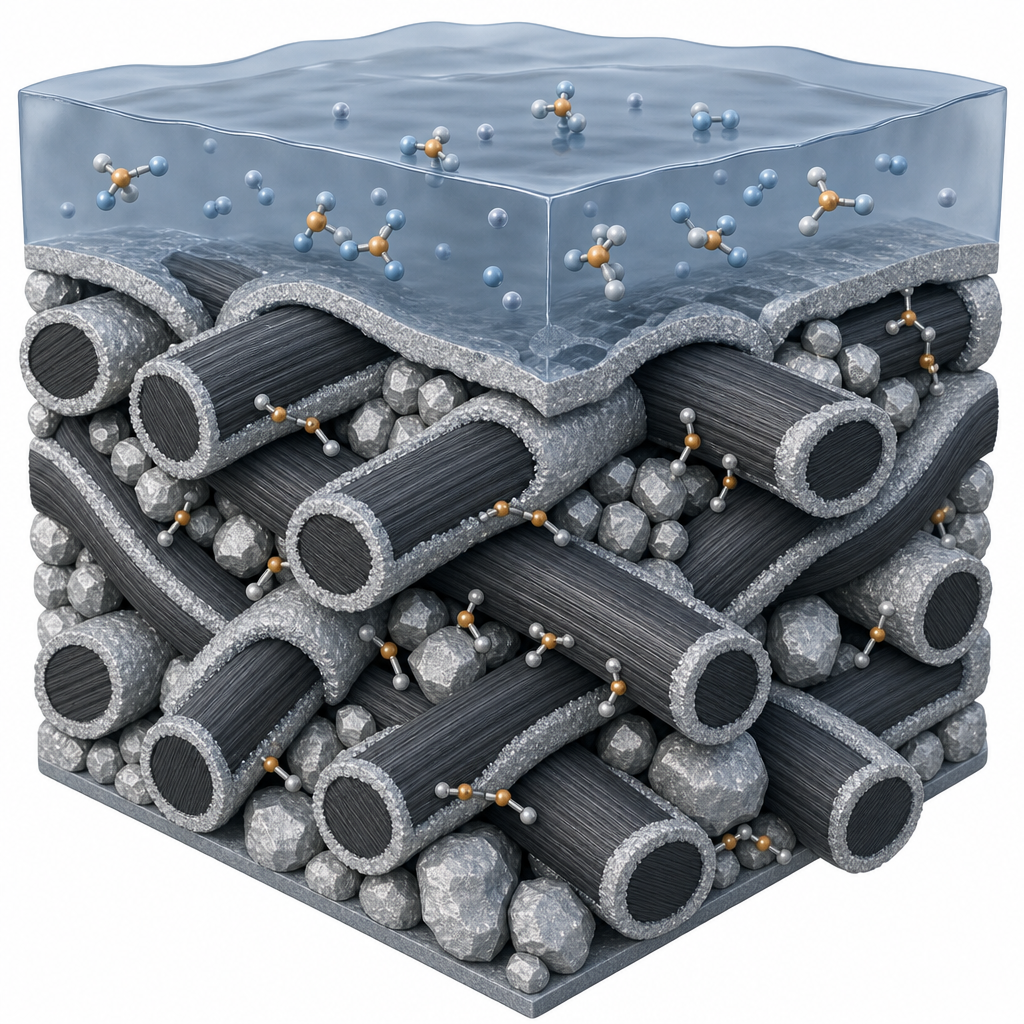
Electrochemical testing showed dramatic improvements. On planar stainless steel at 3.2 mAh cm-2, cells failed by short-circuiting within ~60 hours and exhibited only ~85% Coulombic efficiency, with 15% of the Al lost per cycle. On the carbon fibre anodes, Coulombic efficiencies reached 99.6-99.8%, and cells operated stably for more than 3,600 hours in coin-cell configuration at an aluminium plating/stripping areal capacity of 8 mAh cm-2 - the highest reported value for an Al-ion electrochemical cell and roughly 16× higher than the next best literature entry (0.5 mAh cm-2 over shorter lifetimes). The authors also demonstrated anode-free pouch cells delivering 0.4-0.5 mAh cm-2 over 100 hours. SEM and EDS mapping confirmed planar, fibre-conformal Al coverage with no propagation into the GF separator, eliminating the dominant short-circuit failure mode. The same bonding strategy was extended to zinc, indicating that O-mediated metal-substrate bonding is a general design principle for multivalent metal anodes.
The findings open a credible path toward commercially relevant aluminium and zinc rechargeable batteries for grid storage, stationary backup, and safety-critical applications where lithium chemistries are limited by cost or thermal-runaway risk. Beyond batteries, the chemical-bonding approach to morphology control has implications for electroplating in semiconductor interconnects, electrochemical metal recovery and corrosion-resistant coatings. The authors point to continued work on scaling carbon fibre electrodes, integrating compatible cathodes that match the new anode areal capacities, and probing analogous interfacial chemistries for sodium and magnesium anodes. Functionalized and surface-engineered carbon nanomaterials are likely to play a growing role across this design space.
For researchers working on multivalent metal batteries, electrocatalysis or 3D conductive scaffolds, the carbon nanomaterials and carbon fibre/foam substrates available from ACS Material - including porous carbons, carbon nanotubes, graphene foam and nitrogen-doped carbons - provide a starting point for replicating and extending this electrode design. The paper's central lesson is that interfacial chemistry between the depositing metal and the carbon substrate, not substrate geometry alone, governs morphology and reversibility, which is a useful framework when selecting and functionalizing carbon supports for high-capacity post-lithium battery anodes.How ACS Material products were used
- Carbon fibre substrate (treated with ionic liquid and AlCl3) (Carbon Series) — “the Al deposition morphology on carbon fibres treated by ionic liquid and AlCl3 was highly uniform across multiple length scales. The uniform Al deposition was enabled by Al–O–C bonds formed on the substrate surface”
Product Performance in this Study
Carbon fibre substrates with engineered Al-O-C interfacial bonding enabled uniform, compact Al electrodeposition, Coulombic efficiencies of 99.6-99.8%, and stable cycling over 3,600 hours at high areal capacities up to 8 mAh cm-2.
Related product categories
Frequently asked questionsHow does interfacial metal-substrate bonding improve aluminium battery anode reversibility?
Strong Al-O-C covalent bonds formed between depositing aluminium and an oxygen-functionalized carbon fibre substrate raise the nucleation driving force, creating a dense distribution of small nuclei. Aluminium then grows laterally as a compact nanocrystalline layer along the carbon surface instead of forming coarse dendrites that pierce the separator. This eliminates dead metal, maintains short electron transport pathways, and lifts Coulombic efficiency from approximately 85% to 99.6-99.8%.
What areal capacity can aluminium battery anodes achieve with carbon fibre substrates?
Carbon fibre substrates engineered with Al-O-C interfacial bonding sustained reversible aluminium plating and stripping at 8 mAh cm-2 for more than 3,600 hours in coin cells. This is roughly two orders of magnitude higher than the 0.01-0.18 mAh cm-2 typically reported for aluminium battery anodes in prior literature, bringing the technology much closer to the 1-3 mAh cm-2 range of commercial lithium-ion electrodes.
Why do conventional aluminium anodes short-circuit so quickly?
On planar stainless steel or 3D nickel foam, aluminium forms coarse heterogeneous deposits 20-50 μm in size that grow into the glass fibre separator, partly because of a chemical affinity between Al and SiO2 (4Al + 3SiO2 to 2Al2O3 + 3Si). Even with multiple separator layers, cells fail in under 60 hours at 3.2 mAh cm-2. The fragile, broadly distributed electron transport pathways drive incomplete stripping and rapid shorting.
- Carbon fibre substrate (treated with ionic liquid and AlCl3) (Carbon Series) — “the Al deposition morphology on carbon fibres treated by ionic liquid and AlCl3 was highly uniform across multiple length scales. The uniform Al deposition was enabled by Al–O–C bonds formed on the substrate surface”