-
CFx Cathodes for Ultralow-Temperature Li Batteries - UC San Diego, 2023
May 19, 2026 | ACS MATERIAL LLCYin, Y., Holoubek, J., Liu, A., Sayahpour, B., Raghavendran, G., Cai, G., Han, B., Mayer, M., Schorr, N. B., Lambert, T. N., Harrison, K. L., Li, W., Chen, Z., & Meng, Y. S. (2023). Ultralow‐Temperature Li/CFx Batteries Enabled by Fast‐Transport and Anion‐Pairing Liquefied Gas Electrolytes. *Advanced Materials*. https://doi.org/10.1002/adma.202207932
Materials Science and Engineering Program University of California La Jolla San Diego CA 92093 USA · Advanced Materials (IF 32.0) · 2023
UC San Diego researchers paired ACS Material CFx cathodes with liquefied-gas electrolytes to enable Li/CFx primary batteries operating down to −60 °C.
About this research
Researchers at the Materials Science and Engineering Program, University of California, San Diego, La Jolla, CA 92093, USA used carbon monofluoride (CFx) powder purchased from ACS Material (catalog code GT1FS012) as the cathode active material to demonstrate Li/CFx primary batteries that operate reliably from room temperature down to ultralow temperatures around −60 °C. Reporting in Advanced Materials (2023), the team paired the CFx cathode with a dimethyl ether (Me2O) based liquefied-gas electrolyte and showed that anion pairing and fast ion transport in this electrolyte system unlock most of the theoretical capacity of CFx in regimes where conventional carbonate electrolytes freeze out. The combination is promising for cold-climate sensors, space hardware, and military electronics.
Lithium/CFx is one of the highest-energy-density primary battery chemistries known, with a theoretical specific energy above 2100 Wh kg⁻¹. In practice, however, the rate and low-temperature performance of Li/CFx cells are limited by sluggish discharge kinetics of CFx and by the freezing and poor ionic conductivity of conventional liquid electrolytes such as 1 M LiBF₄ in propylene carbonate. Below about −40 °C, capacity collapses to a small fraction of room-temperature values. Designing electrolytes that remain fluid, conductive, and electrochemically compatible with both lithium metal and CFx at deep sub-zero temperatures is therefore an active research frontier in primary battery science and in broader cold-temperature electrochemistry, including space-grade power sources and arctic monitoring devices.The outstanding low-temperature performance in this UCSD study relies on the highly stable structure of the CFx cathode. The F/C ratio determines the delicate balance between high capacity and rapid discharge rates in extreme environments. View our Fluorinated Carbon (CFx) specifications to select the precise fluorine content tailored for your primary battery or aerospace energy projects.
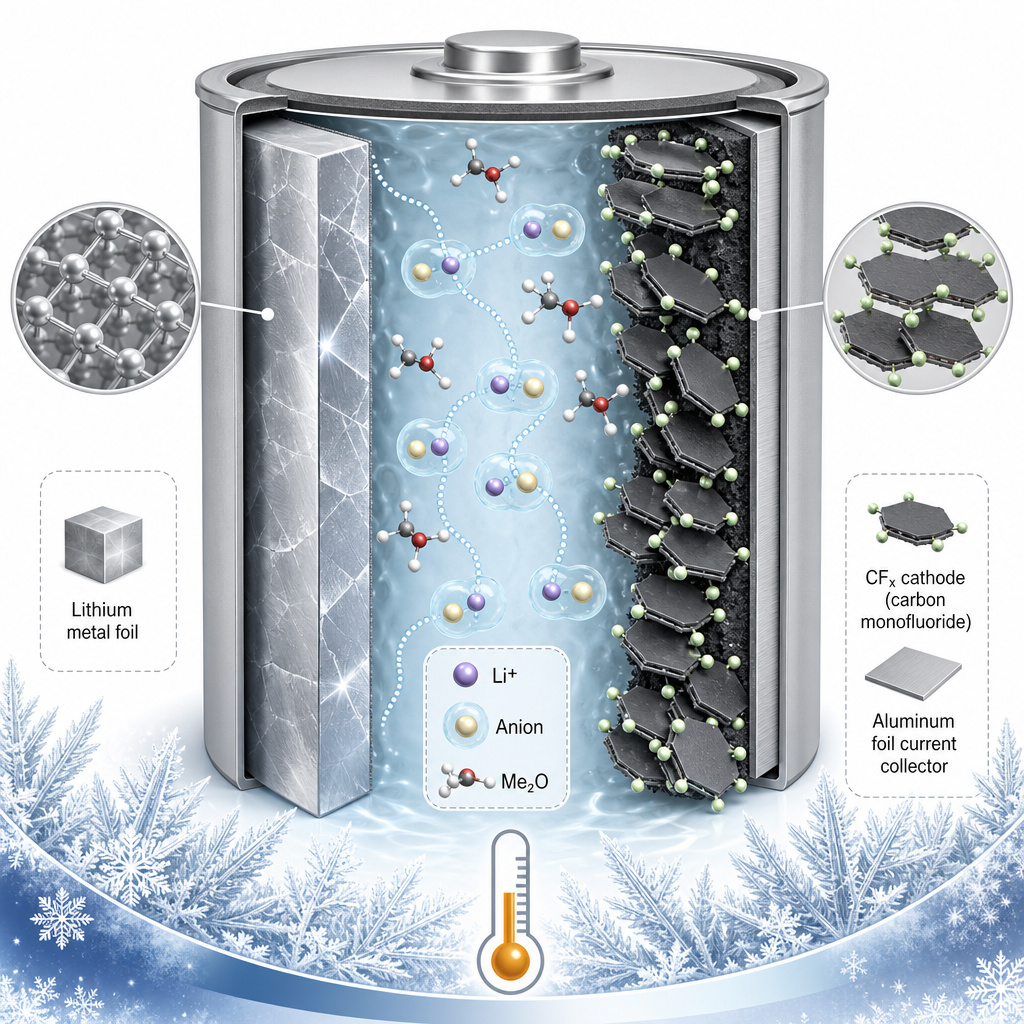
The ACS Material CFx powder (GT1FS012) was the cathode active material throughout the study. CFx electrodes were prepared with an 8:1:1 mass ratio of CFx active material to PVDF binder to C65 carbon, slurry-cast onto aluminum foil, and dried at 80 °C overnight, giving a loading of approximately 4.3 mg cm⁻². A high-loading variant of about 50 mg cm⁻² was also fabricated by mortar-and-pestle mixing of carbon black with a separate commercial CFx, bound with Teflon and rolled into a free-standing dough, but the ACS Material CFx provided the standard, well-defined cathode used for benchmarking the new electrolytes. Cells used Li metal foil as the counter electrode and a Celgard 2325 PP/PE/PP separator, assembled inside custom pressurized stainless-steel hardware capable of containing the Me2O-based liquefied-gas electrolyte under modest pressure (about 4.83 atm at room temperature).
Electrochemical testing across temperatures shows that the Me2O/PC liquefied-gas electrolyte enables Li/CFx cells with ACS Material CFx to access close to the theoretical CFx capacity (~860 mAh g⁻¹) at room temperature and retain a large fraction of that capacity down to −60 °C, dramatically outperforming benchmark DME/PC liquid electrolytes and standard LiBF₄/PC electrolyte at the same temperatures. Ionic conductivity measurements in pressurized SS316L cells confirm that the liquefied-gas electrolyte maintains high conductivity well below the freezing point of conventional carbonate systems. Classical molecular dynamics simulations in LAMMPS, supported by DFT binding energies at the B3LYP/6-311++G** level, attribute the performance to weak Li⁺–solvent binding and strong anion pairing in Me2O-based solutions, which favors fast Li⁺ transport and stable interphase formation. Low-dose HRTEM and EELS mapping on discharged ACS Material CFx cathodes, together with XPS depth profiling and Raman spectroscopy of the electrolyte, reveal that defluorination proceeds cleanly and that LiF-rich, anion-derived interphases form on both the CFx and Li surfaces, consistent with the high capacity utilization observed.
These results matter for any application where primary lithium batteries must deliver energy in harsh, cold environments: polar and high-altitude sensors, deep-sea and downhole instruments, aerospace and defense electronics, and emergency backup power. By showing that a well-characterized commercial CFx, combined with a rationally designed liquefied-gas electrolyte, can sustain useful discharge to −60 °C, the work provides a clear template for scaling ultralow-temperature primary batteries. The authors point toward follow-up work on cell engineering at higher CFx loadings (the 50 mg cm⁻² electrode demonstration is a step in that direction), on optimizing pressure and safety hardware for liquefied-gas systems, and on extending the same electrolyte strategy to rechargeable lithium-metal chemistries that share the cold-temperature transport bottleneck.
For researchers developing low-temperature primary batteries, CFx-based composites, or fluorinated cathode chemistries, the ACS Material CFx powder used here is part of the company’s battery materials portfolio and is suitable for reproducing this type of Li/CFx cell architecture. The work illustrates how a consistent, commercially sourced CFx cathode combined with novel electrolyte design can isolate and quantify electrolyte effects on ultralow-temperature performance, supporting reproducible benchmarking across laboratories working on next-generation cold-environment energy storage.How ACS Material products were used
- Carbon Monofluoride (CFx) Powder (GT1FS012) (Battery Materials) — “The CFx powders were purchased from ACS material (GT1FS012).”
Product Performance in this Study
The ACS Material CFx powder served as the cathode active material in Li/CFx primary battery cells. Combined with the liquefied-gas electrolyte, it delivered nearly full theoretical capacity at room temperature and retained substantial capacity down to ultralow temperatures (−60 °C), validating the CFx as a high-quality cathode source for low-temperature primary-battery research.
Related product categories
Frequently asked questions
Why is CFx attractive as a cathode for ultralow-temperature primary batteries?
Carbon monofluoride (CFx) offers one of the highest theoretical specific energies of any cathode, above 2100 Wh kg⁻¹ when paired with lithium metal. Its discharge involves defluorination to LiF and carbon, which provides a high, flat voltage plateau. For cold-environment applications, CFx is also chemically robust and thermally stable, so the main barrier to low-temperature operation is the electrolyte rather than the cathode itself.
How does a liquefied-gas electrolyte improve Li/CFx performance at −60 °C?
Liquefied-gas electrolytes based on dimethyl ether remain fluid and ionically conductive at temperatures where conventional carbonate solvents become viscous or freeze. Molecular dynamics and DFT analyses in this study show weak Li⁺–solvent binding and strong anion pairing, which together promote fast Li⁺ transport and form stable LiF-rich interphases, enabling Li/CFx cells to retain a large fraction of room-temperature capacity at −60 °C.
What CFx specification was used in this Li/CFx battery study?
The cathode was built from CFx powder purchased from ACS Material, catalog code GT1FS012. Electrodes were prepared with an 8:1:1 mass ratio of CFx to PVDF binder to C65 conductive carbon, cast on aluminum foil and dried at 80 °C overnight to a loading of approximately 4.3 mg cm⁻². A higher-loading 50 mg cm⁻² electrode was also fabricated from a separate commercial CFx via a Teflon-bound dough process.