-
Graphene Oxide Epoxy Dielectric Composites — Hydro-Québec IREQ, 2013
May 18, 2026 | ACS MATERIAL LLCFrechette, M. F., Mancinelli, P., Vanga-Bouanga, C., Savoie, S., David, E., & Fabiani, D. (2013). Preparation and dielectric responses of solid epoxy composites containing a mixture of epoxy powder ball-milled with GO. *2013 Annual Report Conference on Electrical Insulation and Dielectric Phenomena*. https://doi.org/10.1109/ceidp.2013.6748335
2013 Annual Report Conference on Electrical Insulation and Dielectric Phenomena · 2013
Hydro-Québec IREQ researchers ball-milled ACS Material graphene oxide with epoxy powder to fabricate solid epoxy nanocomposites with tunable dielectric responses.
About this research
Researchers led by M. F. Fréchette at Hydro-Québec's research institute (IREQ), in collaboration with the University of Bologna and École de technologie supérieure (Montréal), used commercial single-layer graphene oxide (GO) powder from ACS Material to fabricate a new class of epoxy nanodielectric composites in which the GO was first mechanically alloyed with cured epoxy powder by ball-milling before being dispersed into a liquid DER332 epoxy resin. Reported at the 2013 IEEE Conference on Electrical Insulation and Dielectric Phenomena (CEIDP), the work explores whether ball-milling a polymer powder with a 2D oxide filler can deliver a more compatible, better-coupled hybrid filler than conventional sonication dispersion routes. Broadband dielectric spectroscopy (BDS) over 10⁻² to 10⁶ Hz revealed dielectric behavior close to that of neat epoxy, with slightly reduced permittivity values.
The broader motivation lies in so-called second-generation nanodielectrics, where unusual fillers and unconventional fabrication routes are needed to push beyond the property limits of conventional polymer composites. Graphene and graphene oxide are attractive candidates because, as Wang et al. previously showed, GO-based polymers can exhibit nonlinear field-grading behavior at loadings far lower than the 30–40 wt% needed for SiC or ZnO fillers. However, dispersing graphene in polymers is notoriously difficult: pristine graphene is hydrophobic and aggregates strongly, and even GO presents challenges at the interface with thermoset matrices like epoxy. Addressing this filler–matrix coupling problem is essential for cable insulation, capacitor dielectrics, surge protection, and high-voltage rotating machine insulation, where uniform property profiles and stable dielectric responses across many frequency decades are required.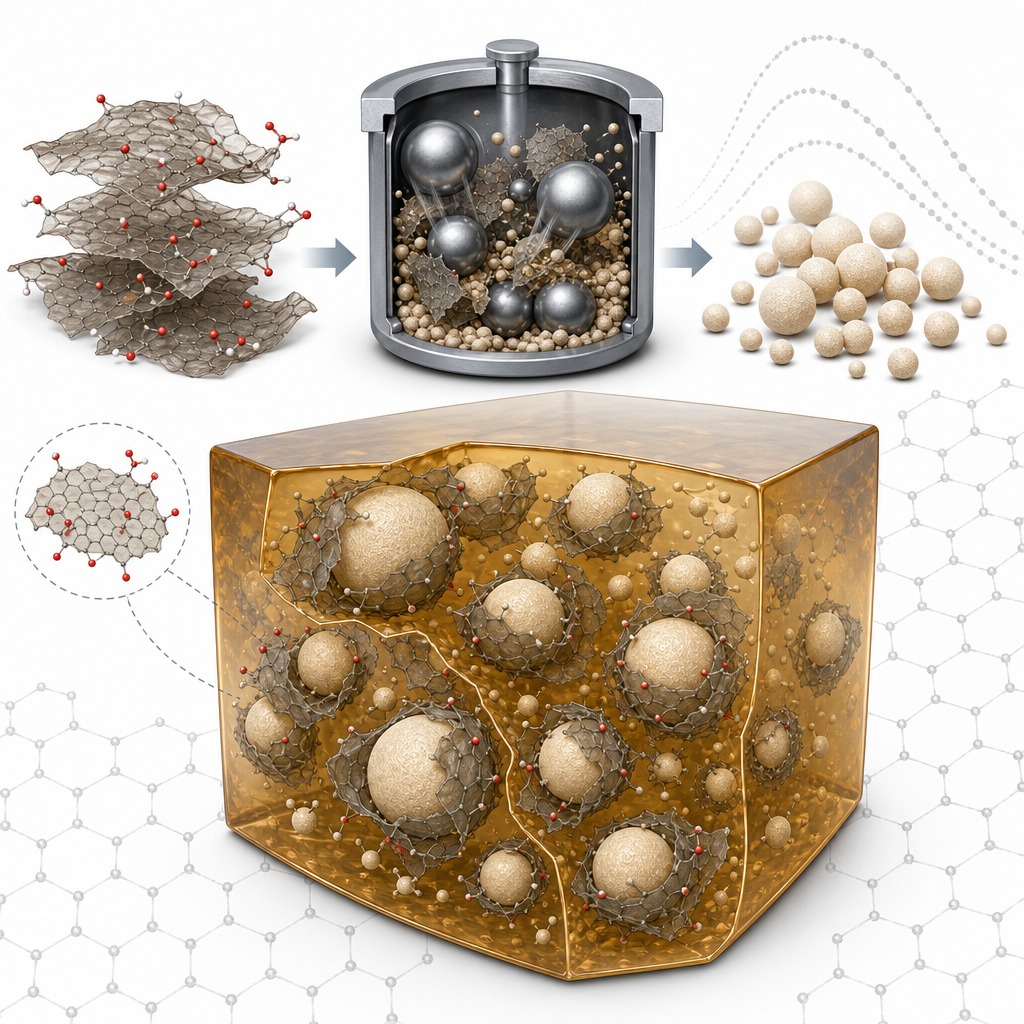
The ACS Material graphene oxide product was central to the study. According to the experimental section, "The GO was prepared following Hummer's method giving flakes of size of 1 to 5 μm and thickness of varying between 0.8 to 1.2 nm. This commercial product was obtained from ACS Material." This dry, single-layer GO powder served as the inorganic component of a hybrid filler. To prepare it, neat DER332 epoxy cured with Jeffamine D230 hardener was impact-milled for one hour to produce an epoxy powder with a bimodal particle size distribution peaking at 2.5 μm and 54 μm. This epoxy powder was then ball-milled together with the ACS Material GO so that mechanical energy could drive contact and partial doping of the polymer grains with GO flakes. The mixed organic–inorganic phase was subsequently dispersed in liquid DER332 resin by sonication at a mass ratio of 55:945, yielding 5 wt% epoxy powder and 0.5 wt% GO in the final formulation. After degassing at 50 °C, addition of Jeffamine D230 hardener, magnetic stirring under vacuum, and casting into molds covered with release agent, samples were cured at 105 °C for 6 h and slowly cooled. A reference sample was prepared by direct sonication of GO and epoxy powder in resin without ball-milling.
Optical stereomicroscopy with 2–5 μm spatial resolution revealed clear differences between the two preparation routes. In the ball-milled sample, the GO and its aggregates were visible as black structures, and the dispersion was characterized as poor with smaller embedded structures attributed to micrometric epoxy powder doped with GO. The authors interpret these features as evidence that ball-milling did drive a specific GO–epoxy-powder interaction, producing agglomerated micrometric epoxy carrying GO at its surfaces. The sonication-only reference showed better overall GO distribution, but still contained isolated ten-micrometer structures and agglomerates spanning roughly 250 μm. Broadband dielectric spectroscopy measurements at 296 K, 3 V, on 40 mm diameter samples covering 10⁻² to 10⁶ Hz showed that the composite behaved as a dielectric with response curves very similar in shape to neat epoxy, but with permittivity values consistently below that of the neat reference. This modest reduction in permittivity, combined with the absence of strong low-frequency dispersion that would have indicated percolation through GO networks, indicates that the GO loading remained non-conductive and the polymer matrix dominated the dielectric response.
The results have direct implications for high-voltage polymer insulation, cable accessories, capacitors, and embedded passive devices, where designers seek dielectrics with tailored permittivity and loss profiles without sacrificing breakdown strength. The mechanical-alloying-style ball-milling route demonstrated here offers a path toward better-coupled GO/epoxy systems without requiring chemical functionalization steps, and could be extended to other 2D fillers such as h-BN or MoS₂, or to alternative thermosets and powder coating resins (the authors note adjacencies with fusion bonded epoxy coating chemistry). Follow-up work pointed to by the paper itself includes parameter tuning of the milling protocol, sedimentation control during cure, and quantitative correlation of GO loading with dielectric loss and breakdown.
For researchers working on polymer nanodielectrics, conductive composites, or 2D-material-filled thermosets, the single-layer graphene oxide powder used here is available from ACS Material in the Graphene Series catalog, alongside related products such as carboxyl-, hydroxyl-, and amine-functionalized graphene and reduced graphene oxide grades. The Hummers-method GO with 1–5 μm flakes and sub-2 nm thickness used in this study is well suited to dispersion studies in epoxies and other polymer matrices investigating dielectric, mechanical, and thermal property modification.How ACS Material products were used
- Single Layer Graphene Oxide Powder (Hummers' Method) (Graphene Series) — “The GO was prepared following Hummer's method giving flakes of size of 1 to 5 μm and thickness of varying between 0.8 to 1.2 nm. This commercial product was obtained from ACS Material.”
Product Performance in this Study
The ACS Material single-layer graphene oxide powder (flake size 1–5 μm, thickness 0.8–1.2 nm) served as the inorganic nanofiller co-ball-milled with epoxy powder to form a hybrid filler for epoxy composites. The GO incorporated successfully into the matrix, though dispersion remained heterogeneous with visible aggregates.
Related product categories
Frequently asked questions
Why use ball-milling to disperse graphene oxide in epoxy resin?
Ball-milling mechanically alloys graphene oxide flakes with epoxy powder before dispersion in liquid resin, promoting direct contact between the GO and polymer grains without requiring chemical functionalization. The energetic collisions can coat polymer particles with GO and improve filler–matrix compatibility. In this study, ball-milling produced epoxy powder grains visibly doped with GO, though optical microscopy showed dispersion uniformity still trailed pure sonication routes.
What loading of graphene oxide is needed to modify epoxy dielectric properties?
The authors used only 0.5 wt% graphene oxide together with 5 wt% epoxy powder in DER332 resin. At this low loading, the composite remained insulating with broadband dielectric responses similar in shape to neat epoxy but with slightly reduced permittivity across 10⁻² to 10⁶ Hz. Previous work cited in the paper achieved nonlinear field grading at around 5 wt% GO, far below the 30–40 wt% needed with SiC or ZnO.
What grade of graphene oxide is suitable for polymer nanodielectric studies?
This study used dry, single-layer graphene oxide prepared by Hummers' method with flake size 1–5 μm and thickness 0.8–1.2 nm, supplied by ACS Material. Single-layer GO with sub-2 nm thickness offers a high aspect ratio and abundant oxygen functional groups that anchor to polar polymers like epoxy, making it well-suited to studies of permittivity, dielectric loss, and field-grading behavior in thermoset nanocomposites.