-
Porous Carbon Sulfur Host for Li-S Batteries — University of Maryland, 2016
May 21, 2026 | ACS MATERIAL LLCWang, X., Gao, T., Fan, X., Han, F., Wu, Y., Zhang, Z., Li, J., & Wang, C. (2016). Tailoring surface acidity of metal oxide for better polysulfide entrapment in Li‐S batteries. *Advanced Functional Materials*. https://doi.org/10.1002/adfm.201602264
Department of Chemical and Biomolecular Engineering University of Maryland College Park MD 20742 USA · Advanced Functional Materials · 2016
University of Maryland researchers benchmark ACS Material porous carbon against acidity-tuned TiO2 hosts for polysulfide entrapment in Li-S batteries.
About this research
Researchers at the Department of Chemical and Biomolecular Engineering University of Maryland College Park MD 20742 USA, working with Central South University, used porous carbon supplied by ACS Material LLC as the baseline sulfur host to benchmark a new acidity-tuned TiO2 cathode for lithium-sulfur (Li-S) batteries. Reporting in Advanced Functional Materials in 2016, the team showed for the first time that the surface acidity of a metal oxide host directly governs how strongly it chemisorbs lithium polysulfides (PS). By doping TiO2 with boron and nitrogen, they fortified the Lewis acid–base interaction, reduced capacity fading to just 0.040% per cycle, and trapped 97.6% of polysulfides — far outperforming the porous-carbon reference.
Li-S batteries promise a theoretical energy density of 2600 Wh kg⁻¹, several times that of conventional lithium-ion cells, but the polysulfide shuttle reaction has long blocked practical deployment. Soluble long-chain Li2Sn (n ≥ 4) species diffuse out of the cathode, causing active-material loss, low Coulombic efficiency, and rapid capacity decay. Strategies range from physical confinement in porous carbons to chemical anchoring on polar oxides, metal-organic frameworks, and heteroatom-doped carbons. While Lewis acid–base interactions between electron-accepting metal sites and PS lone pairs were known to help, the actual factor controlling chemisorption strength had not been quantified. Clarifying this mechanism is critical for guiding rational host design and bringing Li-S chemistry closer to practical energy-dense cells for electric mobility and grid storage.
The authors compared three hosts: B,N-doped TiO2 hollow nanospheres made by ultrasonic spray pyrolysis (boric acid, urea, TiCl4 precursors at 600 °C), pure TiO2 nanospheres synthesized solvothermally in 1,2-propanediol, and porous carbon purchased from ACS Material LLC. The Methods section states explicitly that "pure TiO2 nanospheres ... and porous carbon (ACS Material LLC, USA) were used as sulfur host." Each host was loaded with sulfur in a 1:3 host-to-sulfur ratio by vapor-phase infusion: sealed under vacuum in a glass tube, annealed at 600 °C for 3 h with a 5 °C min⁻¹ ramp. The ACS Material porous carbon thus served as the established physical-confinement benchmark against which the chemisorptive metal oxide hosts were judged. Surface chemistry was probed by XPS, acidity by NH3-TPD, porosity by N2 adsorption (BET/BJH on Micromeritics ASAP 2020), and PS uptake by ICP-OES quantification of residual sulfur in a Li2Sn/DOL/DME solution after host immersion.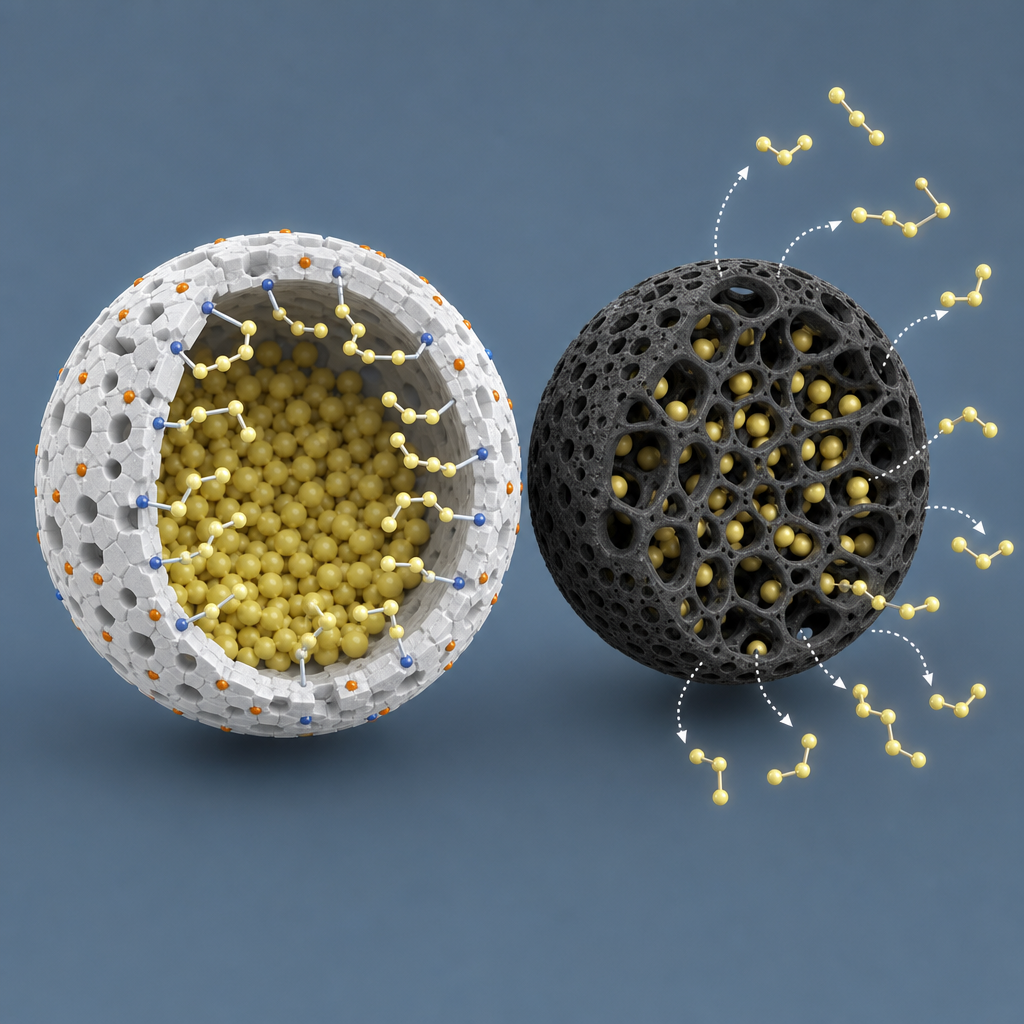
The quantitative findings sharply discriminate the three hosts. After 12 h immersion in Li2Sn solution, 87.6% of the sulfur remained in solution with porous carbon, 29% with pure TiO2, and only 2.4% with B,N-doped TiO2 — meaning the doped oxide captured 97.6% of polysulfides. Cycling at 0.5 C, the doped-TiO2/S cathode showed only 0.040% capacity fading per cycle, versus 0.067% for pure TiO2/S and 0.114% for porous carbon/S. NH3-TPD confirmed that doping increased the population and strength of acid sites on TiO2. XPS S 2p analysis showed terminal (ST⁻¹) and bridging (SB⁰) sulfur peaks shifted by up to 1.4 eV on doped TiO2, accompanied by a new Ti–S bond peak at ≈161.5 eV (S 2p) and 456.5 eV (Ti 2p). Porous carbon showed no shifts beyond a weak C–S⁰ feature at 163.8 eV, consistent with purely physical confinement. Thiosulfate and polythionate features at 167.2 and 168.0 eV provided a secondary mediation pathway, but Ti–S bonding correlated most tightly with both rapid PS adsorption and superior cycling, identifying acidity-driven Lewis acid–base bonding as the dominant capture mechanism.
The study provides a clear design rule for next-generation Li-S cathode hosts: tune surface acidity to maximize Ti–S (or analogous M–S) bond formation. Beyond TiO2, the same Lewis acid–base framework should guide selection and doping of MnO2, V2O5, MoO3, MOFs, and mixed-metal oxides used in sulfur composite cathodes. The mechanism is also relevant to other multiphase electrochemical systems where soluble redox intermediates must be confined — including iodine batteries, polyiodide redox flow batteries, and certain organic-electrolyte cells. The doped TiO2 host approach is compatible with scalable spray-pyrolysis production, making it attractive for industrial cathode formulation.
For researchers benchmarking sulfur hosts, porous carbons remain the standard physical-confinement reference. ACS Material offers a range of porous carbon and mesoporous carbon products in its Carbon Series — including ordered mesoporous carbons (CMK-3, CMK-8), nitrogen-doped mesoporous carbons, hollow carbon spheres, and porous carbon blocks — suitable for direct use as sulfur hosts or as control samples in chemisorption studies. As this paper illustrates, comparing a chemically functional oxide host against a well-characterized porous carbon is essential for isolating the contribution of polar interactions to polysulfide retention.How ACS Material products were used
- Porous Carbon (Carbon Series) — “pure TiO2 nanospheres prepared by solvothermal method using 1, 2-propanediol and porous carbon (ACS Material LLC, USA) were used as sulfur host”
Product Performance in this StudyThe ACS Material porous carbon served as the baseline sulfur host for benchmarking chemisorption performance. It exhibited the weakest polysulfide retention (only 12.4% of sulfur captured after 12 h immersion) and the highest capacity fading (0.114% per cycle), providing the comparison that highlighted the superior performance of acidic doped TiO2.
Related product categories
Frequently asked questionsWhy is porous carbon used as a baseline sulfur host in Li-S battery research?
Porous carbon is the classic physical-confinement host: its high surface area and mesopores trap sulfur and improve electron access, but it lacks strong chemical interaction with polysulfides. This makes it an ideal reference for isolating the contribution of chemical anchoring in newer polar hosts. In this paper, ACS Material porous carbon retained only 12.4% of polysulfides after 12 h, while B,N-doped TiO2 captured 97.6%, quantifying the value of chemisorption.
How does surface acidity of metal oxides affect polysulfide trapping in lithium-sulfur batteries?
Polysulfide anions donate lone electron pairs and act as Lewis bases. A host with stronger Lewis acid sites forms tighter acid–base bonds with these anions. Doping TiO2 with boron and nitrogen increased its strong acid-site density, strengthening the Ti–S bond as confirmed by XPS shifts up to 1.4 eV. The result was rapid polysulfide adsorption and capacity fading reduced to 0.040% per cycle versus 0.114% for porous carbon.
What characterization techniques confirm polysulfide chemisorption on metal oxide hosts?
The combination most diagnostic is XPS plus NH3-TPD. NH3-TPD quantifies weak, medium, and strong acid sites by tracking ammonia desorption between 100 and 500 °C. XPS S 2p and Ti 2p spectra reveal Ti–S bond peaks near 161.5 eV and 456.5 eV and shifts in terminal/bridging sulfur peaks. ICP-OES quantifies residual sulfur in solution after host immersion, directly measuring chemisorption capacity.