-
SiC Nanowires for Phonon Polariton Heat Conduction - Vanderbilt University, 2023
May 19, 2026 | ACS MATERIAL LLCPan, Z., Lu, G., Li, X., McBride, J. R., Juneja, R., Long, M., Lindsay, L., Caldwell, J. D., & Li, D. (2023). Remarkable heat conduction mediated by non-equilibrium phonon polaritons. *Nature*. https://doi.org/10.1038/s41586-023-06598-0
Nature (IF 64.8) · 2023
Vanderbilt researchers used 3C-SiC nanowires from ACS Material to demonstrate that non-equilibrium surface phonon polaritons boost thermal conductivity by 5.8 W/m·K.
About this research
Researchers at Vanderbilt University, in collaboration with Oak Ridge National Laboratory, used 3C-SiC nanowires purchased from ACS Material to provide the first clear experimental demonstration that non-equilibrium surface phonon polaritons (SPhPs) can substantially enhance heat conduction along a nanowire. Reporting in Nature (2023), the team measured a thermal conductivity enhancement of 5.8 W m⁻¹ K⁻¹ at 300 K in gold-end-coated SiC nanowires relative to uncoated wires, with the extracted pre-decay SPhP thermal conductance exceeding the equilibrium Landauer limit by more than two orders of magnitude. The work establishes SPhPs as a practical additional heat-carrying channel in polar nanostructures.
This research matters because the classical size effect causes lattice (phonon) thermal conductivity to drop sharply as device dimensions shrink, creating heat-management bottlenecks in microelectronics, power electronics and optoelectronic devices. Theoretical work since 2005 has predicted that SPhPs—hybrid quasiparticles arising from coupling between infrared light and optical phonons at polar surfaces—could counteract this drop in films and wires. However, previous experiments on long thin films extracted SPhP-mediated thermal conductivities below 0.5 W m⁻¹ K⁻¹, far smaller than predicted. The new result shows that, when SPhPs are launched in a non-equilibrium fashion, their contribution can be more than an order of magnitude larger than equilibrium estimates suggest, with direct implications for thermal design in SiC power electronics, GaN devices and other polar-material platforms.
The 3C-SiC nanowires from ACS Material were the central material in the study. High-resolution transmission electron microscopy and selected-area electron diffraction confirmed the 3C polytype with high crystalline quality; the wires used ranged in diameter from tens of nanometers (e.g., 65.5 nm for Sample S1) and were suspended over micro-thermal-bridge measurement platforms. Each wire was placed between two suspended membranes equipped with platinum serpentine heater/thermometer coils, with a 200-nm SiO₂ buffer layer preventing direct platinum contact and parasitic SPhP launching from the electrodes. A reagent-alcohol wetting step at ~80 °C reduced wire–membrane contact resistance to a negligible level. The same wire was then measured before and after evaporating gold coatings of controlled length onto one or both ends, allowing the SPhP contribution to be isolated by direct comparison on identical samples.Vanderbilt's breakthrough in non-equilibrium surface phonon polariton (SPhP) heat conduction underscores the extreme crystalline quality of our 3C-SiC nanowires. For single-wire thermal transport or micro-electronics thermal management, reproducibility is key. Explore our SiC Nanowires and Full Nanowire Series to eliminate defects in your nanostructure designs.
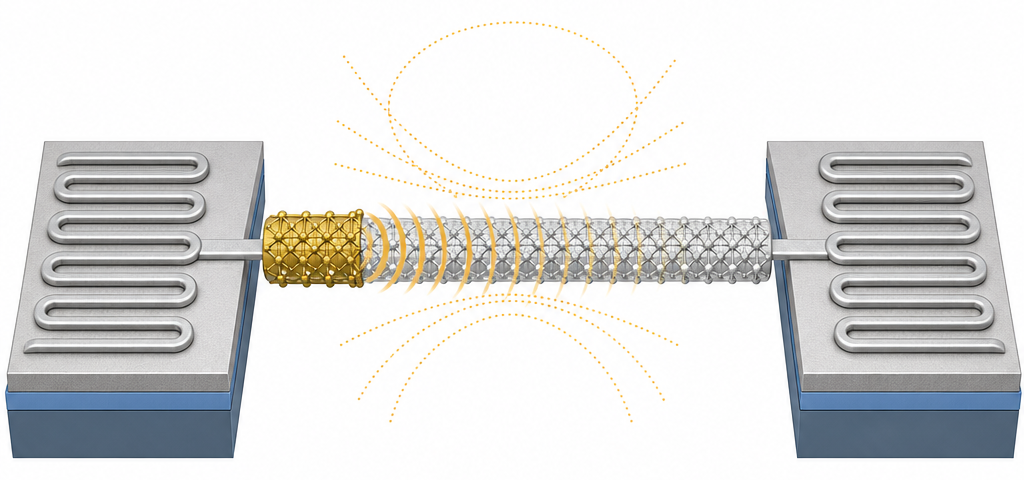
The quantitative findings are striking. For Sample S1, the bare-wire thermal conductivity overlapped across four suspended lengths from 11.6 µm to 47.4 µm, and total thermal resistance was linear in length and extrapolated to the origin, confirming negligible contact resistance and yielding the intrinsic phonon conductivity. When one end was gold-coated, the wire conductivity rose by up to ~60% at intermediate temperatures, with an absolute SPhP-mediated contribution of 5.8 W m⁻¹ K⁻¹ at 300 K. Coating both ends roughly doubled the enhancement, and the SPhP-mediated thermal conductivity scaled linearly with the length of the gold coating—direct evidence that the gold film acts as an efficient launcher of non-equilibrium SPhPs into the uncoated SiC region. The extracted pre-decay SPhP conductance was more than 100× the Landauer limit calculated from equilibrium Bose–Einstein statistics, indicating that the polariton population injected from the metal is far above thermal equilibrium. Measurements were performed under high vacuum (<1 × 10⁻⁶ mbar) with no external light, ruling out radiative artefacts.
These findings open practical pathways for managing heat in nanoscale and thin-film devices. Power electronics based on SiC and GaN, mid-infrared photonic components, microelectromechanical systems and nanowire-based thermoelectric or sensor platforms all suffer from reduced phonon conductivity at small dimensions; introducing engineered metallic launchers to inject non-equilibrium SPhPs offers a new degree of freedom for thermal design. The work also motivates follow-up studies on other polar materials such as hexagonal boron nitride, aluminum nitride and silicon dioxide, and on tailoring metal–dielectric interfaces to maximize polariton injection efficiency and decay length.
For researchers pursuing similar questions in nanoscale heat transport, polariton physics or polar-semiconductor device engineering, 3C-SiC nanowires are available from ACS Material in the Nanowire Series catalog. Their use as the sample platform in this Nature paper underscores their suitability for demanding single-wire thermal-transport experiments, while leaving the scientific credit for the discovery firmly with the Vanderbilt and Oak Ridge teams.How ACS Material products were used
- SiC Nanowire (Nanowire Series) — “Silicon carbide nanowires were purchased from ACS Material, which are of 3C-SiC polytype, as indicated by high-resolution transmission electron microscopy”
Product Performance in this Study
The 3C-SiC nanowires from ACS Material were the central experimental platform. Their high crystalline quality enabled clean thermal-conductivity measurements that revealed a 5.8 W m⁻¹ K⁻¹ enhancement from non-equilibrium surface phonon polaritons launched by gold end-coatings.
Related product categories
Frequently asked questions
How do surface phonon polaritons enhance thermal conduction in SiC nanowires?
Surface phonon polaritons are hybrid excitations that form when infrared light couples to optical phonons at polar surfaces. In this Nature 2023 study, gold coatings on the ends of 3C-SiC nanowires launched non-equilibrium SPhPs into the uncoated region, contributing an additional 5.8 W m⁻¹ K⁻¹ to thermal conductivity at 300 K. Because SPhPs travel along the surface, they bypass the size-induced suppression of bulk phonon transport.
What is special about the SiC nanowires used in this thermal conductivity study?
The nanowires were purchased from ACS Material and confirmed by high-resolution TEM and selected-area electron diffraction to be the 3C-SiC polytype with high crystallinity. Diameters of tens of nanometers (e.g., 65.5 nm) and clean surfaces made them ideal for single-wire micro-thermal-bridge measurements, where reproducible intrinsic phonon transport had to be established before isolating the surface polariton contribution.
Why does the SPhP-mediated thermal conductivity scale with the gold coating length?
The gold film acts as an antenna that thermally excites surface phonon polaritons and injects them into the adjacent uncoated SiC nanowire. A longer gold section excites more SPhP modes before they decay, producing a larger non-equilibrium population entering the bare wire. The measured linear dependence between SPhP-mediated thermal conductivity and coating length confirms this launching mechanism rather than an equilibrium polariton bath.
- SiC Nanowire (Nanowire Series) — “Silicon carbide nanowires were purchased from ACS Material, which are of 3C-SiC polytype, as indicated by high-resolution transmission electron microscopy”