-
Silver Nanowires for Robotic E-Skin Sensors - Caltech, 2022
May 19, 2026 | ACS MATERIAL LLCYu, Y., Li, J., Solomon, S. A., Min, J., Tu, J., Guo, W., Xu, C., Song, Y., & Gao, W. (2022). All-printed soft human-machine interface for robotic physicochemical sensing. *Science Robotics*. https://doi.org/10.1126/scirobotics.abn0495
California Institute of Technology · Science Robotics (IF 32.9) · 2022
Caltech researchers used ACS Material silver nanowires to inkjet-print piezoresistive tactile sensors for an all-printed soft robotic e-skin (M-Bot).
About this research
The California Institute of Technology team led by Wei Gao used silver nanowire (AgNW) suspension supplied by ACS Material to inkjet-print the piezoresistive tactile sensors that give a fully printed soft robotic skin (M-Bot) its sense of touch. Published in Science Robotics (2022), the work demonstrates an all-printed, kirigami-structured electronic-skin pair: e-skin-R on the robot hand and e-skin-H on the human forearm, together enabling AI-assisted gesture control, closed-loop electrical feedback, and on-site detection of explosives (TNT), organophosphate (OP) nerve agents, and the SARS-CoV-2 S1 protein.
Soft robotics and prosthetics increasingly demand skins that combine high-density mechanical perception with chemical sensing, all in a thin, flexible, scalable format. Conventional rigid silicon transducers cannot conform to fingertips, and most multimodal e-skins rely on serial lithography, which limits scalability and customization. The authors target a fully inkjet-printable platform compatible with kirigami cutting and integration onto 3D-printed robotic fingers, with the broader goal of letting robots perform hazardous-chemical reconnaissance, biothreat screening, and human-machine collaboration. Achieving this requires a mechanically robust yet sensitive pressure transducer whose ink can be co-printed alongside chemical sensing inks (Pt-graphene, MOF-808/Au, CNT-antibody) without cross-contamination - a niche where solvent-stable metallic nanowire dispersions excel.
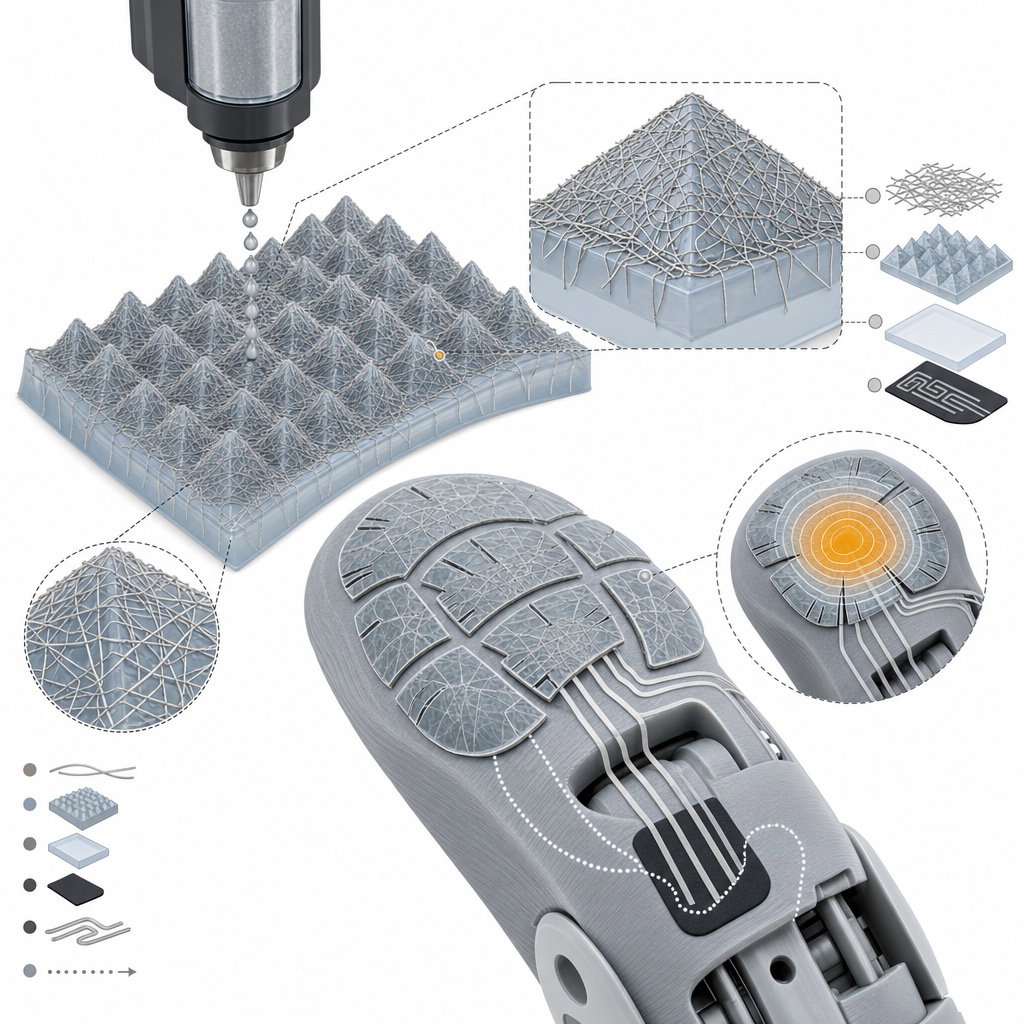
The ACS Material silver nanowire suspension (20 mg mL-1 in isopropyl alcohol) was diluted with IPA to 2 mg mL-1, sonicated for 10 minutes, and inkjet-printed using a Fujifilm Dimatix DMP-2850 onto a nanotextured PDMS substrate that had been cured against 1000-mesh sandpaper. Thirty AgNW layers were deposited with the printer plate held at 40 degrees C to ensure rapid IPA vaporization between passes, yielding a percolating AgNW network conformally tracing the PDMS micropyramids. After printing, the AgNW/N-PDMS films were cut into semicircular tactile pads and integrated onto the e-skin-R fingertips, electrically interconnected to printed silver traces and a carbon counter electrode. The nanotextured architecture converts applied normal force into modulated contact area between adjacent AgNWs, producing a strong piezoresistive response. The sensors were biased at a constant 2 V during operation.
The printed AgNW tactile sensors responded to varied pressure loads and survived repetitive loading-unloading cycles with stable baselines, enabling real-time spatial pressure mapping across the robotic fingers as they grasped spherical and cylindrical objects. Beyond tactile sensing, the broader M-Bot system reached: nDPV detection of TNT down to sub-micromolar levels using a Pt-graphene electrode; OP (paraoxon-methyl) detection on a MOF-808/Au electrode with dry-phase sampling via a gelatin hydrogel; and SARS-CoV-2 S1 protein detection on antibody-functionalized carbon-nanotube electrodes from a 10 microliter, 1 microgram mL-1 dry blot relevant to COVID-19 saliva-droplet loads. A KNN machine-learning model trained on 60 samples per gesture across 6 gestures, sampled from four sEMG channels on the e-skin-H, drove robotic-arm control with high classification accuracy, while electrical stimulation delivered through the same e-skin closed the haptic feedback loop. An autonomous multimodal sensing robotic boat (M-Boat) variant successfully tracked a simulated OP leak source by combining gradient-descent and interpolated-map search algorithms with the same printed sensor stack.Caltech's robotic e-skin relies on precise nanowire dimensions to maintain conductivity under extreme strain. Explore our AgNW product line to find the exact diameter and length specifications for your sensor development.
The M-Bot platform points toward practical deployments in hazardous-chemical reconnaissance, food-safety screening, biothreat triage, and assistive teleoperation, where a single soft, disposable, inkjet-printed skin can replace racks of benchtop instruments. The authors highlight extensions to nerve-agent decomposition diagnostics via Zr-based MOFs, multiplexed wearable telemedicine following their SARS-CoV-2 RapidPlex precedent, and scalable manufacturing of e-skin sensor sheets for prosthetics. Because every functional layer - interconnect, encapsulation, transducer, and biorecognition film - is printed from a solution-processable ink, the workflow is well-suited to rapid prototyping in academic labs and to roll-to-roll scale-up by commercial partners.
For researchers building wearable or robotic multimodal sensors, the dispersion-quality and IPA solvent compatibility of the ACS Material silver nanowire ink were enabling: 30-layer inkjet stacks formed conformal piezoresistive networks on textured PDMS without clogging or aggregation. The AgNW suspension used here is available from ACS Material's Nanowire Series, alongside complementary materials (CNT inks, graphene oxide for Pt-graphene composites, MOF precursors) for groups developing similar all-printed soft electronics, flexible biosensors, and human-machine interfaces.How ACS Material products were used
- Silver Nanowire (AgNWs) Suspension (20 mg/mL in IPA) (Nanowire Series) — “Silver nanowire (AgNWs) suspension (20 mg ml-1 in IPA) was purchased from ACS material, LLC.”
Product Performance in this Study
The AgNWs were diluted to 2 mg/mL and inkjet-printed (30 layers) onto a nanotextured PDMS substrate to form the piezoresistive tactile sensor on the robotic e-skin. The resulting AgNWs/N-PDMS sensors delivered reliable pressure-load detection and stable, repeatable responses that enabled the M-Bot to map tactile pressure distributions during object grasping.
Related product categories
Frequently asked questions
How are silver nanowires used to build piezoresistive tactile sensors?
Silver nanowire suspension is inkjet-printed in multiple layers onto a nanotextured PDMS substrate that is cured against fine-mesh sandpaper. The nanowires form a percolating network conformal to the micropyramid surface. When pressure deforms the PDMS, adjacent nanowire contacts increase, lowering resistance. In this study, 30 AgNW layers at 2 mg/mL were printed at a 40 degrees C plate temperature, producing stable response to varied loads and repetitive pressure cycles.
Why is silver nanowire ink preferred over ITO or evaporated metal films for soft e-skins?
Silver nanowire dispersions are solution-processable, mechanically flexible, and inkjet-compatible, allowing them to be patterned alongside other functional inks on plastic or PDMS substrates without lithography. Unlike brittle ITO or rigid evaporated metal films, AgNW networks tolerate bending and stretching while maintaining conductivity, which is essential for kirigami-cut robotic skins that conform to fingertips and undergo repeated mechanical deformation during grasping.
What concentration of silver nanowire ink works for inkjet printing on PDMS?
The Caltech team diluted a 20 mg/mL silver nanowire suspension in isopropyl alcohol down to 2 mg/mL and sonicated it for 10 minutes before loading into a Fujifilm Dimatix DMP-2850 printer. Printing was performed with the plate at 40 degrees C to rapidly evaporate IPA between passes. Thirty sequential layers were required to build a continuous, conductive piezoresistive network on the nanotextured PDMS substrate.
- Silver Nanowire (AgNWs) Suspension (20 mg/mL in IPA) (Nanowire Series) — “Silver nanowire (AgNWs) suspension (20 mg ml-1 in IPA) was purchased from ACS material, LLC.”