
Of all the places graphene has turned up, the one you are most likely to wear is a shirt. “Graphene” now appears on base layers, socks, jackets and running gear, promising warmth without bulk, odor control, and even garments that track your heartbeat. Some of this is real materials science and some is marketing gloss. The honest version is specific: a fabric is not made of graphene, it is made of ordinary fibers that have graphene either spun into them or coated onto their surface, and that thin layer changes three things — how the fabric moves heat, whether it conducts electricity, and how it resists bacteria. This article walks through how those functions actually work, with two interactive tools and the peer-reviewed literature behind the key claims.
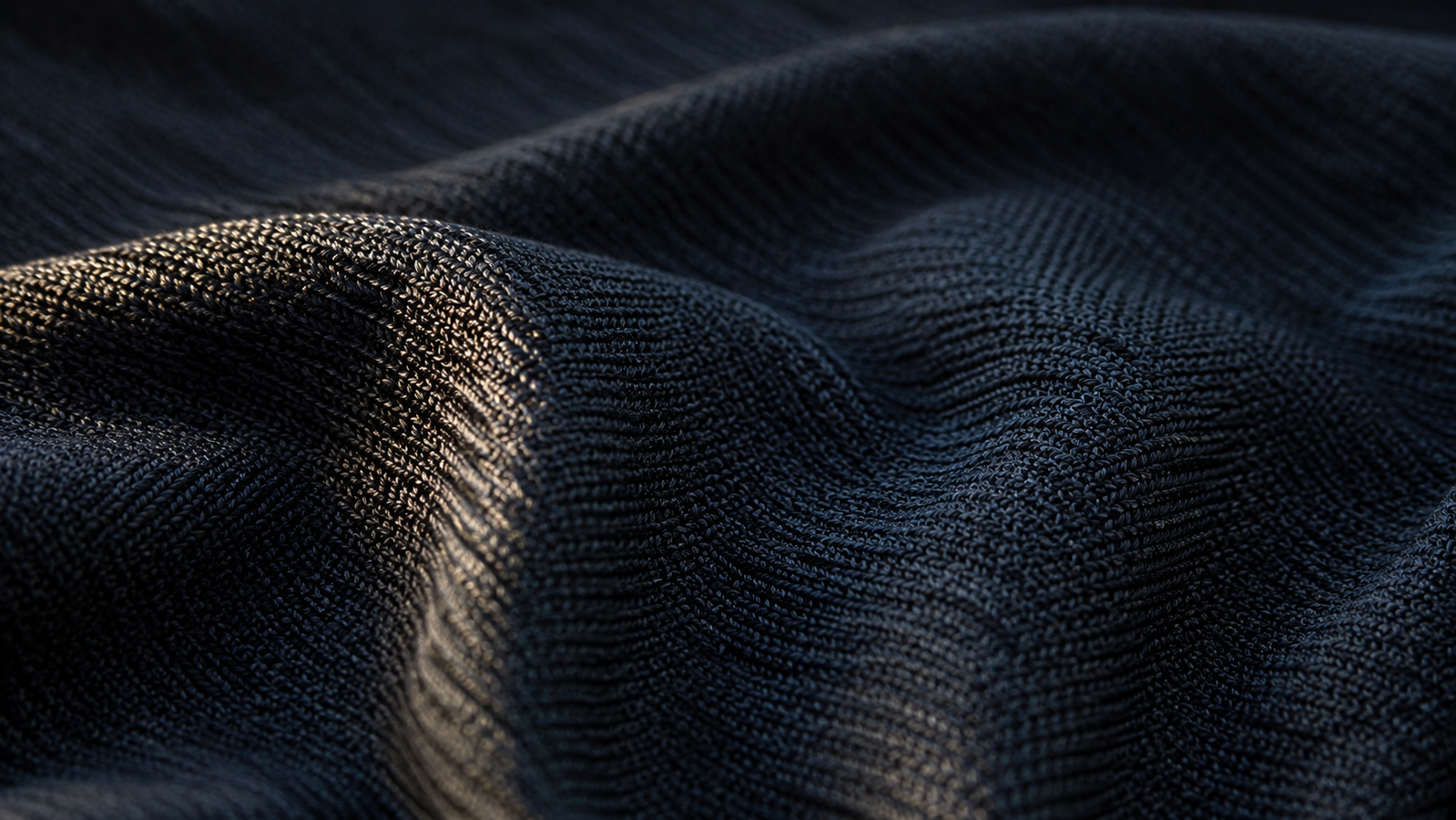
Why put graphene in a fabric at all?
Textiles are a hard problem in disguise. We ask clothing to be light, soft, breathable and comfortable, but also to manage heat, resist odor, and increasingly to carry electronics — and most of those goals pull against each other. Metal wires make a fabric conductive but heavy, stiff and prone to corrosion; conventional fibers are comfortable but do almost nothing with heat or electricity. Graphene is interesting because it addresses several of these at once from a vanishingly small amount of material. It is a single layer of carbon atoms, first isolated in 2004,1 and it combines properties that are usually mutually exclusive: it is the strongest material ever measured, with a stiffness near 1 TPa,2 yet it is flexible, nearly transparent as a single layer,3 among the best electrical conductors known, and among the best thermal conductors known, with a measured in-plane thermal conductivity near 5000 W m⁻¹ K⁻¹.4 If you want the full account of where those numbers come from, see our complete guide to graphene. The point for textiles is that a coating one atom thick, or a fiber loaded with a few percent of flakes, can add heat-spreading, conductivity and antibacterial action without meaningfully changing the weight or feel of the cloth.5
Two ways in: blended fibers and surface coatings
Before any of the functions matter, the graphene has to get into the textile, and there are essentially two routes — each with real trade-offs. The first is to build it into the fiber itself. Graphene or graphene oxide is dispersed into the polymer melt or solution and the mixture is spun into filament, so the flakes are distributed throughout the fiber. This has been demonstrated by spinning polyester (PET) with graphene, where adding a couple of weight percent raised the fiber’s modulus and hardness while keeping it spinnable, with conductivity preserved even under repeated bending.6 Similar reinforcement has been shown in nylon fibers loaded with reduced graphene oxide.7 The advantage is durability — the graphene is locked inside the fiber, so it survives washing and abrasion; the disadvantage is that most of the graphene is buried where it cannot touch anything, so you need more of it to get a surface effect.
The second route is to coat the outside of a finished fiber, yarn or fabric, which is simpler and far more material-efficient. A monolayer of CVD-grown graphene can be transferred onto textile fibers to make a transparent conductive yarn with sheet resistance around 1 kΩ per square and only a 2.3 % loss of transparency.8 More practically for mass production, graphene oxide can be applied to cotton or polyester by simple dip-and-dry or pad-dry-cure methods and then reduced to conductive graphene,9 a process that has been pushed to production speeds of roughly 150 m/min while keeping the fabric soft and washable.10 Graphene has even been coated onto natural fibers like jute to dramatically improve their strength.11 Coating puts the graphene exactly where the action is — on the surface — at the cost of needing good adhesion so it survives the laundry, which we return to below. In both routes the benefit ultimately depends on how efficiently stress and charge transfer between the graphene and the host fiber, the same interfacial physics that governs graphene composites generally.12,13
Managing heat: warm without hot spots
The most marketed property of graphene sportswear is temperature regulation, and this one rests on graphene’s standout thermal conductivity.4 Your body does not heat a garment evenly — it runs hot over working muscles and cool elsewhere. An ordinary fabric conducts heat poorly, so those hot spots stay put; a fabric with a conductive graphene network spreads heat sideways, pulling it from hot regions into cool ones so the surface temperature evens out. The same conductivity can be driven actively: graphene-coated fabrics work as efficient, low-voltage electric heaters, demonstrated in de-icing panels that warm quickly and uniformly.14 The tool below shows the passive version — how raising the graphene loading spreads a body hot-spot across the cloth.
Read the simulator for what it is: a teaching model of heat spreading, not a prediction of any specific garment. What it captures correctly is the mechanism — higher in-plane conductivity flattens temperature gradients — and why manufacturers describe graphene fabric as feeling “warm without hot spots” and helping move heat away from where you are working hardest. It is worth being clear-eyed here: the effect is real but modest, and depends heavily on how much graphene is present and how connected the coating is. A garment with a token amount of graphene will not manage your temperature meaningfully; the physics only works when there is a genuine conductive network.
Conductive cloth: sensors you can wear
The same conductive network that spreads heat also lets a fabric carry electrical signals, and this is where textiles get genuinely futuristic. But conductivity in a coated fabric does not switch on gradually — it appears suddenly, at a percolation threshold. Below a critical amount of graphene the flakes are too sparse to touch and the fabric is an insulator; add a little more and a connected path snaps into existence, and resistance drops steeply. This percolation behavior is fundamental to graphene-polymer systems.15 Once the fabric conducts, printing and coating methods can pattern electrodes and interconnects directly onto cloth: inkjet-printed graphene patterns,16 highly conductive flake-based inks,17 and scalable yarn-dyeing techniques18 all turn ordinary fabric into a circuit. The best machine-washable graphene e-textiles now reach sheet resistances around 12 Ω per square.19 The second tool shows both halves of the story: crossing the percolation threshold, and what happens when you then bend the conductive fabric.
The bending behavior in that tool is not a side effect — it is the entire basis of wearable sensing. Because bending or stretching the fabric pulls the graphene flakes apart and opens micro-gaps, the electrical resistance rises in a clean, repeatable way with strain. That turns the cloth into a strain gauge you can wear: graphene-coated fabrics have been used as flexible motion and pressure sensors,20,21 and as dry electrodes that pick up an electrocardiogram directly from the skin, performing comparably to conventional gel electrodes.22 Fully printed graphene garments have been demonstrated for continuous personalised health monitoring.23 Reviews of the field describe a rapidly maturing toolkit of printed, washable textile electronics.24,25,26 As the simulator hints, the sensitivity is highest for networks just above the percolation threshold, where the conductive path is most fragile and therefore most responsive to movement.
Odor and hygiene: the antibacterial angle
A quieter but well-supported benefit is antibacterial action, which is why graphene turns up in socks, underwear and activewear sold on “odor control.” Graphene and graphene oxide are physically hostile to bacteria: their sharp edges can pierce and disrupt microbial cell membranes, and graphene oxide can also generate oxidative stress inside the cell. This was shown directly for graphene and graphene-oxide surfaces against both Gram-positive and Gram-negative bacteria,27 and the mechanisms and applications are covered in reviews of graphene’s antibacterial behavior.28 Because odor in worn clothing largely comes from bacteria metabolizing sweat, a fabric that suppresses bacterial growth can stay fresher longer. How much difference this makes in practice varies widely with the fabric and the amount of graphene, and independent, standardized testing on finished garments remains limited. The caveat is the same as everywhere else in this article: the effect scales with how much graphene actually sits at the fiber surface where bacteria contact it, so a durable, well-adhered coating matters more than the mere presence of the word on a label.
The real test: does it survive the wash?
Every functional textile lives or dies by laundry, and this is the honest weak point of coated graphene fabrics. A coating that conducts beautifully when new is worthless if it washes off after three cycles, so durability — not peak performance — is the property that actually gates real products. The encouraging news is that this has become a central research focus rather than an afterthought. Fiber-blended graphene is inherently wash-durable because the flakes are locked inside the filament.6 For coatings, adhesion has been improved with encapsulation and compression steps: machine-washable graphene e-textiles have been demonstrated that retain conductivity after repeated home laundering,19 and reduced-graphene-oxide coatings engineered specifically as wash-durable strain sensors.20 The field is also increasingly attentive to sustainability, since a durable e-textile is also a less wasteful one.24 For a buyer, washability is the single most useful question to ask: a graphene garment that cannot survive normal laundering has not solved the problem, however impressive its initial numbers.
Reading the label
Pulling this together: graphene genuinely changes what a fabric can do, but every one of its benefits — heat spreading, conductivity, sensing, antibacterial action — scales with how much graphene is present, how well it forms a connected network, and how well it survives washing. That makes “graphene” on a clothing label almost meaningless on its own; two garments carrying the same word can behave completely differently. The useful questions are concrete: is the graphene blended into the fiber or coated on the surface, what specific property is claimed to improve, and does it survive laundering? Reviews of graphene sportswear and smart textiles consistently stress that outcomes vary widely with material and process rather than with the marketing term.29,30 Treated with that skepticism, graphene is one of the most promising materials in textiles — not because it makes clothing magic, but because a tiny, well-engineered amount can make a fabric warmer, smarter, cleaner and more capable than the fiber alone. For the graphene grades used to build these fabrics, ACS Material supplies research-grade graphene products, including the graphene oxide and graphene nanoplatelets formulated for fiber and coating work, to the labs and manufacturers turning this science into fabric.
References
This article is provided by ACS Material LLC for educational purposes and describes the use of graphene and graphene-related materials in textiles, including fiber-blended and surface-coated fabrics, thermal regulation, electrical conductivity and strain sensing, antibacterial action, and wash durability. Property values — thermal conductivity, sheet resistance, gauge factor and the like — are representative figures drawn from the referenced studies and describe idealized single sheets or specific laboratory samples; a real garment uses a small fraction of graphene, and its performance depends on the graphene grade, loading, dispersion, coating adhesion, and manufacturing process. The interactive tools are simplified teaching aids based on the stated models — a two-dimensional heat-diffusion model and a percolation-plus-piezoresistive sensing model — and are not predictive engineering software. Consult product datasheets and safety data sheets for material specifications and handling guidance.