
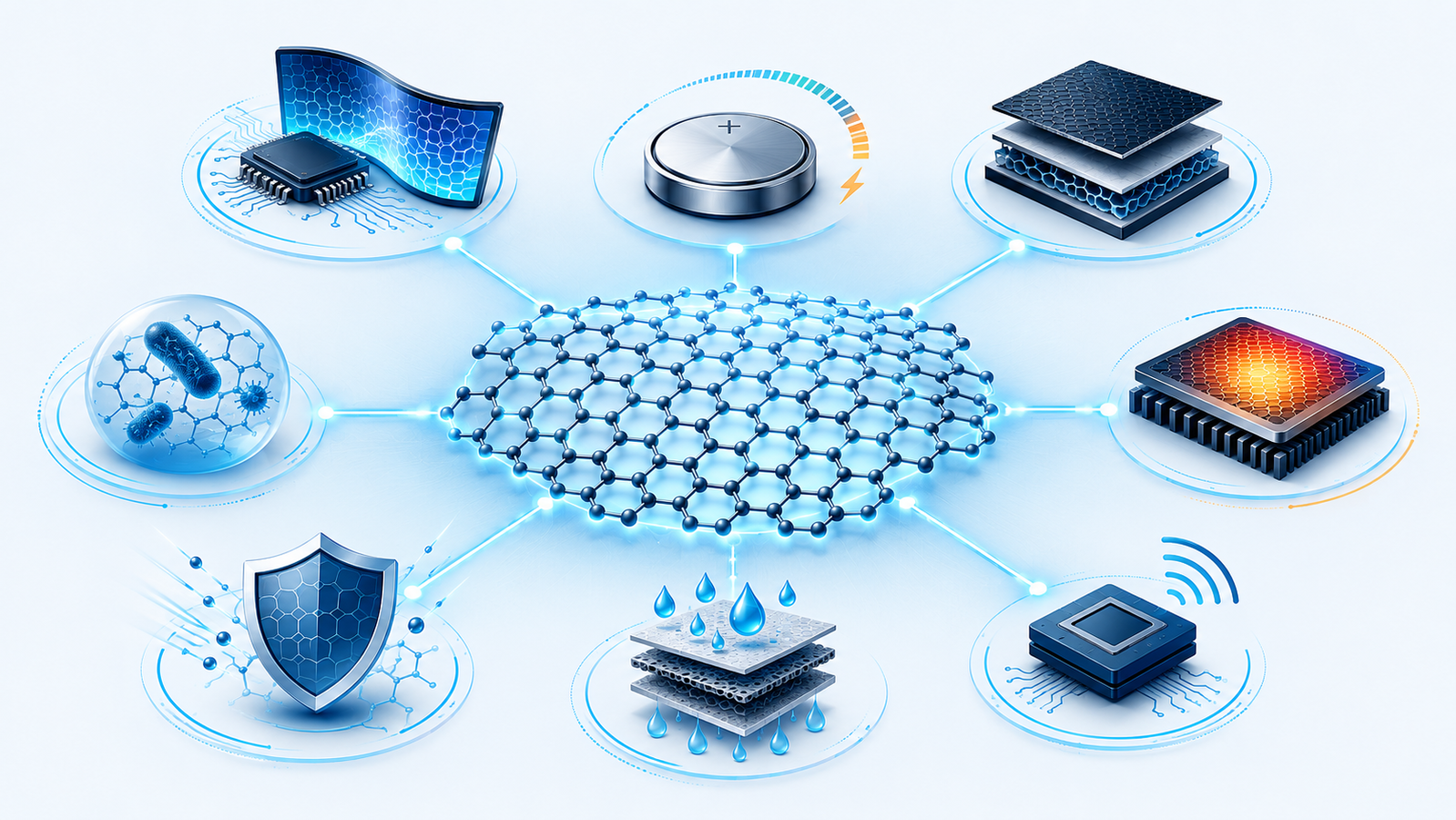
Graphene shows up in batteries, touchscreens, sports gear, water filters, paints, and wound dressings — an unusually wide spread for a single material. The reason is that one sheet of carbon carries an extreme set of properties at once: record stiffness and strength, very high electrical and thermal conductivity, near-total optical transparency, an enormous surface area, and a structure dense enough to be impermeable even to helium. This guide walks through the major application areas one by one, explains the physics that makes graphene useful in each, and points to the specific form of graphene — CVD film, nanoplatelet, graphene oxide, or reduced graphene oxide — that real products use, with two interactive simulators for the mechanisms that recur across the most applications.
Why graphene works across so many fields
Graphene is a single layer of carbon atoms arranged in a hexagonal lattice — a two-dimensional crystal isolated from graphite in 2004, work that earned the 2010 Nobel Prize in Physics.1 For the full background on its structure and properties, see our graphene facts overview; here the focus is on what those properties are for. The unusual thing about graphene is not any single record but the fact that several records belong to the same material at the same time. It is the stiffest and strongest substance ever measured,2 one of the best electrical and thermal conductors known, almost perfectly transparent, and effectively impermeable, all in a sheet one atom thick.3
Because those properties live in one place, graphene can be slotted into very different problems. A display wants transparency plus conductivity; a battery electrode wants conductivity plus surface area; a composite wants strength and a conductive or barrier network at low loading; a membrane wants atomic-scale precision and chemical robustness. Two influential roadmaps mapped this breadth in detail, and most commercial activity still tracks the application areas they identified.4,5 The sections below take those areas in turn.
Electronics, displays, and flexible devices
Graphene's charge carriers move with very high mobility, and a monolayer absorbs only about 2.3% of visible light — a value set by the fine-structure constant rather than by sample thickness.6 That combination is exactly what a transparent electrode needs: it must let light through while still carrying current. Roll-to-roll processes have produced graphene transparent conductors at the scale of tens of centimeters for touch panels and flexible screens.7 The catch is a genuine trade-off, captured by a single figure of merit relating transparency to sheet resistance; graphene's figure of merit trails indium tin oxide on rigid glass, so its real advantages are flexibility, chemical stability, and abundance.8 Reduced graphene oxide offers a lower-cost, solution-processed route to the same role where peak performance is not required.9 Our deeper treatment of devices, transistors, and conductive electrodes is in the guide on graphene in electronics.
The simulator below makes the transparency–resistance trade-off concrete. Improve the material's figure of merit (as doping would), or stack more layers, and watch the operating point move against the targets that real touch panels, displays, and solar front-contacts demand.
Batteries, supercapacitors, and solar cells
In energy storage, graphene is rarely the whole electrode; it is the conductive, high-area scaffold that makes the active material work harder. In lithium-ion cells, a small fraction of graphene or graphene nanoplatelets forms a conductive network through the electrode, improving rate capability and cycle life, and graphene is widely studied as a host or coating for high-capacity anodes.10 In supercapacitors, the value is raw accessible surface area for charge storage, where early graphene electrodes already showed competitive capacitance.11 In photovoltaics and dye-sensitized cells, graphene serves as a transparent electrode or a charge-collecting layer, the same electrode physics seen in displays.12 The dedicated discussion of photovoltaics is in our article on graphene in organic solar cells.
Composites, inks, and EMI shielding
This is where graphene reaches the largest tonnage, and it rests on one idea: a thin, wide platelet bridges far more space per unit volume than a compact particle. Disperse a few tenths of a percent of high-aspect-ratio graphene in an insulating polymer and the filler forms a connected network that spans the material — the percolation threshold — above which conductivity jumps by orders of magnitude. This was demonstrated for graphene–polymer composites at loadings near 0.1 vol%.13 The same low-loading network underlies conductive inks and coatings, antistatic plastics, and electromagnetic-interference shielding, while the platelets' stiffness and the tortuous path they create also raise mechanical strength and lower gas permeability.14 Graphene nanoplatelets are the workhorse form here because they are made by the kilogram and blend into existing formulations.
The first simulator shows the percolation transition directly. Raise the loading and change the platelet aspect ratio to see why high-aspect-ratio graphene turns an insulator into a conductor at a fraction of a percent.
Coatings are a related case: a continuous or platelet graphene layer can act as a chemical barrier, and graphene has been shown to slow corrosion of the metal beneath it, though long-term behavior depends strongly on coating quality.15
Thermal management
Graphene conducts heat exceptionally well in-plane — thermal conductivities of single-layer graphene were measured in the thousands of watts per meter-kelvin, above even high-quality copper or diamond.16 That makes it attractive for spreading and removing heat in dense electronics, as heat-spreader films and as a conductive filler in thermal-interface materials, a role reviewed alongside graphene's other thermal properties.17 As with composites, real materials use stacked or platelet graphene rather than perfect monolayers, so practical conductivities are lower than the single-sheet record but still high enough to matter.
Sensors and detectors
A sheet that is all surface makes an excellent sensor: every carbon atom is exposed, and adsorbed molecules shift the local carrier concentration enough to change the measured resistance. Graphene was shown to detect even single gas molecules adsorbing on its surface.18 The same sensitivity, combined with easy chemical functionalization, supports biological and chemical sensors that read out binding events electrically, from glucose to DNA.19 Strain sensors exploit how the sheet's resistance changes when it is stretched, which is one route into wearable and flexible electronics.
Membranes and water treatment
Graphene oxide stacks into membranes whose nanometer-scale channels behave with surprising precision. Such membranes were found to be effectively impermeable to gases and liquids yet to let water vapor through almost unimpeded, and later work showed they can sieve ions and molecules by size.20,21 That makes graphene-oxide membranes a candidate for desalination, filtration, and separation, where the goal is to pass water while blocking dissolved species. Our focused article covers this area in more depth: graphene and water treatment. Graphene oxide is the relevant form here, because its oxygen groups make it disperse in water and assemble into layered films.
Biomedical and antibacterial uses
In biomedicine, graphene oxide's large surface and abundant functional groups let it carry drugs, genes, and imaging agents, and graphene materials are studied as platforms for delivery and biosensing.22 Separately, graphene oxide and reduced graphene oxide show antibacterial activity — their sharp edges and oxidative behavior can damage bacterial membranes — which is of interest for coatings and dressings.23 The use of graphene against drug-resistant organisms is treated in our article on graphene and antimicrobial resistance. These remain largely research-stage applications, and biocompatibility depends heavily on the specific material, dose, and form.
Which graphene material for which application
"Graphene" in a product is almost never a perfect monolayer; it is one of a family of materials, and choosing the right member matters more than chasing the single-sheet records. Thin CVD graphene films are the choice when continuity and transparency are essential, as in transparent electrodes, sensors, and device research. Graphene nanoplatelets are the practical filler for composites, conductive inks, EMI shielding, and thermal materials, where what matters is a connected network at low loading rather than a single flawless sheet — the form behind most tonnage uses, covered in our graphene nanoplatelets overview. Graphene oxide disperses in water and assembles into films and membranes, making it the natural fit for water treatment, biomedical work, and solution-based coatings, while its reduced form recovers much of the conductivity for inks and electrodes at lower cost. Matching grade to job — layer count, lateral size, oxidation, and dispersion — is the difference between a material that works in a formulation and one that does not.
- CVD Graphene films — continuous monolayer and few-layer films on substrate for transparent electrodes, sensors, and device fabrication, where an unbroken conductive sheet is required.
- Single-Layer Graphene and Trivial Transfer Graphene™ — monolayer material and an easy-transfer format for research and prototyping.
- Graphene Nanoplatelets — the workhorse for composites, conductive inks, EMI shielding, and thermal fillers; available across thicknesses and lateral sizes to tune the percolation network.
- Graphene Oxide and Reduced Graphene Oxide — water-dispersible material for membranes, coatings, biomedical research, and solution-processed conductive films.
- Full graphene series — the complete catalog with grades, specifications, and datasheets to match a material to your application.
Frequently asked questions
References
This article is provided for educational purposes by ACS Material LLC and surveys the applications of graphene and related materials. Property values cited — such as ~2.3% per-layer light absorption, single-sheet thermal conductivity, and low-loading percolation — refer to idealized or single-layer graphene under specific conditions; real products use multilayer platelets, graphene oxide, or films whose performance depends on grade, layer count, lateral size, dispersion, and formulation, and many applications described are at the research stage. Consult the relevant product datasheets and safety data sheets before purchase or use. The interactive simulators are schematic teaching tools built on the simplified physical models stated, not predictive engineering software.