
Graphene-family materials are among the most efficient nano-reinforcements studied for cementitious composites: a dose of well under one-tenth of one percent — by weight of cement — can lift compressive, flexural, and tensile strength by tens of percent while making the matrix denser and more durable. This guide focuses on reduced graphene oxide (rGO) and its close relative graphene oxide (GO) in cementitious materials: what they are, the mechanisms by which they strengthen cement, how much to add, how to disperse them, what they do for durability, and how they turn ordinary concrete into self-sensing and self-heating, de-icing smart concrete.
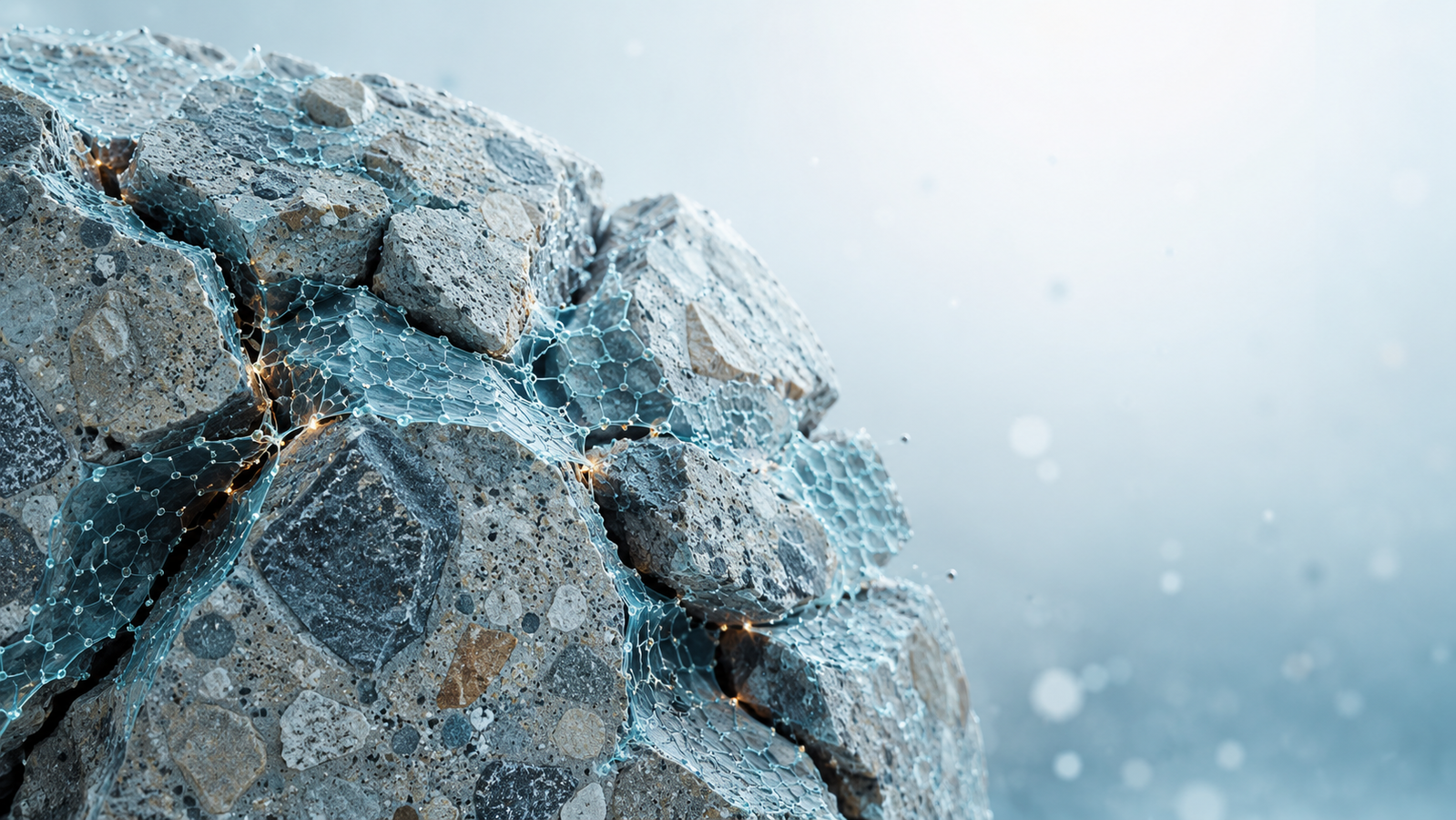
Short answer: reduced graphene oxide (rGO) is graphene oxide that has had most of its oxygen groups stripped away, restoring much of graphene’s electrical conductivity and strength while staying easier to disperse than pristine graphene. Added to concrete at very low dosages (typically ~0.02–0.1% by weight of cement), rGO and GO act as nucleation sites that accelerate and densify cement hydration, refine the pore structure, and bridge microcracks — raising 28-day compressive, flexural, and tensile strength (often by 20–60%) and improving resistance to chloride ingress, water permeability, and freeze–thaw damage. Because rGO is electrically conductive, it also makes concrete piezoresistive (able to sense its own strain and cracking) and electrically heatable (for de-icing pavements). The catch is dispersion: graphene must be uniformly separated in the mix water, or it clumps and the benefits vanish.
Carbon nano-additives for concrete at a glance:
| Additive | Best for | Key advantage | Main limitation |
|---|---|---|---|
| Graphene oxide (GO) | Strength & durability | Easy water dispersion and strong hydration nucleation | Electrically insulating |
| Reduced graphene oxide (rGO) | Smart concrete: sensing & de-icing | Restored conductivity plus mechanical reinforcement | Harder to disperse than GO |
| Carbon nanotubes (CNTs) | Conductive cement composites | High aspect ratio and conductivity | Dispersion and cost challenges |
| Carbon fiber | Heating / de-icing systems | Established conductive reinforcement | Little nanoscale pore-refining effect |
What is reduced graphene oxide (rGO)?
Reduced graphene oxide starts life as graphene oxide (GO) — single-layer carbon sheets covered in oxygen-containing groups (hydroxyl, epoxy, carboxyl) that are produced by chemically oxidizing graphite. Those oxygen groups make GO hydrophilic and easy to disperse in water, which is exactly why it mixes so readily into the water phase of concrete.1 The downside is that the same oxygen groups disrupt the carbon lattice, so GO is electrically insulating and weaker than pristine graphene.
Reduction removes most of that oxygen — chemically, thermally, or electrochemically — partially restoring the conjugated carbon network. The result, reduced graphene oxide, recovers much of graphene’s electrical conductivity and mechanical strength while remaining far cheaper and more dispersible than defect-free graphene.2 For concrete, this matters: GO is the easier reinforcement to disperse and a powerful nucleating agent, while rGO additionally brings the electrical conductivity needed for self-sensing and self-heating concrete. Both belong to the broader graphene family covered in ACS Material’s complete guide to graphene.
Why use GO and rGO in concrete?
Concrete is strong in compression but weak and brittle in tension, and it is riddled with microscopic pores and microcracks that let water and aggressive ions in. Graphene-family nanosheets attack all of these weaknesses at once. With an enormous specific surface area and an atom-thin two-dimensional shape, even a tiny mass of GO or rGO reaches throughout the cement paste, where it accelerates hydration, fills nanopores, and physically bridges cracks.3 Comprehensive reviews conclude that well-dispersed GO improves the pore structure, mechanical properties, and durability of cement composites simultaneously — a combination few admixtures achieve.4
The appeal is also functional, not just structural. Because rGO conducts electricity, it converts an inert structural material into a multifunctional one: concrete that reports its own strain and damage, and concrete that can be warmed electrically to melt ice. The rest of this guide works through both the structural and the functional benefits in turn.
How graphene oxide strengthens cement: the mechanisms
The strengthening effect is not magic — it comes from four well-documented mechanisms that act together.3
- Nucleation and accelerated hydration. The oxygen groups on GO attract calcium ions, creating local calcium-rich zones that seed the growth of calcium-silicate-hydrate (C-S-H), the glue that holds cement together. GO and rGO therefore act as templates that speed up early hydration and increase the amount of C-S-H formed.1,5,6 This catalytic, nucleating role has been confirmed directly in studies of GO and cement hydration.7
- Regulating hydration-product morphology. Beyond simply accelerating hydration, GO nanosheets can guide the shape of the growing crystals, encouraging regular, interlocking, flower-like hydration products instead of disordered ones — a denser, tougher microstructure.8,9
- Pore-filling and densification. The sheets and the extra hydration products they nucleate fill capillary pores and reduce air voids, giving a markedly denser matrix — the change visible in SEM as a more compact microstructure.10,11
- Crack-bridging. Thanks to their two-dimensional geometry and high aspect ratio, GO and rGO sheets act as barriers to crack propagation, bridging microcracks and forcing cracks to detour — a “shield effect” that raises both strength and toughness.5,12
How much stronger? The data
The strength gains reported in the literature are large for such tiny dosages. In the foundational study, adding just 0.05% GO by weight of cement increased compressive strength by 15–33% and flexural strength by 41–59%.5 A widely cited result found that 0.03% GO raised 28-day compressive, flexural, and tensile strength by about 21%, 40%, and 54% respectively.12 Reduced graphene oxide performs comparably: at around 0.1% rGO, large gains in compressive and tensile strength have been measured,2 and in geopolymer binders 0.35% rGO boosted flexural strength by 134% and toughness by 56%.13 Beyond static strength, dispersed GO also improves dynamic behavior, raising energy absorption and damping substantially.14 Independent studies repeatedly confirm strength improvements in the same range for both GO and rGO.15,16
The dosage sweet spot
More is not better. Every study finds an optimum dosage: below it the matrix is under-reinforced, and above it the nanosheets agglomerate, introducing defects that drag strength back down. The interactive below illustrates this trade-off — how 28-day strength rises to a peak near ~0.03% and then falls as dosage climbs toward over-dosing.
What the simulator shows. Model: each strength curve rises from the plain-concrete baseline, peaks at an optimum dosage, then declines — a shape captured by a simple rise-and-fall function scaled to the gains reported for an ~0.03% optimum (compressive, flexural, and tensile peaks of roughly +21%, +40%, and +54%).12 The status badge flags whether the chosen dosage is under-dosed, near optimum, or over-dosed. Takeaway: the “sweet spot” is real and narrow — for many GO and rGO systems it sits in the ~0.02–0.06% range — and the exact peak shifts with the specific material, its oxygen content and particle size, the water-to-cement ratio, and how well the sheets are dispersed.17 Values are illustrative of representative literature trends, not a single experiment.
Dispersing and mixing graphene into concrete
Dispersion is the single most important practical factor. Because GO and rGO sheets have huge surface areas and strong inter-sheet attraction, they readily clump — and an agglomerate is a defect, not a reinforcement. GO’s carboxyl groups make it especially prone to re-agglomerate once it meets the calcium-rich, high-pH cement environment.5 The practical workflow is therefore to disperse the graphene in the mix water first, not to add dry powder to the dry mix.
Two tools do most of the work: ultrasonication to break apart stacks, and a chemical dispersant — most commonly a polycarboxylate-ether (PCE) superplasticizer — to keep the separated sheets apart. A typical recipe sonicates GO together with PCE in the mix water before combining it with cement.14 Dispersion quality is usually verified by UV-vis spectroscopy or microscopy. Because GO disperses more easily in water than rGO does, rGO formulations often rely more heavily on surfactants or on functionalization to achieve a stable suspension. Get this step right and the strength and durability gains follow; get it wrong and even an optimal dosage underperforms.
GO vs rGO in concrete: which to use
The choice depends on what you want the concrete to do. Graphene oxide is the easier reinforcement: it is hydrophilic, disperses readily in water, and its oxygen groups make it an outstanding nucleating agent, so for pure mechanical and durability improvement GO is often the practical pick.9 Its oxygen content can even be tuned to optimize performance.8
Reduced graphene oxide trades some of that easy dispersibility for restored electrical conductivity — and that conductivity is the whole point when the goal is a functional concrete. rGO-modified mixes deliver competitive strength while also enabling piezoresistive strain sensing and electrical heating; one study reported flexural strength gains of up to ~49% alongside strong electromagnetic-shielding and pressure-sensing behavior.18 The particle size of the rGO matters too, with intermediate sizes giving the best mechanical balance.17 In short: choose GO for the lowest-effort strength and durability boost; choose rGO when you also need the concrete to sense or heat itself.
Durability benefits
A denser, less porous matrix is also a more durable one. By refining the pore structure and disconnecting capillary pathways, GO sharply reduces the transport of water and aggressive ions. Studies of transport properties show that incorporating GO lowers water permeability and chloride migration,19 and reviews report chloride-ingress resistance improving by up to ~50% relative to plain concrete.4 The same pore refinement improves freeze–thaw durability: small GO additions leave concrete markedly more resistant to freeze–thaw damage,20 with an optimum dosage minimizing mass loss after hundreds of cycles.
The benefits extend to chemical attack. GO-modified concrete shows improved resistance to sulfate attack, and although strength still degrades under combined sulfate and freeze–thaw exposure, GO slows that degradation by inhibiting crack propagation.21 Resistance to fatigue cracking under sulfate corrosion is likewise enhanced.22 The practical implication is a longer service life and better protection of embedded steel reinforcement — one of the strongest arguments for graphene admixtures in marine and de-icing-salt environments.
Self-sensing (piezoresistive) smart concrete
Add a conductive nanomaterial and concrete gains a new ability: it can sense its own deformation. The mechanism is piezoresistivity — when the material is strained, the conductive network of rGO or GO sheets is squeezed or stretched, and its electrical resistance changes measurably with the applied load. Tracking that resistance turns a structural element into an embedded strain gauge for structural health monitoring.23,24
Graphene oxide is a remarkably efficient sensing filler: a small content of GO can simultaneously raise compressive strength and deliver a high gauge factor, outperforming larger loadings of carbon nanotubes or graphite nanofibers for the same sensitivity.23 rGO brings even better intrinsic conductivity, and rGO–cement composites have been shown to combine high strength with strong pressure sensitivity and electromagnetic-shielding behavior.18 Recent reviews conclude that, when well dispersed, GO and rGO enable non-destructive self-sensing that outperforms most existing self-sensing fillers.25 The result is “smart concrete” that can flag overload or cracking before it becomes visible.
Conductive and self-heating de-icing concrete
The same electrical conductivity that enables sensing also enables heating. Passing a current through an rGO-modified, electrically conductive concrete dissipates energy as heat (Joule heating), which can melt snow and ice on pavements, bridge decks, and runways — replacing salt and plows with a switch.
The numbers are striking. Adding rGO to an engineered cementitious composite dropped its resistivity from about 4115 kΩ·cm to roughly 49 kΩ·cm, and the resulting material melted ice with a de-icing energy efficiency around 63% — reaching about 86% efficiency for heating in a −33 °C environment.26 Highly conductive graphene papers have been used as embedded heating elements for snow-melting asphalt, with conductivities up to ~5300 S/m powered by clean electricity.27 Related conductive-concrete systems achieve de-icing with hybrid carbon additions,28 and graphene has been used to make bituminous pavements electrically de-icing as well.29 Compared with the older carbon-fiber heating-wire approach, graphene-based conductive systems can provide a more distributed heating path, although real-world efficiency and durability depend on the mix design, electrode layout, and field conditions.30
ACS Material rGO & graphene products
- Reduced Graphene Oxide (rGO) — conductive rGO powder for high-performance and functional concrete.
- Graphene Oxide (GO) — hydrophilic graphene oxide for cement hydration, dispersion, and durability studies.
- Highly Conductive rGO — for self-sensing and electrically heated, de-icing concrete.
- Graphene Series — graphene oxide, rGO, and related grades for cement research.
Frequently asked questions
How much rGO or GO should I add to concrete?
Very little — typically about 0.02–0.1% by weight of cement, with many systems peaking near 0.03–0.05%. Adding more than the optimum usually causes the sheets to agglomerate and reduces strength, so the dosage should be tuned for the specific material and mix.
Does graphene actually make concrete stronger?
Yes. At the optimum low dosage, well-dispersed GO or rGO commonly raises 28-day compressive strength by tens of percent and flexural and tensile strength even more, by nucleating and densifying the cement hydration and bridging microcracks.
What is the difference between GO and rGO for concrete?
GO is oxygen-rich, hydrophilic, easy to disperse in water, and electrically insulating — ideal for strength and durability. rGO has had most of that oxygen removed, restoring electrical conductivity, which is what enables self-sensing and electrically heated, de-icing concrete.
Why is dispersion so important?
Graphene sheets clump together because of their large surface area and strong inter-sheet attraction. A clump acts as a defect rather than a reinforcement, so the graphene must be ultrasonicated and stabilized with a dispersant (often a polycarboxylate superplasticizer) in the mix water before it meets the cement.
Can rGO concrete really melt ice by itself?
Yes. Because rGO makes concrete electrically conductive, passing a current through it generates heat that can melt ice and snow. Demonstrations have reached de-icing energy efficiencies on the order of 60–86% in cold conditions.
Does graphene improve concrete durability?
Yes. By refining the pore structure and blocking transport pathways, GO and rGO improve resistance to water permeability, chloride ingress, freeze–thaw cycling, and sulfate attack, which can extend service life and better protect embedded steel.
References
This article is provided by ACS Material LLC for educational purposes and concerns reduced graphene oxide (rGO) and graphene oxide (GO) as admixtures in cementitious materials. The strength, durability, electrical, and de-icing figures cited from the referenced studies were obtained under specific mix designs, dosages, dispersion methods, and test conditions; real-world results depend strongly on the graphene grade, oxygen content, particle size, dispersion quality, water-to-cement ratio, and curing, and will differ. The interactive dosage–strength chart is a schematic teaching tool based on representative literature trends, not a database of exact values, and should not be used as a mix-design specification. Consult product datasheets and safety data sheets, and validate any mix with trial batches and standard testing before structural use.