-
3D Strutted Graphene Supercapacitors — NIMS, 2013
May 22, 2026 | ACS MATERIAL LLCWang, X., Zhang, Y., Zhi, C., Wang, X., Tang, D., Xu, Y., Weng, Q., Jiang, X., Mitome, M., Golberg, D., & Bando, Y. (2013). Three-dimensional strutted graphene grown by substrate-free sugar blowing for high-power-density supercapacitors. *Nature Communications*. https://doi.org/10.1038/ncomms3905
Nature Communications · 2013
Sugar-blown 3D strutted graphene from NIMS delivers high-power-density supercapacitors, benchmarked against ACS Material commercial graphene powder.
About this research
Researchers at the National Institute for Materials Science (NIMS), in collaboration with Waseda University, Southeast University, and City University of Hong Kong, developed a three-dimensional strutted graphene (SG) foam using a substrate-free sugar-blowing process, and benchmarked the resulting electrodes against commercial graphene powder obtained from ACS Material LLC for high-power-density supercapacitor applications. The 3D bubble network is composed of mono- or few-layered graphitic membranes that are tightly glued and spatially reinforced by micrometre-scale graphitic struts, producing an interconnected, mechanically robust scaffold ideal for electrochemical energy storage.
Three-dimensional graphene architectures are attractive because they aim to translate the extraordinary properties of single graphene flakes—high conductivity, large specific surface area, and mechanical resilience—into bulk macroscopic forms. However, prior 3D graphene products have suffered from poor electrical conductivity, modest accessible surface area, and weak structural integrity, largely because their interflake junctions rely on physical contact rather than continuous covalent linkage. This work addresses those long-standing limitations directly, offering a scalable, low-cost route to a self-supporting graphene foam suitable for supercapacitor electrodes, flexible energy storage, and other applications where simultaneous electrical, mechanical, and surface-area performance matter.
In this study, commercial graphene powder (GP) obtained from ACS Material LLC functioned as a critical comparison sample in the supercapacitor benchmarking experiments. Symmetric supercapacitors were assembled with two electrodes using 1.0 mg of active material each. Four active materials were compared head-to-head: as-grown SG, milled SG (M-SG), the ACS Material commercial graphene powder, and activated charcoal (AC) from Merck. Conventional powder electrodes were prepared by mixing the active material with polytetrafluoroethylene binder in a 10:1 ratio and pasting the slurry onto steel current collectors, while SG was attached directly as foam blocks. All electrochemical tests—chronopotentiometry, cyclic voltammetry, and electrochemical impedance spectroscopy—were performed in 1 M H2SO4 electrolyte using a Solartron 1280B workstation. The inclusion of the ACS Material commercial graphene reference was essential: it allowed the team to demonstrate that the performance advantages of the 3D strutted architecture arise from the topology of the network, not merely from the intrinsic properties of graphene.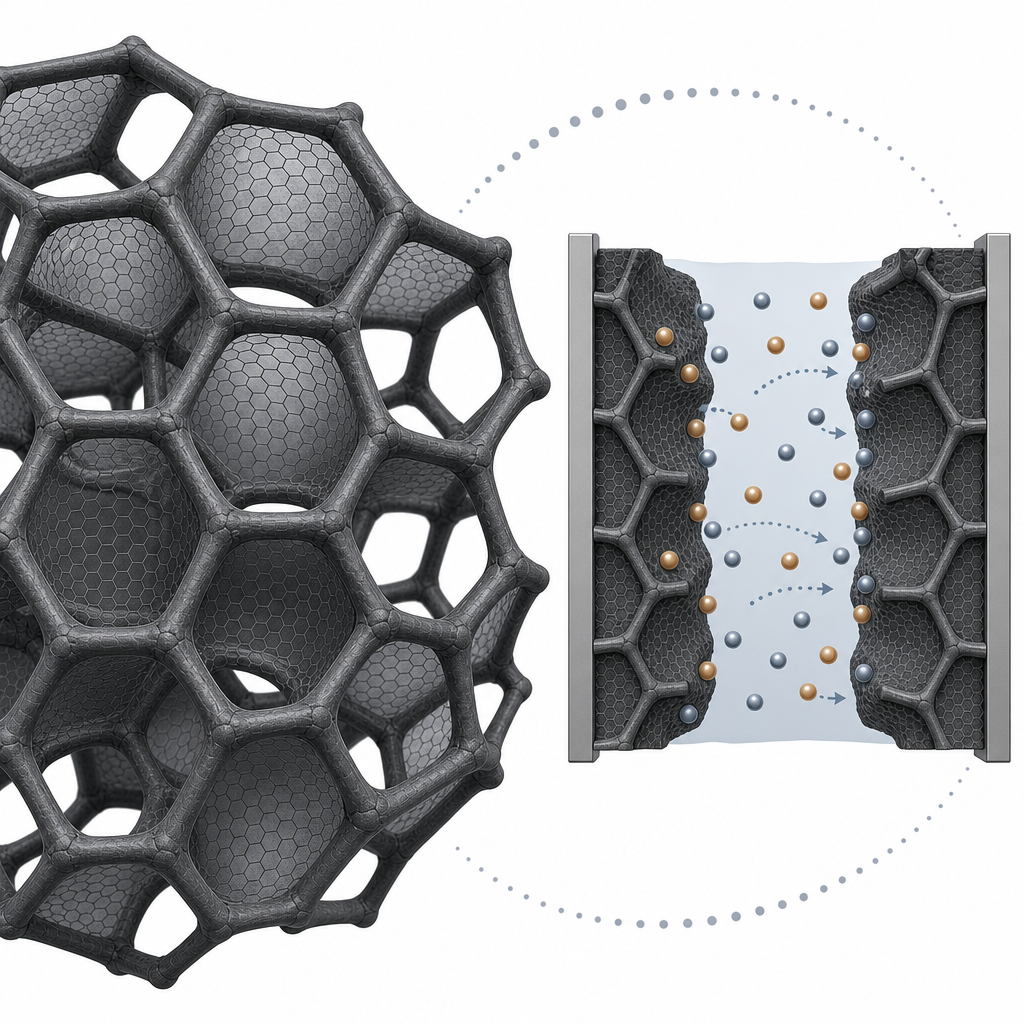
The synthesized SG combines mono- to few-layered graphitic membranes with micrometre-scale struts that act as both mechanical reinforcement and continuous electronic pathways. Raman spectroscopy, XRD, electron diffraction, and HRTEM (JEOL JEM-3000F) confirmed the graphitic nature of the membranes, while BET analysis on a Quantachrome Autosorb-1 confirmed a large accessible surface area. The conductivity of individual few-layered graphene membranes was characterized in a field-effect transistor configuration using a Keithley 4200-SCS. In supercapacitor testing, M-SG was discharged at extreme current densities up to 100 A g−1, showing that the strutted graphene retained capacitive behavior at power levels typical of electrolytic capacitors. Energy and power densities were calculated from galvanostatic charge–discharge data using standard equations for two-electrode cells, including the internal resistance derived from the Ohmic voltage drop and the equivalent series resistance from Nyquist plots. SG outperformed both the ACS Material commercial graphene powder and activated charcoal benchmarks, and the device performance was further compared to a 25 V / 4.7 mF aluminum electrolytic capacitor, highlighting the potential of SG to bridge the gap between conventional supercapacitors and electrolytic capacitors in the Ragone plot.
The results enable a range of practical applications: high-power, high-energy electrochemical capacitors for regenerative braking, pulsed power, and grid-scale buffering; lightweight conductive scaffolds for composite materials; and 3D substrates for catalysts, sensors, and electrochemistry. Because the sugar-blowing process is substrate-free and uses common precursors—glucose or even kitchen-grade granulated sugar plus NH4Cl—the method offers a scalable, inexpensive route to 3D graphene that could be readily integrated into manufacturing pipelines. The authors point to follow-up work in functionalizing or doping the strutted graphene, integrating it with pseudocapacitive metal oxides, and exploring flexible-electrode geometries to further enhance both energy and power densities.
For researchers working on 3D carbon architectures, supercapacitor electrodes, or graphene-based composites, this paper provides a clear methodology and a benchmark dataset against commercially sourced graphene. The commercial graphene powder used as the reference is available in the ACS Material graphene series catalog, alongside related products such as reduced graphene oxide, graphene nanoplatelets, and 3D graphene foams that researchers may use to replicate, extend, or compare against this study's findings.How ACS Material products were used
- Commercial Graphene Powder (GP) (Graphene Series) — “two electrodes made of diverse 1.0 mg active materials: SG, M-SG, commercial GP (from ACS Material LLC) and AC (charcoal activated, Merck Chemicals Co.)”
Product Performance in this StudyThe ACS Material commercial graphene powder served as a benchmark electrode active material against which the new sugar-blown strutted graphene (SG) was compared in symmetric supercapacitor measurements. It allowed the authors to demonstrate that SG outperformed conventional commercial graphene powders in supercapacitor performance.
Related product categories
Frequently asked questionsWhat is sugar-blown 3D strutted graphene and how is it made?
Sugar-blown 3D strutted graphene (SG) is a foam-like 3D carbon network synthesized by heating glucose (or common granulated sugar) mixed with ammonium chloride. The mixture is heated at a controlled rate and treated at 1,350 °C for 3 hours under argon in a tube furnace. The decomposing precursor releases gas that blows polymeric bubbles, which then graphitize into mono- or few-layered graphene membranes reinforced by micrometre-scale graphitic struts.
Why use commercial graphene powder as a benchmark for new 3D graphene electrodes?
Benchmarking against commercial graphene powder, such as that from ACS Material LLC, isolates the contribution of architecture from intrinsic material properties. Both the new 3D strutted graphene and the commercial powder are graphitic carbons, so any performance gap reflects differences in interconnectivity, accessible surface area, and electronic transport pathways. Without such a reference, claims about a novel topology delivering improved supercapacitor performance would be far less convincing.
How does 3D strutted graphene improve supercapacitor power density compared to activated carbon?
3D strutted graphene provides continuous covalent linkages between graphene membranes through micrometre-scale struts, creating high-speed pathways for electron and ion transport. Unlike activated carbon, which relies on point contacts between particles and has tortuous micropores, SG combines large accessible surface area with low internal resistance. This combination supports very high charge/discharge currents—up to 100 A g−1 in the reported tests—enabling supercapacitor performance approaching electrolytic capacitor power densities.