-
CMK-3 Mesoporous Carbon for Li-S Batteries - Rensselaer, 2018
May 22, 2026 | ACS MATERIAL LLCLi, L., Hou, L., Cheng, J., Simmons, T., Zhang, F., Zhang, L. T., Linhardt, R. J., & Koratkar, N. (2018). A flexible carbon/sulfur-cellulose core-shell structure for advanced lithium–sulfur batteries. *Energy Storage Materials*. https://doi.org/10.1016/j.ensm.2018.08.019
Energy Storage Materials · 2018
Rensselaer researchers used ACS Material CMK-3 mesoporous carbon to build a flexible cellulose-wrapped sulfur cathode delivering high-capacity Li-S batteries.
About this research
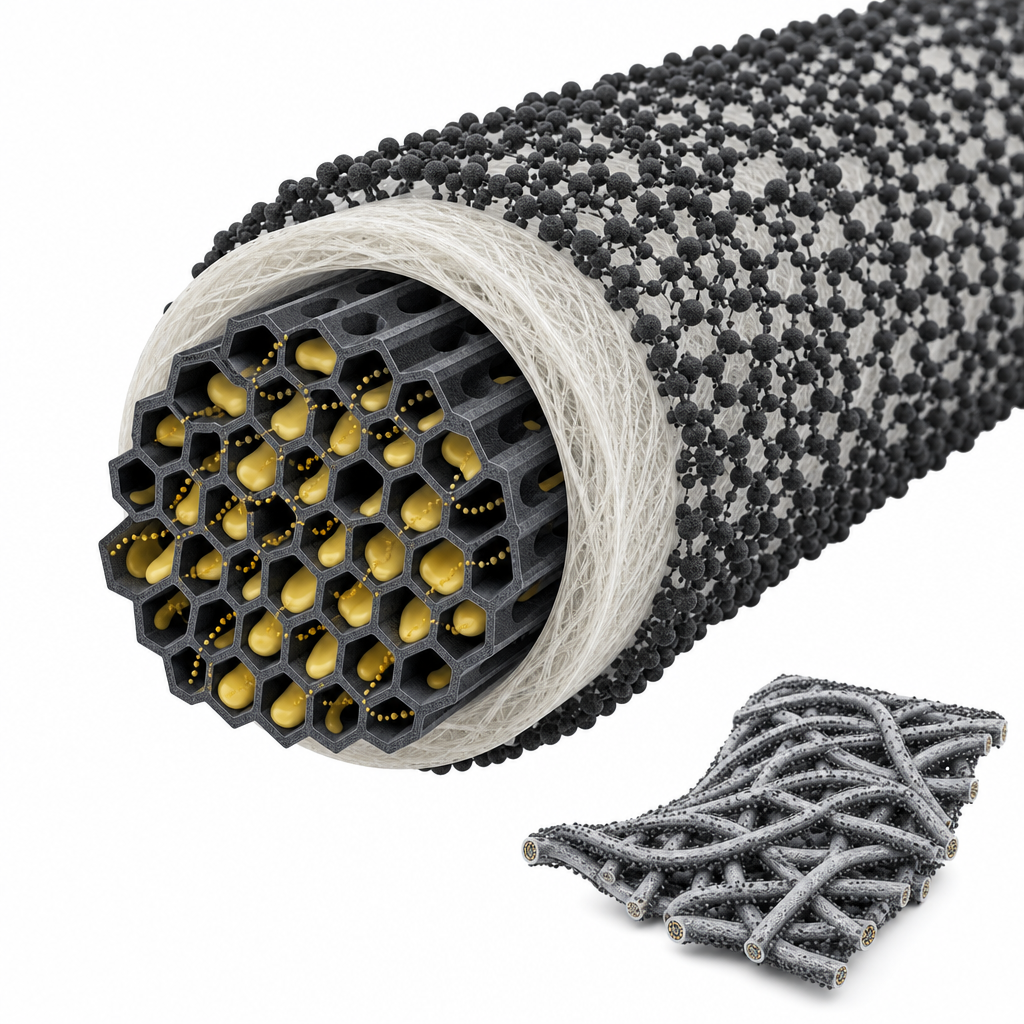
Researchers at Rensselaer Polytechnic Institute report a flexible carbon/sulfur–cellulose core-shell fiber cathode for lithium–sulfur batteries, built around CMK-3 ordered mesoporous carbon supplied by ACS Material. Published in Energy Storage Materials (2018) by Li, Hou, Cheng, Simmons, Zhang, Linhardt and Koratkar, the work uses coaxial electrospinning to encapsulate a CMK-3/sulfur composite inside cellulose fibers whose outer surface is decorated with carbon black, yielding a binder-free, current-collector-free freestanding electrode. The architecture targets two long-standing pain points of Li–S chemistry simultaneously: polysulfide shuttling and the mechanical degradation that accompanies sulfur's ~80% volume change during cycling.
Lithium–sulfur batteries are among the most promising post-lithium-ion chemistries because sulfur offers a theoretical specific capacity of 1675 mAh g⁻¹ and is inexpensive and abundant. In practice, however, intermediate lithium polysulfides dissolve into the electrolyte and shuttle to the lithium anode, while sulfur's poor electronic conductivity and large volumetric expansion erode the cathode. Mesoporous carbons, conductive coatings, and polymer wrappings have each been explored as remedies, but combining strong polysulfide confinement with mechanical resilience and electrode flexibility in a single, scalable architecture remains an open challenge for wearable and flexible energy-storage applications.
ACS Material's CMK-3 ordered mesoporous carbon is the functional core of this design. The authors report that "commercial sulfur (Alfa Aesar) was impregnated into CMK-3 mesoporous carbon (ACS Material) by mixing (weight ratio of 3 : 1) and heating to ~155 °C for several hours," exploiting CMK-3's ordered hexagonal mesopores and high surface area to wick molten sulfur into the channels by capillary action. The resulting CMK-3/S composite was dispersed in Triton X-100 and pumped through the inner channel of a coaxial spinneret at ~120 µL min⁻¹, while a 2% (w/v) cellulose solution in the ionic liquid 1-ethyl-3-methylimidazolium acetate was delivered through the outer channel at ~180 µL min⁻¹ under ~15 kV. Fibers were collected in a carbon-black-laden water/ethanol coagulation bath, where the ionic liquid was extracted and carbon black particles attached to the cellulose sheath, producing the final Cellulose(CMK-3/S)CB fiber mat. CMK-3 thus simultaneously supplies the conductive framework around sulfur, anchors polysulfides within its mesopores, and accommodates volume change inside the cellulose shell.
Electrochemical testing in 2032-type coin cells with a 1 M LiTFSI in DOL/DME electrolyte containing 0.1 M LiNO₃ confirmed the value of the core-shell architecture. The freestanding Cellulose(CMK-3/S)CB electrode was cut directly from the fiber mat and used without any binder, conductive additive, or aluminum current collector — a notable simplification relative to the comparison slurry electrode (60 wt% CMK-3/S, 5 wt% carbon black, 35 wt% PVDF on Al foil). Galvanostatic cycling between 1.5 and 2.8 V vs. Li/Li⁺ on an Arbin BT2000 instrument showed that the cellulose-encapsulated fiber electrode delivered substantially higher reversible specific capacities (calculated per gram of sulfur) and improved capacity retention compared with the CMK-3/S slurry control. Cyclic voltammetry at 0.2 mV s⁻¹ exhibited the two characteristic sulfur reduction peaks and one oxidation peak with sharper, better-aligned features over successive cycles, indicating reduced polysulfide loss. Electrochemical impedance spectroscopy demonstrated lower charge-transfer resistance, consistent with the continuous carbon-black outer percolation network. Linear elasticity simulations using Abaqus, comparing a cellulose tube (Young's modulus ~10 GPa) to a carbon nanotube (~500 GPa), supported the idea that the more compliant cellulose shell accommodates sulfur volume expansion without cracking.
The Cellulose(CMK-3/S)CB fiber mats are mechanically flexible — they can be shaped into squares or helical forms as shown in the digital photographs — pointing to applications in wearable electronics, roll-up flexible batteries, and structurally integrated energy-storage textiles. Because cellulose is biodegradable and ionic-liquid-based dissolution is a known scalable process, the route is also attractive from a sustainability perspective. The authors suggest the design principle, combining a polysulfide-trapping mesoporous carbon core, a polymer mechanical buffer, and a conductive carbon outer skin, can be extended to other conversion-type electrodes that face similar volume-change and dissolution problems, including Li–Se, Na–S, and Si anode chemistries.
For research groups developing next-generation Li–S cathodes, polysulfide trapping hosts, or sulfur–carbon composites, ordered mesoporous carbon CMK-3 from ACS Material provides a well-characterized, reproducible scaffold whose performance in this study is documented in a peer-reviewed Energy Storage Materials article. The same CMK-3 product, along with related ordered mesoporous carbons such as CMK-8 and N-doped mesoporous carbons, is available through ACS Material's Carbon Series for researchers working on battery electrodes, electrocatalyst supports, and adsorption studies.How ACS Material products were used
- Ordered Mesoporous Carbon CMK-3 (Carbon Series) — “Commercial sulfur (Alfa Aesar) was impregnated into CMK-3 mesoporous carbon (ACS Material) by mixing (weight ratio of 3 : 1) and heating to ~155 °C for several hours.”
Product Performance in this Study
CMK-3 from ACS Material served as the host scaffold for sulfur, providing the ordered mesoporous channels needed to confine sulfur and accommodate volume expansion. The resulting CMK-3/S composite was the electrochemically active core of the freestanding Li–S cathode.
Related product categories
Frequently asked questions
Why is CMK-3 mesoporous carbon used as a sulfur host in lithium-sulfur batteries?
CMK-3 has an ordered hexagonal mesoporous structure with high surface area and uniform channels that wick molten sulfur in by capillary action. Its mesopores physically confine lithium polysulfide intermediates and limit their dissolution into the electrolyte, while the conductive carbon framework compensates for sulfur's poor electronic conductivity. These features translate into higher utilization of active sulfur and better cycling stability than unsupported sulfur cathodes.
How does the cellulose core-shell coating improve sulfur cathode performance?
The cellulose sheath physically encapsulates the CMK-3/sulfur composite and acts as a compliant mechanical buffer that absorbs sulfur's roughly 80% volume change during cycling. Finite-element simulations in the paper show cellulose's lower Young's modulus (~10 GPa) accommodates expansion better than stiffer carbon tubes. Combined with an outer carbon-black layer that restores electronic conductivity, this yields a freestanding, flexible electrode without any binder or current collector.
What sulfur-to-carbon ratio is used when impregnating CMK-3 with sulfur?
In this study, commercial sulfur from Alfa Aesar was mixed with CMK-3 mesoporous carbon from ACS Material at a 3:1 sulfur-to-carbon weight ratio and heated to about 155 °C for several hours. At this temperature sulfur reaches its viscosity minimum and infiltrates the ordered mesopores by capillary action, giving a high sulfur loading while keeping the active material confined inside the carbon scaffold.