-
Flash Joule Heating of Peanut Shells - UNSW Sydney, 2026
Jun 26, 2026 | ACS MATERIAL LLCCordeiro, I. D. C. et al. (2026). Precursor engineering for rapid joule heating synthesis of graphitic carbon from peanut shells. *Chemical Engineering Journal Advances*. https://doi.org/10.1016/j.ceja.2026.101099
Chemical Engineering Journal Advances · 2026
UNSW Sydney researchers use ACS Material's HelioVolt Joule Heating System to convert peanut shells into few-layer turbostratic graphene (I2D/IG = 2.05).
About this research
Researchers at the University of New South Wales (UNSW Sydney) used the HelioVolt™ Joule Heating System from ACS Material LLC to convert peanut shell biomass into few-layer turbostratic graphene with a Raman I2D/IG ratio of 2.05, demonstrating that precursor engineering — not flash voltage — is the dominant factor controlling graphene quality. Published in Chemical Engineering Journal Advances (2026), the study by De Cachinho Cordeiro and co-workers systematically isolates the roles of thermal pretreatment and applied voltage in Flash Joule Heating (FJH), and shows that short Indirect Joule Heating (IJH) coupled with low-voltage conditioning produces graphene of comparable or superior quality to much more energy-intensive furnace routes, at a production cost of only USD $1.30 per kilogram.
Agricultural residues such as peanut shells are generated in billions of tonnes annually and are typically incinerated, landfilled, or downcycled. Flash Joule Heating offers a route to upcycle this lignocellulosic carbon into graphitic materials within milliseconds by resistively self-heating a conductive precursor above 3000 °C. However, FJH-derived graphene quality varies widely between feedstocks, and many studies depend on carbon black additives that complicate scalability. There is therefore a clear need to understand how the precursor's pre-flash structure and conductivity affect graphitic ordering, defect density, and turbostratic stacking. This work directly addresses that gap by establishing precursor engineering as the key determinant of FJH outcomes for biomass-to-graphene conversion.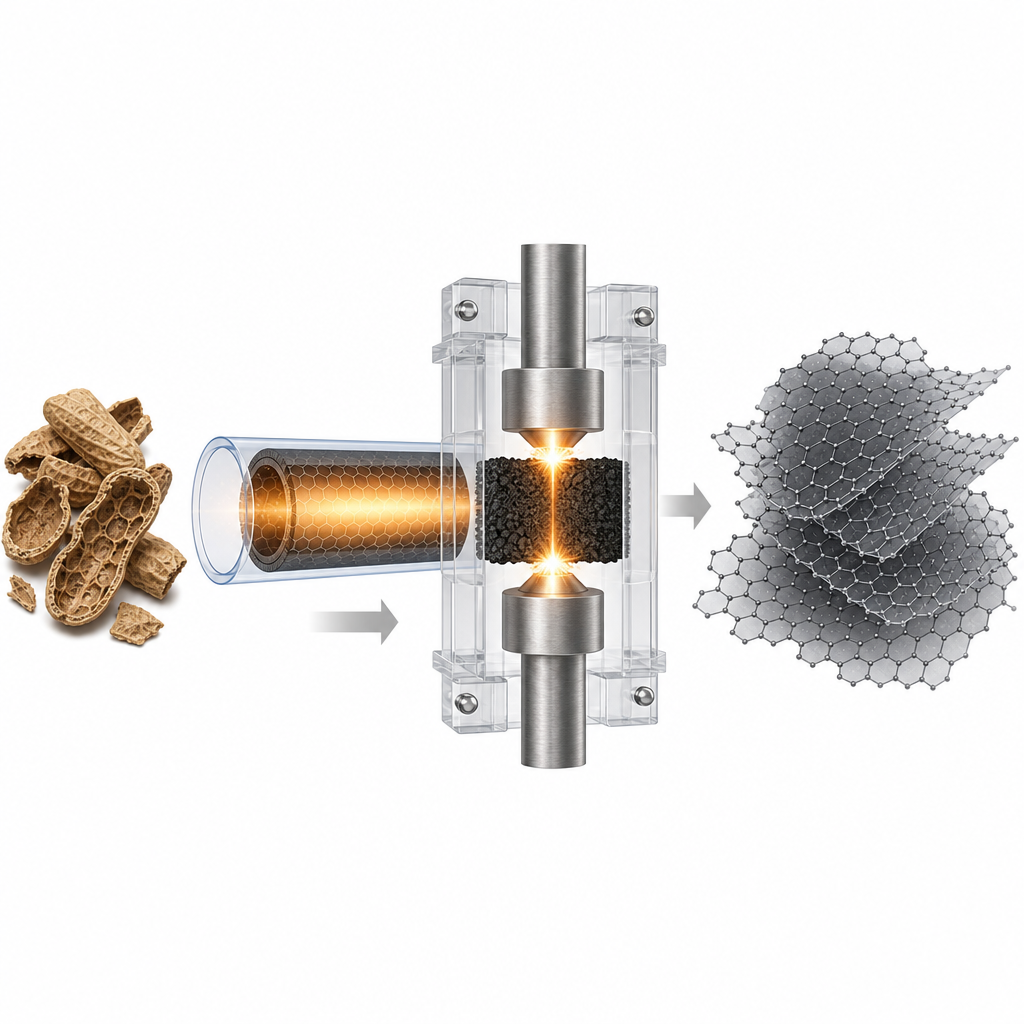
Both IJH and FJH steps were carried out on the commercial HelioVolt™ Joule Heating System from ACS Material LLC. For IJH, an 8 mm quartz tube was internally wrapped with a conductive graphite sheet, and the system delivered low-voltage pulses that heated the graphite sleeve to 500–1000 °C for short conditioning steps (5 min at 500 °C, 1 min at 1000 °C), removing volatiles and building conductive percolation pathways in otherwise insulating peanut shell powder. For FJH, the same system was reconfigured with graphite electrodes inside an acrylic vacuum chamber, drawing on a 90 mF capacitor controlled through the system's real-time monitoring software. Approximately 1.0 g batches of pretreated peanut shell were discharged at 90–180 V, with the entire flash event completed within ~500 ms. In-situ voltage and temperature monitoring, supported by the integrated control software, allowed the authors to precisely correlate flash parameters with structural outcomes.
The optimised pathway — staged IJH at 500 °C and 1000 °C, three 60 V conditioning pulses, then a single 150 V flash — produced few-layer turbostratic graphene with I2D/IG = 2.05, ID/IG = 0.15, an (002) interlayer spacing of d002 ≈ 0.342 nm, and XPS sp²/sp³ ≈ 1.69. HRTEM revealed thin, transparent flakes (1–3 layers) with long coherence length, while SAED patterns showed sharp concentric rings with discrete spots consistent with turbostratic stacking. In contrast, long furnace pretreatment at 1000 °C followed by 180 V FJH yielded thick (>50-layer) restacked graphitic domains with a weak 2D band (I2D/IG = 0.34) despite the lowest defect ratio (ID/IG = 0.07). Increasing the flash voltage from 90 V to 180 V refined sp² content but could not overcome the over-graphitised precursor structure. TGA confirmed that the IJH-flashed sample retained ~92 wt% mass at 900 °C, reflecting a robust sp²-rich framework. Reactive molecular dynamics (ReaxFF) simulations reproduced the experimentally observed sequence of deoxygenation, aromatic ring nucleation, and edge growth driven by C2H2 and C2H4 intermediates.
The demonstrated process is directly relevant to large-scale biomass valorisation, sustainable carbon manufacturing, energy-storage electrodes, hydrogen evolution catalysts, and composite reinforcement — all applications already pursued for flash graphene. By eliminating the need for carbon black additives and avoiding lengthy furnace carbonisation, the IJH + low-voltage + 150 V FJH route achieves a specific electrical energy of 15.6 MJ per kg of flash graphene and a production cost of about USD $1.30 per kg, one to two orders of magnitude lower than typical FJH routes for plastics, corn straw, or sawdust. The authors suggest this approach is well suited to continuous, scalable upcycling of lignocellulosic agricultural residues.
For researchers working on flash graphene, biomass upcycling, or rapid thermal processing of carbons, the HelioVolt™ Joule Heating System used here is available from ACS Material LLC and supports both indirect Joule heating pretreatment and high-voltage flash discharges in a single integrated platform. The reproducibility of staged IJH and millisecond flash protocols on a commercial instrument lowers the barrier to entry for groups studying precursor-controlled graphitization, defect engineering, and turbostratic graphene synthesis from a wide range of carbon feedstocks.How ACS Material products were used
- FlashVolt™ / HelioVolt™ Joule Heating System (Joule Heating System) — “The IJH was performed using the commercial HelioVolt™ Joule Heating System (ACS Material LLC, USA) with a continuous low-voltage supply... FJH experiments were conducted using the same HelioVolt™ Joule Heating System with a different reactor quartz tube.”
- FlashVolt™ Joule Heating System (HelioVolt™ Joule Heating System) (Joule Heating System) — “The IJH was performed using the commercial HelioVolt™ Joule Heating System (ACS Material LLC, USA) with a continuous low-voltage supply... FJH experiments were conducted using the same HelioVolt™ Joule Heating System with a different reactor quartz tube.”
Product Performance in this StudyThe HelioVolt™ Joule Heating System was central to the entire study, enabling both Indirect Joule Heating (IJH) pretreatment and Flash Joule Heating (FJH) at voltages up to 180 V. It delivered millisecond-scale heating exceeding 3000 °C and allowed precise voltage and pulse control to convert peanut shells into few-layer turbostratic graphene with I2D/IG = 2.05.
Related product categories
Frequently asked questionsWhat is precursor engineering in Flash Joule Heating?
Precursor engineering refers to deliberately tailoring the structure and electrical conductivity of a carbon feedstock before the flash discharge. For biomass such as peanut shells, this means using short indirect Joule heating and low-voltage conditioning to remove volatiles and build conductive percolation pathways while avoiding over-graphitisation. The pre-flash state largely controls defect density, sp² ordering, and whether the final product is few-layer turbostratic graphene or restacked multilayer graphite.
Why does indirect Joule heating outperform furnace pretreatment for flash graphene?
Long furnace carbonisation at 1000 °C produces dense, restacked lamellar carbon that resists reorganisation during the millisecond flash, yielding thick graphite-like domains with a weak 2D Raman band. Short indirect Joule heating (500–1000 °C for minutes) instead delivers a homogeneous conductive precursor with structural flexibility, which under a single 150 V flash converts to few-layer turbostratic graphene with I2D/IG = 2.05 and lower energy consumption.
How energy efficient is biomass-to-graphene conversion by Flash Joule Heating?
Using the optimised peanut-shell route, the specific electrical energy required to produce flash graphene is about 15.6 MJ per kilogram, corresponding to roughly USD $1.30 per kilogram in electricity costs. This is one to two orders of magnitude lower than reported Flash Joule Heating routes for plastic waste, corn straw, or sawdust, mainly because no carbon black or catalyst is required and the indirect Joule heating pretreatment is fast.