-
Graphene and Its Application in Electronics
Oct 15, 2019 | ACS MATERIAL LLCGraphene has been called a wonder material so often that it is easy to lose sight of what it actually does well in electronics — and what it does not. This single sheet of carbon atoms carries electricity with astonishing ease and conducts heat better than almost anything known, yet it stubbornly resists doing the one thing a logic transistor most needs: switching off. Understanding that tension is the key to understanding where graphene genuinely belongs in modern electronics. This article walks through the device physics, the real numbers, and the applications where graphene is already changing what is possible.
Quick answer: Graphene is not a practical replacement for silicon logic because it has no natural bandgap and cannot fully switch off. Its strongest electronics applications are instead RF and analog transistors, transparent conductive electrodes, thermal spreaders, interconnects, flexible sensors, and wearable devices.In this article: Bandgap problem RF transistors Transparent electrodes Thermal management Sensors & wearablesWhy Graphene Matters in Electronics
Graphene is a two-dimensional crystal: carbon atoms locked into a honeycomb lattice exactly one atom thick. That structure gives it a rare combination of properties that are each, on their own, remarkable, and together unusual in a single material. It is mechanically strong and flexible, nearly transparent, an outstanding conductor of both charge and heat, and chemically stable in air. For electronics, three of these properties carry the most weight: extremely high carrier mobility, exceptional thermal conductivity, and the fact that it is intrinsically a surface — every atom is exposed.
But graphene is not a drop-in replacement for silicon, and framing it that way has caused a decade of inflated expectations. The honest picture is more interesting: graphene is poorly suited to some of silicon's core jobs, and dramatically better than silicon at others. The sections below separate the two, starting with the physics that explains why.
The Physics: Massless Dirac Fermions and a Missing Bandgap
The behavior of any electronic material is dictated by its band structure — the relationship between an electron's energy and its momentum. In most semiconductors, that relationship is parabolic and, crucially, interrupted by a bandgap: a forbidden range of energies where no electron states exist. Silicon's bandgap is about 1.1 eV.
Graphene is different. Near the corners of its Brillouin zone, the conduction and valence bands meet at a single point — the Dirac point — and the energy varies linearly with momentum rather than quadratically. The consequence is profound: charge carriers in graphene behave like massless Dirac fermions, moving at a nearly constant Fermi velocity of roughly 106 m/s — about 1/300 the speed of light. This is why graphene's carrier mobility is so high. In suspended, ultra-clean samples, electron mobility can exceed 200,000 cm²/V·s at room temperature — around two orders of magnitude higher than silicon. Even on a supporting substrate of hexagonal boron nitride, mobilities of 20,000–40,000 cm²/V·s are routine.
The interactive model below shows the two band structures side by side. Toggle between them, then choose "Compare" to see the single difference that drives everything else.
That linear, gapless dispersion is the origin of both graphene's greatest strength and its most stubborn limitation. The absence of a bandgap is precisely what we turn to next.
The Bandgap Problem — and Why It Limits Logic
A digital logic transistor is fundamentally a switch. It must turn current on to represent a "1" and off to represent a "0," and the ratio between those two states — the on/off current ratio — needs to be large, typically between 104 and 106. Silicon achieves this easily: when the gate voltage drops below threshold, the bandgap ensures there are simply no states available to carry current, and the channel shuts off.
Graphene cannot do this. With no bandgap, there is no gate voltage that empties the channel of carriers. Sweeping the gate merely shifts the dominant carrier type from electrons to holes, passing through a minimum at the Dirac point where conductivity dips but never vanishes. The result is an on/off ratio of only about 2 to 10 in a typical graphene field-effect transistor — thousands of times too small for digital logic. The transfer curve below makes the contrast vivid.
Researchers have worked for years to engineer a bandgap into graphene, and several methods do work — but each comes at a cost. Cutting graphene into narrow ribbons (graphene nanoribbons) opens a gap through quantum confinement, but the narrower the ribbon, the more the edges scatter carriers: sub-10 nm ribbons have shown mobility collapsing below 200 cm²/V·s once a usable gap appears. Stacking two layers and applying a vertical electric field opens a tunable gap, and chemical functionalization can do so as well, but both degrade transport. This is the heart of the matter, sometimes called the mobility–bandgap trade-off: the very act of giving graphene an off-state usually suppresses much of the extraordinary mobility that made it attractive in the first place. As of the mid-2020s, growing a sizeable, well-ordered bandgap while preserving high mobility remains an open research challenge.
Transistors: Where Graphene Wins (RF, Not Logic)
If graphene struggles at digital logic, it excels at a different transistor job: high-frequency analog amplification. Radio-frequency (RF) transistors do not need to switch fully off — they need to respond as fast as possible to small signal changes. Here graphene's high mobility and its atomically thin channel are decisive advantages.
Because the channel is only one atom thick, graphene transistors can be scaled to very short channel lengths without suffering the "short-channel effects" that plague conventional devices — a point the physicist Frank Schwierz emphasized in his influential review: graphene's thinness, more than its raw mobility, may be its most compelling device feature. Epitaxial graphene RF transistors have demonstrated cutoff frequencies as high as 300 GHz, with reported oscillation frequencies around 70 GHz, well beyond what conventional silicon MOSFETs could achieve in comparable early high-frequency demonstrations. This makes graphene genuinely attractive for high-speed communications, mixers, and analog front-ends where an off-state is unnecessary.
The lesson is that "graphene transistor" is not one thing. As a logic switch it is a poor fit; as a high-frequency amplifier it is a strong candidate. The material did not fail — it simply belongs in a different part of the circuit.
Transparent Conductive Electrodes: Replacing ITO
One of graphene's most commercially mature electronic applications has nothing to do with transistors. Touchscreens, OLED displays, and solar cells all need a transparent conductive electrode (TCE): a film that conducts electricity while letting light through. The incumbent material, indium tin oxide (ITO), works well optically but is brittle, depends on increasingly scarce indium, and requires high-temperature deposition — all problems for the flexible, foldable devices the industry is moving toward.
Graphene is a natural challenger. A single layer absorbs only about 2.3% of visible light — a value set by fundamental constants — so it is exceptionally clear. Its conductivity and transparency are linked, however, by an unavoidable trade-off: adding layers lowers the sheet resistance but also blocks more light. In a landmark demonstration, researchers produced 30-inch graphene films by roll-to-roll processing with a sheet resistance around 125 Ω/sq at 97.4% transmittance for a monolayer; with chemical doping, a four-layer film reached roughly 30 Ω/sq at about 90% transmittance — performance approaching commercial ITO targets in important demonstrations, while remaining bendable. The simulator below lets you explore that balance directly.
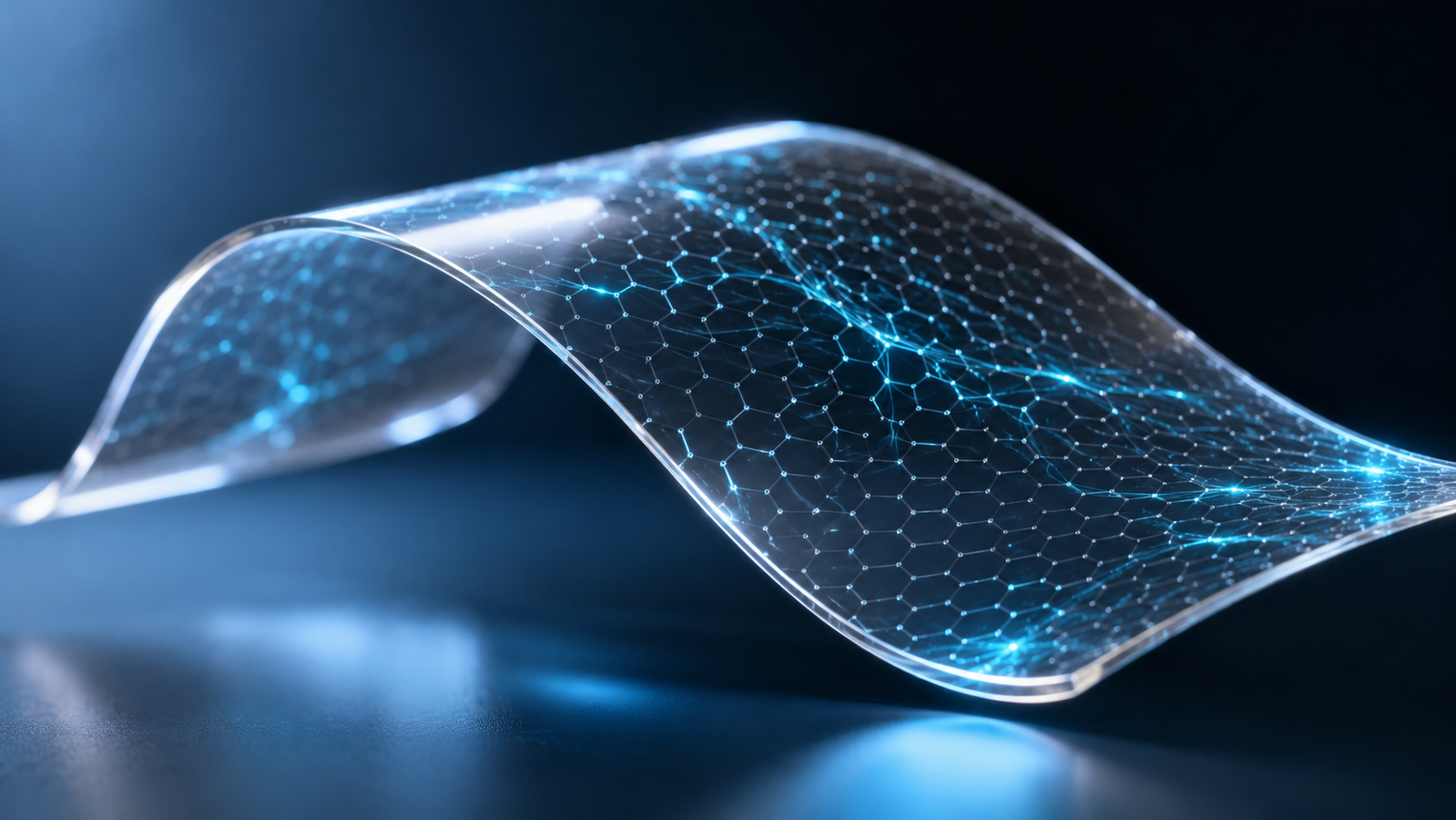
A flexible, transparent graphene electrode conducts electricity while staying optically clear — and survives bending that would crack rigid ITO. Crucially, graphene electrodes survive bending and flexing that would crack ITO, which is why they are especially promising for flexible touch panels, wearable displays, and conformable solar cells. ACS Material's Transparent Conductive Film and large-area CVD Graphene are produced with exactly these applications in mind.
Thermal Management and Interconnects
As chips grow denser and stack into three dimensions, removing heat has become one of electronics' hardest problems. Localized "hot spots" degrade performance and can trigger thermal breakdown. Here graphene offers something almost unmatched: the suspended single layer has a measured in-plane thermal conductivity in the range of 3,000 to 5,300 W/m·K near room temperature — higher than copper (~400 W/m·K), higher than many reported values for bulk graphite (~2,000 W/m·K), and comparable to or exceeding the best-known thermal conductors under ideal measurement conditions. Heat in graphene is carried predominantly by acoustic phonons, with a phonon mean free path of roughly 775 nm at room temperature.
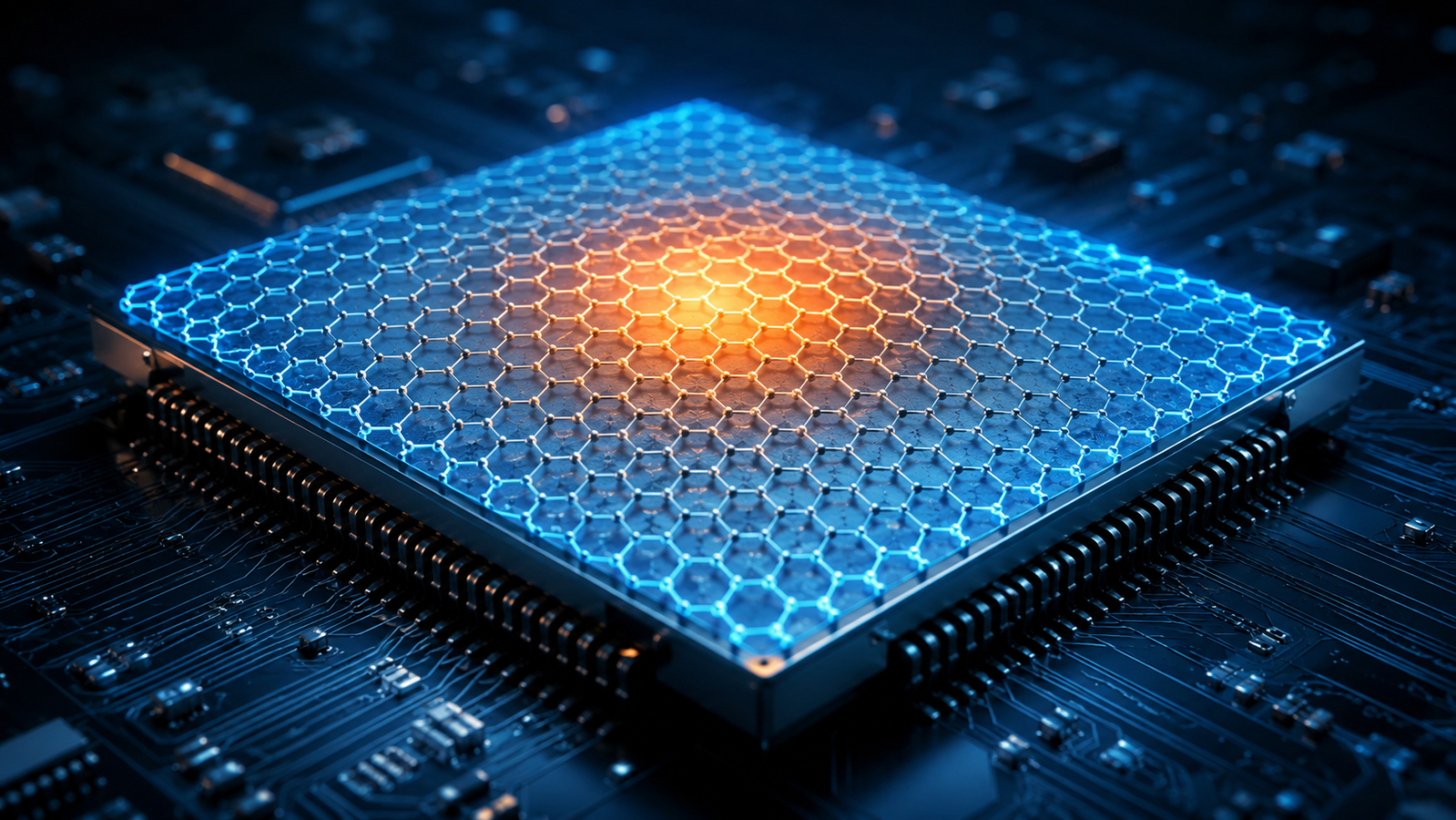
A single-atom-thick graphene layer acts as a heat spreader, rapidly conducting heat away from a chip hot spot across the plane. That makes graphene an excellent lateral heat spreader: a few atomic layers can pull heat sideways away from a hot spot while adding essentially no thickness to a device. Demonstrations have used few-layer graphene "quilts" to cool high-power GaN transistors and to manage heat in prototype 3D chips. The simulator below contrasts how a hot spot evolves with no spreader, a copper spreader, and a graphene spreader.
The interconnect problem is closely related. Industry roadmaps have warned that in advanced nodes the majority of a microprocessor's power can be consumed by the metal wiring that links its transistors, and that wiring also generates and traps heat. Graphene's combination of high current-carrying capacity, low resistivity (~10-8 Ω·m in quality samples), and exceptional thermal conductivity makes it a candidate both for next-generation interconnects and for the heat-spreading layers that keep them cool.
Flexible, Wearable, and Sensing Electronics
Graphene's mechanical flexibility, combined with its electrical performance, opens a domain where silicon simply cannot follow: electronics that bend, stretch, and conform to the body. Because graphene is intrinsically a surface — every carbon atom exposed to the environment — it is also exquisitely sensitive to anything that lands on it, which makes it a superb sensing material.
Graphene field-effect transistor (GFET) biosensors can detect biomarkers in sweat or blood at very low concentrations, enabling non-invasive, wearable health monitoring. Graphene-based gas sensors have reached detection limits in the parts-per-billion range — one flexible ammonia sensor using functionalized graphene oxide reported a theoretical limit of detection near 9 ppb — and all-graphene gas sensors have been built that tolerate humidity and repeated mechanical bending. The same properties support strain sensors, electrophysiological electrodes for monitoring heart and muscle activity, and transparent, foldable touch interfaces. This is one of the fastest-growing areas of graphene electronics, and one where its 2D nature is not a curiosity but the entire point.
The Road Ahead: Complement, Not Replacement
The realistic future of graphene in electronics is not a wholesale replacement of silicon. Silicon's mature manufacturing base and natural bandgap keep it firmly in control of digital logic, and that is unlikely to change soon. Instead, graphene is finding its place where its specific strengths matter most: high-frequency analog and RF devices, flexible and transparent electrodes, thermal management, interconnects, and a rapidly expanding family of sensors and wearable devices. In many of these, graphene works alongside silicon and other materials rather than against them.
Progress now depends as much on manufacturing as on physics — producing large-area, low-defect, reproducible graphene at scale, and integrating it cleanly with existing processes. As those production methods mature, the applications that already work in the lab will move steadily into products.
How ACS Material Supports Graphene Electronics Research
Turning any of these applications from a paper into a device starts with reliable, well-characterized material. ACS Material supplies a broad range of graphene products used in electronics research and development worldwide:
- Graphene Series — a full catalog of graphene powders, films, and derivatives for electronics, energy, and composite research.
- CVD Graphene — high-quality, large-area monolayer and few-layer films for transparent electrodes, transistors, and sensors.
- Trivial Transfer Graphene™ — graphene engineered for easy transfer onto arbitrary substrates, ideal for device prototyping.
- Transparent Conductive Film — ready-to-use conductive films for displays, touch panels, and photovoltaics.
For application guidance or custom specifications, the ACS Material team can help match the right graphene product to your device requirements. Visit acsmaterial.com or contact us directly.
Frequently Asked Questions
Why can't graphene replace silicon in computer processors?
Because graphene has no bandgap. A logic transistor must switch fully off, and silicon's ~1.1 eV bandgap lets it do that with an on/off current ratio of 106 or more. A graphene transistor's ratio is only about 2–10, since there is no gate voltage that stops conduction. Engineering a bandgap into graphene is possible but sharply reduces its carrier mobility, so it does not yet yield a competitive logic device.
What is graphene's carrier mobility, and why does it matter?
Carrier mobility measures how easily electrons move through a material. In suspended, ultra-clean graphene it can exceed 200,000 cm²/V·s at room temperature — roughly 100 times higher than silicon. High mobility enables very fast, high-frequency devices, which is why graphene is attractive for RF and analog electronics even though it is unsuited to digital logic.
Where is graphene actually used in electronics today?
The most mature applications are transparent conductive electrodes (for touchscreens, displays, and solar cells), high-frequency RF transistors, thermal-management and heat-spreading layers, and a fast-growing range of flexible and wearable sensors and biosensors. Many of these use graphene alongside conventional materials rather than replacing them.
Can graphene replace ITO in touchscreens and displays?
Graphene can replace ITO in selected flexible, bendable, and transparent-electrode applications. Doped multilayer graphene films have reached about 30 Ω/sq at ~90% transmittance, competitive with commercial ITO in important demonstrations, and unlike brittle ITO they survive bending. Large-area uniformity, transfer cleanliness, and production cost remain the main hurdles.
Why is graphene good for thermal management?
Suspended single-layer graphene has a measured thermal conductivity of roughly 3,000–5,300 W/m·K, far higher than copper and among the highest thermal conductivities reported for any material. A few atomic layers can spread heat away from chip hot spots while adding almost no thickness, which is valuable for high-power and 3D electronics.
What is a graphene field-effect transistor (GFET) biosensor?
A GFET biosensor uses a graphene channel whose conductivity changes when target molecules bind to its surface. Because every graphene atom is exposed, even tiny amounts of a biomarker produce a measurable signal, enabling sensitive, non-invasive, often wearable health monitoring — for example, detecting proteins in sweat.
References
1Novoselov, K. S. et al. Electric Field Effect in Atomically Thin Carbon Films. Science 306, 666–669 (2004). DOI: 10.1126/science.11028962Geim, A. K. & Novoselov, K. S. The Rise of Graphene. Nature Materials 6, 183–191 (2007). DOI: 10.1038/nmat18493Schwierz, F. Graphene Transistors. Nature Nanotechnology 5, 487–496 (2010). DOI: 10.1038/nnano.2010.894Castro Neto, A. H. et al. The Electronic Properties of Graphene. Reviews of Modern Physics 81, 109–162 (2009). DOI: 10.1103/RevModPhys.81.1095Das Sarma, S. et al. Electronic Transport in Two-Dimensional Graphene. Reviews of Modern Physics 83, 407–470 (2011). DOI: 10.1103/RevModPhys.83.4076Bolotin, K. I. et al. Ultrahigh Electron Mobility in Suspended Graphene. Solid State Communications 146, 351–355 (2008). DOI: 10.1016/j.ssc.2008.02.0247Chen, J. H. et al. Intrinsic and Extrinsic Performance Limits of Graphene Devices on SiO2. Nature Nanotechnology 3, 206–209 (2008). DOI: 10.1038/nnano.2008.588Dean, C. R. et al. Boron Nitride Substrates for High-Quality Graphene Electronics. Nature Nanotechnology 5, 722–726 (2010). DOI: 10.1038/nnano.2010.1729Zhang, Y. et al. Direct Observation of a Widely Tunable Bandgap in Bilayer Graphene. Nature 459, 820–823 (2009). DOI: 10.1038/nature0810510Han, M. Y. et al. Energy Band-Gap Engineering of Graphene Nanoribbons. Physical Review Letters 98, 206805 (2007). DOI: 10.1103/PhysRevLett.98.20680511Li, X. et al. Chemically Derived, Ultrasmooth Graphene Nanoribbon Semiconductors. Science 319, 1229–1232 (2008). DOI: 10.1126/science.115087812Lin, Y.-M. et al. 100-GHz Transistors from Wafer-Scale Epitaxial Graphene. Science 327, 662 (2010). DOI: 10.1126/science.118428913Liao, L. et al. High-Speed Graphene Transistors with a Self-Aligned Nanowire Gate. Nature 467, 305–308 (2010). DOI: 10.1038/nature0940514Wu, Y. et al. State-of-the-Art Graphene High-Frequency Electronics. Nano Letters 12, 3062–3067 (2012). DOI: 10.1021/nl300904k15Bae, S. et al. Roll-to-Roll Production of 30-Inch Graphene Films for Transparent Electrodes. Nature Nanotechnology 5, 574–578 (2010). DOI: 10.1038/nnano.2010.13216Li, X. et al. Transfer of Large-Area Graphene Films for High-Performance Transparent Conductive Electrodes. Nano Letters 9, 4359–4363 (2009). DOI: 10.1021/nl902623y17Nair, R. R. et al. Fine Structure Constant Defines Visual Transparency of Graphene. Science 320, 1308 (2008). DOI: 10.1126/science.115696518Balandin, A. A. et al. Superior Thermal Conductivity of Single-Layer Graphene. Nano Letters 8, 902–907 (2008). DOI: 10.1021/nl073187219Balandin, A. A. Thermal Properties of Graphene and Nanostructured Carbon Materials. Nature Materials 10, 569–581 (2011). DOI: 10.1038/nmat306420Ghosh, S. et al. Extremely High Thermal Conductivity of Graphene: Prospects for Thermal Management. Applied Physics Letters 92, 151911 (2008). DOI: 10.1063/1.290797721Yan, Z. et al. Graphene Quilts for Thermal Management of High-Power GaN Transistors. Nature Communications 3, 827 (2012). DOI: 10.1038/ncomms182822Schwierz, F. Graphene Transistors: Status, Prospects, and Problems. Proceedings of the IEEE 101, 1567–1584 (2013). DOI: 10.1109/JPROC.2013.225763323Schedin, F. et al. Detection of Individual Gas Molecules Adsorbed on Graphene. Nature Materials 6, 652–655 (2007). DOI: 10.1038/nmat196724Yavari, F. & Koratkar, N. Graphene-Based Chemical Sensors. Journal of Physical Chemistry Letters 3, 1746–1753 (2012). DOI: 10.1021/jz300358t25Singh, E. et al. Flexible Graphene-Based Wearable Gas and Chemical Sensors. ACS Applied Materials & Interfaces 9, 34544–34586 (2017). DOI: 10.1021/acsami.7b0706326Kim, Y. H. et al. Self-Activated Transparent All-Graphene Gas Sensor. ACS Nano 9, 10453–10460 (2015). DOI: 10.1021/acsnano.5b0468027Novoselov, K. S. et al. A Roadmap for Graphene. Nature 490, 192–200 (2012). DOI: 10.1038/nature1145828Ferrari, A. C. et al. Science and Technology Roadmap for Graphene and Related 2D Materials. Nanoscale 7, 4598–4810 (2015). DOI: 10.1039/C4NR01600AThis article is provided by ACS Material LLC for educational purposes. Property values cited are representative of the referenced literature; exact figures depend on sample quality, substrate, and measurement conditions.