-
Graphene-Enhanced PTO Cathodes for High-Power Mg Batteries - University of Houston, 2020
May 20, 2026 | ACS MATERIAL LLCDong, H., Tutusaus, O., Liang, Y., Zhang, Y., Lebens-Higgins, Z., Yang, W., Mohtadi, R., & Yao, Y. (2020). High-power Mg batteries enabled by heterogeneous enolization redox chemistry and weakly coordinating electrolytes. *Nature Energy*. https://doi.org/10.1038/s41560-020-00734-0
Nature Energy · 2020
University of Houston researchers built a Mg battery delivering 30.4 kW/kg using PTO cathodes, graphene additives, and a weakly coordinating boron cluster electrolyte.
About this research
Researchers at the University of Houston, in collaboration with Toyota Research Institute of North America and Lawrence Berkeley National Laboratory, have demonstrated a high-power magnesium battery built around a pyrene-4,5,9,10-tetraone (PTO) organic cathode, a weakly coordinating Mg(CB11H12)2 (MMC) boron cluster electrolyte, and graphene-based conductive additives. The full cell delivers a specific capacity of 315 mAh/g at 2.1 V versus Mg2+/Mg and a specific power of up to 30.4 kW/kg—nearly two orders of magnitude higher than state-of-the-art Mg batteries. The work, published in Nature Energy in 2020, establishes a heterogeneous enolization redox mechanism that avoids the bond-cleavage steps that have traditionally throttled Mg2+ kinetics.
The broader context is the search for low-cost, safe, post-lithium-ion chemistries. Magnesium offers dendrite-free plating, abundant resources, and high volumetric capacity, but the divalent Mg2+ ion couples strongly with both electrolyte solvents and cathode lattices. This makes ion dissociation and solid-state diffusion sluggish, capping power density. Existing intercalation cathodes such as Mo6S8 or Ti2S4 require elevated temperatures to approach theoretical capacity, while organic and layered hosts often store bulky complex ions like MgCl+ that degrade cycle life and energy density. A cathode reaction that genuinely stores Mg2+ at room temperature, with fast kinetics, has remained a long-standing target.
The authors address this through a two-pronged design. First, they exploit the reversible enolization of carbonyl groups (C=O ↔ C–O−) in PTO, a small-molecule quinone, so that charge compensation occurs by electron transfer to oxygen rather than by ion insertion into a rigid lattice. Second, they engineer a weakly coordinating electrolyte: 0.5 mol/kg Mg(CB11H12)2 dissolved in a 1:1 (w/w) DME–diglyme (G2) blend. The boron cluster anion is bulky and weakly basic, so Mg2+ desolvates rapidly at the electrode interface. To make the cathode practical, PTO is composited with Ketjenblack and PTFE binder, with graphene oxide and graphene nanoplatelets added in the long-cycling cell formulation. The graphene component provides a conductive scaffold and mechanical reinforcement, mitigating PTO dissolution and capacity fade.The high power density achieved by the University of Houston is a direct result of the exceptionally high specific surface area and electrical conductivity of the graphene matrix. For next-generation multivalent batteries (Mg, Al, Zn) where ion kinetics are bottlenecked, pristine graphene isn't just an additive—it's a structural necessity. Explore our highly conductive Graphene Series (Powders & Nanoplatelets) to overcome sluggish diffusion in your battery designs.
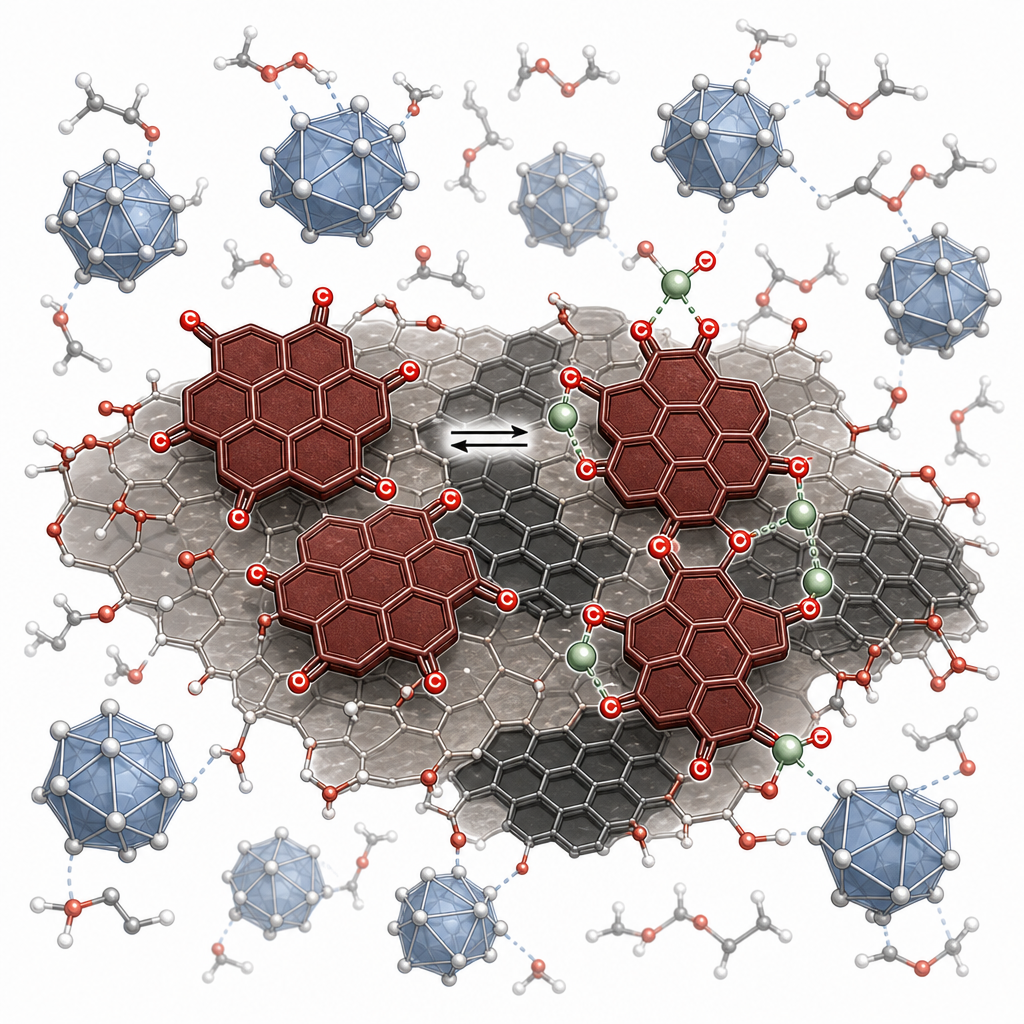
Quantitatively, the Mg–PTO cell achieves 315 mAh/g near 2.1 V at low rate, retains useful capacity at C-rates from 1 C up to 50 C (1 C = 408 mA/g), and reaches a Ragone-plot specific power of 30.4 kW/kg—roughly 100× higher than prior Mg batteries that store true Mg2+. The MMC/(DME-G2) electrolyte supports dendrite-free Mg plating and stripping at current densities up to 20 mA/cm², a level previously unreachable for chloride-free Mg electrolytes. The GO/GN-incorporated cathode cycles stably at 5 C with high Coulombic efficiency over hundreds of cycles. Soft X-ray absorption spectroscopy, XPS, ICP, and FTIR confirm that the redox process is genuinely enolization-driven and that Mg2+, rather than complex ions like MgCl+, is the stored species.
The implications stretch across rechargeable battery research. Pairing organic enolization cathodes with weakly coordinating electrolytes opens a route to Mg, Ca, and Zn multivalent batteries with both high energy and high power, while avoiding the corrosive chlorides historically required for Mg salts. Applications include grid storage, electric mobility, and safety-critical formats where Li-ion dendrite risk is unacceptable. The authors point to further optimization of carbonyl-rich polymers, fluorinated ether co-solvents, and 3D conductive networks—including graphene foams and reduced graphene oxide composites—as natural next steps to push energy density while preserving the demonstrated power.
For researchers developing similar multivalent battery chemistries, the role of graphene oxide and graphene nanoplatelets as cathode conductive additives is directly relevant. ACS Material supplies graphene oxide, reduced graphene oxide, graphene nanoplatelets, and related carbon nanomaterials at the purity and consistency required for electrochemical testing. The same product family also supports work in supercapacitors, Li-S batteries, and electrocatalysis where conductive carbon scaffolds determine rate capability and cycle stability.How ACS Material products were used
- Graphene oxide / graphene nanoplatelets (GO/GN) conductive additive (Graphene Series) — “Cycling stability and coulombic efficiency of a GO/GN-incorporated Mg–PTO cell cycled at 5 C.”
Product Performance in this Study
Graphene oxide/graphene nanoplatelet additives were incorporated into the PTO cathode composite to enhance electronic conductivity and mechanical integrity, contributing to stable cycling at 5 C rate in the high-power Mg battery.
Related product categories
Frequently asked questions
How does graphene oxide improve organic cathodes in magnesium batteries?
Graphene oxide and graphene nanoplatelets serve as a conductive, high-surface-area scaffold for small-molecule organic cathodes like PTO. They enhance electronic transport across the insulating organic matrix, anchor the active material to suppress dissolution into the ether electrolyte, and provide mechanical support during repeated Mg2+ uptake. In this Mg–PTO cell, GO/GN incorporation enabled stable cycling at 5 C with high Coulombic efficiency.
What is the enolization redox mechanism used in this Mg battery?
Enolization is a reversible carbonyl reduction in which a C=O bond converts to C–O− as electrons are transferred to oxygen and Mg2+ ions associate with the resulting alkoxide. Because charge compensation happens at oxygen sites rather than through bulk lattice intercalation, ion dissociation and solid-state diffusion bottlenecks are bypassed, yielding fast and reversible Mg2+ storage at room temperature.
Why is a weakly coordinating electrolyte important for high-power Mg batteries?
Strongly coordinating glyme solvents bind Mg2+ tightly, raising desolvation energy and slowing kinetics at the electrode interface. A weakly coordinating boron cluster anion such as CB11H12−, paired with a low-viscosity DME-diglyme blend, lets Mg2+ shed its solvation shell quickly and migrate through bulk electrolyte rapidly, enabling 20 mA/cm² plating/stripping and the reported 30.4 kW/kg specific power.
- Graphene oxide / graphene nanoplatelets (GO/GN) conductive additive (Graphene Series) — “Cycling stability and coulombic efficiency of a GO/GN-incorporated Mg–PTO cell cycled at 5 C.”