-
Graphene Oxide Sand Filters for Heavy Metal Removal — University of Florida, 2014
May 22, 2026 | ACS MATERIAL LLCDing, Z., Hu, X., Morales, V., & Gao, B. (2014). Filtration and transport of heavy metals in graphene oxide enabled sand columns. *Chemical Engineering Journal*.
Chemical Engineering Journal · 2014
Researchers used ACS Material graphene oxide to build GO-enabled sand columns that filter Pb(II) and Cu(II) from water, with quantified breakthrough behavior.
About this research
Researchers led by Bin Gao at the University of Florida used graphene oxide obtained from ACS Material to construct GO-enabled quartz-sand filter columns and quantified their performance for removing Pb(II) and Cu(II) from aqueous solution, with measured removal efficiencies of up to 26.7% for lead and 15.3% for copper at a 1 mL min⁻¹ flow rate. The study, published in the Chemical Engineering Journal in 2014, combined fixed-bed column experiments with convection–dispersion–reaction (CDER) modeling to understand how a small mass of layered GO modifies the transport and capture of dissolved heavy metals in sand. The work establishes practical design guidance—on flow rate, GO loading, and competitive sorption—for low-cost graphene-oxide-enhanced point-of-use water filtration.
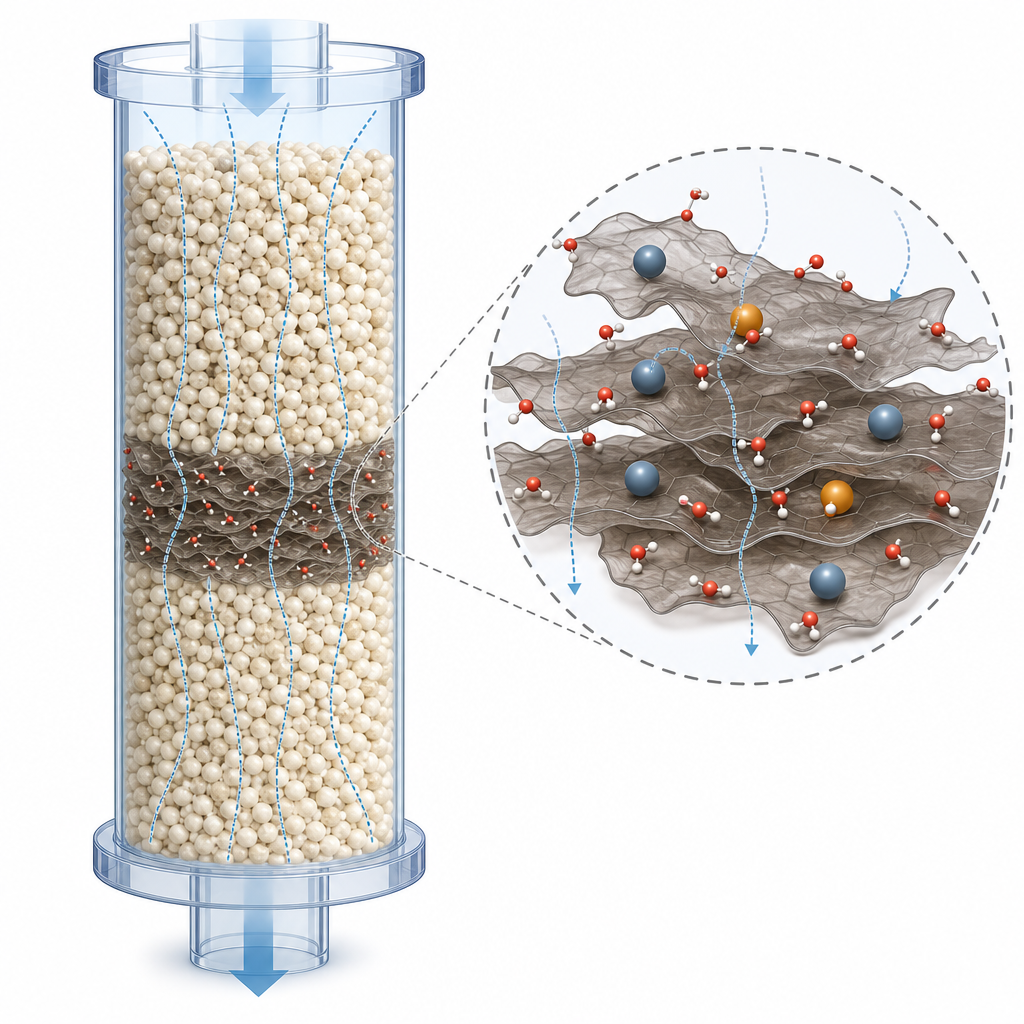
Heavy-metal contamination of surface and groundwater remains a persistent environmental and public-health problem, and conventional sand filters are inexpensive but offer only modest removal of dissolved metals such as lead and copper. Engineered carbon nanomaterials, including carbon nanotubes and graphene oxide, have high specific surface areas and abundant oxygen functional groups (carboxyl, hydroxyl, epoxy) that bind heavy-metal cations strongly. The open challenge is translating those batch-adsorption advantages into a flowing column geometry without losing the nanomaterial to the effluent or sacrificing hydraulic performance. Layering GO inside an otherwise conventional sand bed is an attractive strategy because it leverages existing filter infrastructure, uses very small nanomaterial mass loadings, and is compatible with continuous operation. Understanding flow-rate dependence, loading dependence, and binary-metal competition is essential before such hybrid filters can be deployed for water treatment.
The ACS Material graphene oxide, prepared by a modified Hummers' method and used as received, served as the active sorbent layer in the column. The team reported an average GO flake thickness of 0.92 ± 0.13 nm and an average lateral dimension of 582 ± 111.2 nm, indicating predominantly single- to few-layer flakes. Filter columns were built in 1.5 cm I.D. × 5 cm acrylic tubes by wet-packing approximately 16.5 g of acid-washed quartz sand (0.5–0.6 mm grain size), depositing either 10 or 30 mg of GO as a thin horizontal layer in the middle of the bed, and then wet-packing the remaining sand on top. These loadings correspond to only 0.06 wt% or 0.18 wt% GO relative to sand, so the bed porosity was assumed to remain at 0.45. Membranes with 50 µm pores at the inlet and outlet distributed flow. Single (10 mg L⁻¹ Cu²⁺ or Pb²⁺) and dual (10 mg L⁻¹ each) metal pulses at pH 5.6 were injected at 1 or 5 mL min⁻¹, followed by metal-free DI water elution; effluent was analyzed by ICP-OES.
Across all conditions, adding the GO layer enhanced metal removal versus pure-sand controls. For 10 mg GO loading, peak normalized effluent concentrations (C/C₀) of Cu(II) and Pb(II) were 0.94 and 0.86 at 1 mL min⁻¹ and 0.95 and 0.90 at 5 mL min⁻¹, respectively—indicating the GO layer suppresses breakthrough more strongly at lower flow. Overall removal efficiency dropped from 15.3% to 10.3% for Cu(II) and from 26.7% to 19.0% for Pb(II) when the flow rate was increased from 1 to 5 mL min⁻¹, consistent with reduced contact time. Pb(II) was consistently removed more efficiently than Cu(II), matching previously reported GO affinity ordering of Pb(II) > Cu(II) ≈ Cd(II) > Zn(II) in batch experiments. Increasing GO mass from 10 to 30 mg at 1 mL min⁻¹ further raised removal efficiency, confirming sorbent-mass dependence. The CDER model with first-order removal kinetics reproduced the breakthrough curves and provided fitted retardation factors, dispersion coefficients, and removal-rate constants, giving a quantitative basis for scaling. Dual-metal experiments showed competitive sorption effects, with Pb(II) outcompeting Cu(II) on the GO surface.
The results support the use of GO-enabled sand columns as compact, low-cost units for removing divalent heavy-metal cations from drinking water, industrial effluents, mining runoff, and remediation pump-and-treat streams. Because only milligram-scale GO is needed per column, material cost is modest, and the layered architecture is compatible with existing rapid sand-filter operations. The modeling framework also provides parameters that engineers can use to size columns for target effluent concentrations or to predict service life. Follow-up directions implied by the paper include longer multi-pulse operation to study saturation and regeneration, optimization of GO placement and thickness, evaluation under realistic water matrices containing natural organic matter and competing ions, and extension to other priority contaminants such as Cd, Zn, As, and organic micropollutants.
For researchers working on water purification, environmental remediation, or composite adsorbents, the graphene oxide used here is part of ACS Material's Graphene Series catalog, which offers single-layer GO, large-size GO, low-defect GO, industrial-grade GO, and aqueous dispersions suitable for column packing, membrane casting, and composite synthesis. The paper does not claim performance beyond what its column data show, and the modest removal efficiencies reported reflect deliberately small GO loadings; higher loadings or hybrid configurations are expected to improve capture further. The work is a useful reference point for groups planning their own GO-based filtration studies.How ACS Material products were used
- Graphene Oxide (modified Hummers' method) (Graphene Series) — “GO was obtained from ACS Material (Medford, MA) and used as received. According to the manufacturer, it was prepared by the modified hummer's method.”
Product Performance in this Study
The ACS Material graphene oxide, layered as a thin filter bed within quartz sand columns, substantially enhanced the removal of Pb(II) and Cu(II) from water relative to pure-sand controls, with Pb showing higher affinity than Cu, consistent with prior batch studies.
Related product categories
Frequently asked questions
How effective is graphene oxide for removing lead and copper from water?
In this study a 10 mg layer of graphene oxide in a quartz-sand column removed 26.7% of Pb(II) and 15.3% of Cu(II) from a 10 mg L⁻¹ feed at 1 mL min⁻¹, compared with a much lower removal in the pure-sand control. Pb(II) was consistently captured more effectively than Cu(II), reflecting the well-known higher affinity of oxygen functional groups on GO for lead than for copper.
Why does flow rate affect heavy metal removal in GO-enabled sand columns?
Faster flow shortens the contact time between dissolved metal cations and the GO sorbent layer, so fewer ions diffuse to and bind on GO surface sites before exiting the column. In this work, raising the flow rate from 1 to 5 mL min⁻¹ dropped Pb(II) removal from 26.7% to 19.0% and Cu(II) removal from 15.3% to 10.3%, even though the GO mass and packing geometry were unchanged.
What grade of graphene oxide is suitable for water filtration column studies?
Studies of this type typically use single- or few-layer GO produced by a modified Hummers' method, with lateral flake sizes around several hundred nanometers and rich surface oxygen functionality. The GO in this paper averaged 0.92 nm thick and 582 nm across. ACS Material's Graphene Series offers comparable single-layer, low-defect, and industrial-grade graphene oxide products suitable for column-bed and membrane filtration research.