-
Graphene Oxide Transport in Porous Media — UF & UC Davis, 2013
May 22, 2026 | ACS MATERIAL LLCLiu, L., Gao, B., Wu, L., Morales, V. L., Yang, L., Zhou, Z., & Wang, H. (2013). Deposition and transport of graphene oxide in saturated and unsaturated porous media. *Chemical Engineering Journal*.
Chemical Engineering Journal · 2013
University of Florida and UC Davis researchers used ACS Material single-layer graphene oxide to study GO deposition and transport in saturated and unsaturated sand columns.
About this research
Researchers at the University of Florida, working with collaborators from UC Davis, Cornell University, and the Chinese Academy of Sciences, used single-layer graphene oxide (GO) supplied by ACS Material to characterize how GO nanoparticles deposit and migrate through saturated and unsaturated porous media. Published in Chemical Engineering Journal in 2013, the study established that GO mobility in sandy aquifer-analog columns is strongly governed by solution ionic strength and moisture content, with secondary-minimum deposition and film straining identified as the dominant retention mechanisms. The work provides quantitative transport parameters that can be plugged directly into vadose-zone risk models for emerging carbon nanomaterials.
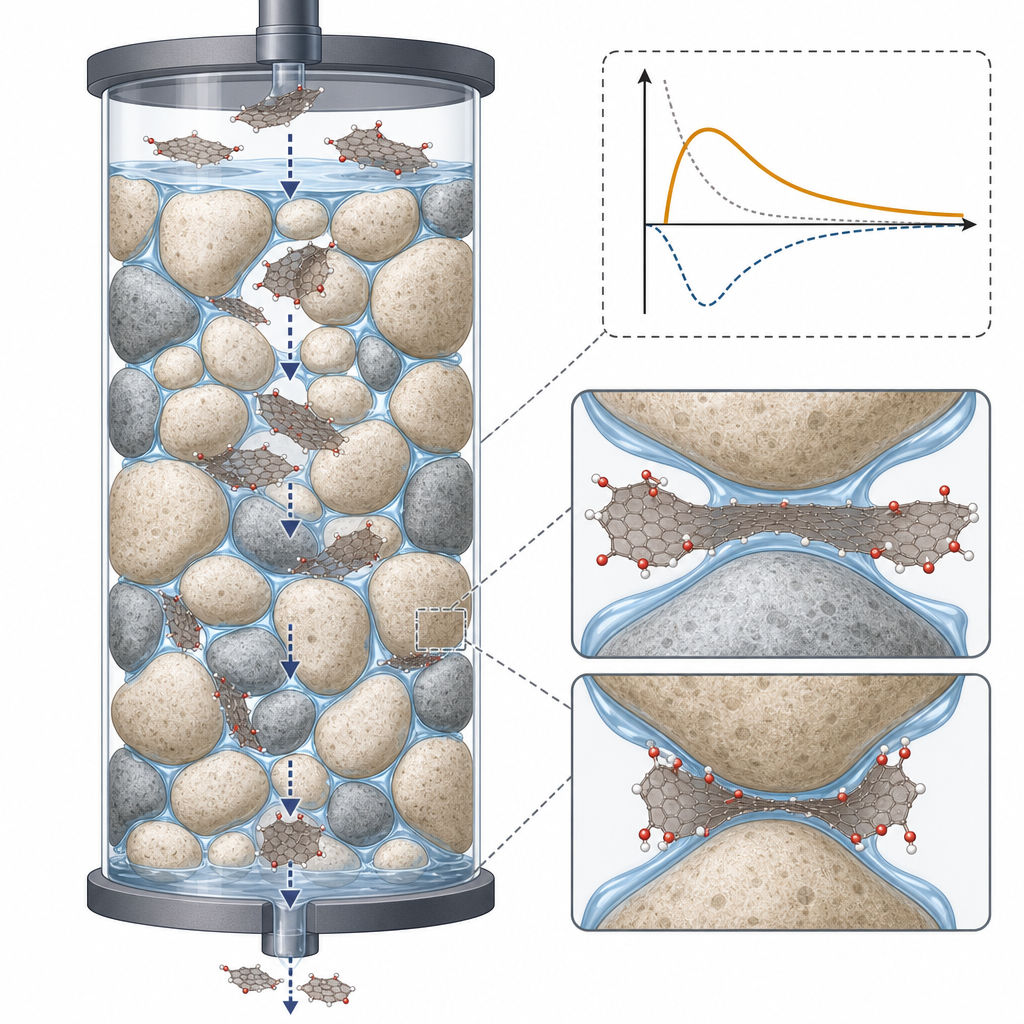
The environmental fate of graphene oxide has become an urgent question as production volumes scale. GO carries reactive oxygen functional groups that make it disperse readily in water, and its very high surface-area-to-mass ratio means that even modest concentrations released to soils or groundwater could facilitate co-transport of heavy metals, pesticides, and organic contaminants. Prior work had touched on GO transport in fully saturated sand, but the vadose (unsaturated) zone — the natural barrier between surface releases and aquifers — had not been studied. Because unsaturated systems contain air–water interfaces that can capture or repel nanoparticles, transport behavior cannot simply be extrapolated from saturated experiments. This paper addresses that gap and is now widely cited in the nanomaterial environmental risk and colloid transport literature.
The ACS Material product used was single-layer graphene oxide prepared by a modified Hummers method, with TEM-measured flake diameters of 0.5–5 μm and a thickness of 0.8–1.2 nm. The team used the powder as received, dispersing 12 mg into 1000 mL of NaCl electrolyte at three ionic strengths (1, 10, and 100 mM) and sonicating for 2 h with a Misonix S3000 ultrasonicator to ensure full exfoliation. GO concentrations were tracked by UV–Vis absorbance at 230 nm using a Thermo Evolution 60 spectrophotometer, while zeta potential and electrophoretic mobility were measured on a Brookhaven ZetaPlus. The GO suspensions were then injected into quartz-sand columns (0.5–0.6 mm grain size, acid-cleaned) packed at controlled moisture contents, and into a separate acrylic bubble column to probe GO–air–water interface interactions. Reproducible flake size and known surface chemistry of the ACS Material GO were essential for clean interpretation of the XDLVO and transport modeling.
Key results show GO transport is highly sensitive to ionic strength. At 1 mM NaCl, GO breakthrough in saturated sand columns was nearly complete, demonstrating high colloidal mobility consistent with strongly negative zeta potentials. Increasing the ionic strength to 10 mM and then 100 mM NaCl dramatically suppressed breakthrough and increased retention in the sand, behavior the authors traced to secondary-minimum deposition in the XDLVO interaction energy profiles between GO flakes and quartz grains. Recovery rates in unsaturated columns were systematically lower than in saturated columns at matched ionic strength, indicating that moisture content imposes an additional retention mechanism. Bubble column experiments showed essentially no attachment of GO to the rising air–water interface, ruling out air–water interface capture and consistent with XDLVO predictions of repulsion between GO and the interface. The authors therefore attributed the additional retention in unsaturated systems to film straining — physical trapping of micron-scale GO flakes in thin water films between grains. An advection–dispersion-reaction model fit the breakthrough curves accurately across all ionic strength and moisture combinations, yielding deposition rate coefficients usable in larger-scale transport simulations.
The practical applications are significant for environmental risk assessment of carbon nanomaterials. Results suggest that under low-salinity conditions typical of pristine freshwater aquifers, released GO could travel substantial distances, while saline groundwater and partially saturated vadose zones offer natural attenuation. The findings inform regulatory frameworks for industrial GO discharge and guide the design of engineered barrier systems. The same experimental and modeling approach now serves as a template for studying transport of related 2D materials including reduced graphene oxide, MXenes, and transition metal dichalcogenides, as well as functionalized derivatives used in water treatment, drug delivery, and energy storage.
For researchers working on colloid transport, environmental nanotechnology, or 2D material safety, this paper demonstrates how a well-characterized commercial graphene oxide enables reproducible mechanism-level studies. The ACS Material single-layer graphene oxide product line — including standard, large-size, and low-defect grades — remains available through ACS Material for groups extending this kind of work to more complex porous media, natural soils, or competing nanoparticle systems. Reproducible flake dimensions and surface chemistry are particularly valuable when results must be modeled with XDLVO theory or advection–dispersion-reaction frameworks.How ACS Material products were used
- Single Layer Graphene Oxide Flake (Graphene Series) — “Single layer graphene oxide (ACS Material), prepared by modified hummer's method, was used as received from the manufacturer. Transmission electron microscope (TEM), as measured by the manufacturer, demonstrated that the diameter range of GO particles was 0.5–5 μm with a thickness range of 0.8–1.2 nm.”
Product Performance in this Study
The ACS Material single-layer graphene oxide was the central subject of the study. Its 0.5–5 μm flake size and ~1 nm thickness provided a well-defined nanomaterial whose colloidal stability and transport behavior in porous media could be reproducibly characterized under varied ionic strength and moisture conditions.
Related product categories
Frequently asked questions
How does ionic strength affect graphene oxide transport in sandy aquifers?
Graphene oxide moves freely through quartz sand at low ionic strength (1 mM NaCl) because strong electrostatic repulsion between negatively charged GO flakes and sand grains prevents attachment. As NaCl concentration rises to 10 and 100 mM, the electrical double layer compresses, secondary-minimum wells deepen in the XDLVO interaction profile, and GO retention increases sharply. Saline groundwater therefore acts as a natural attenuation barrier for released GO.
Why is graphene oxide retained more in unsaturated soils than in saturated ones?
Recovery rates in unsaturated columns were systematically lower than in saturated columns at the same ionic strength. Bubble column tests showed GO does not attach to the air–water interface, so interfacial capture is not the cause. The authors attribute the extra retention to film straining: micron-scale GO flakes become physically trapped in thin water films connecting grain contacts when pore water content is low.
What size and thickness of graphene oxide were used in the porous media transport study?
The researchers used single-layer graphene oxide from ACS Material, prepared by a modified Hummers method. Manufacturer TEM data indicated flake diameters of 0.5–5 μm and thicknesses of 0.8–1.2 nm. Suspensions were prepared at 12 mg/L in NaCl electrolyte and sonicated for 2 h before injection into the sand columns to ensure complete exfoliation and reproducible colloidal dispersion.