
Walk into any pro shop and you will see it on the labels: graphene tennis rackets, graphene bike frames, graphene running shoes, graphene skis. The word has become shorthand for “high performance.” But what is graphene actually doing inside a racket or a helmet — and how much of the marketing is real? The honest answer is that graphene is neither magic nor a gimmick. Used correctly, a tiny amount blended into a composite measurably changes three things athletes care about: how stiff the gear is for its weight, how well it soaks up impact and vibration, and how long it survives repeated pounding. This article walks through the real materials science, with two interactive tools and peer-reviewed literature behind the key materials claims.
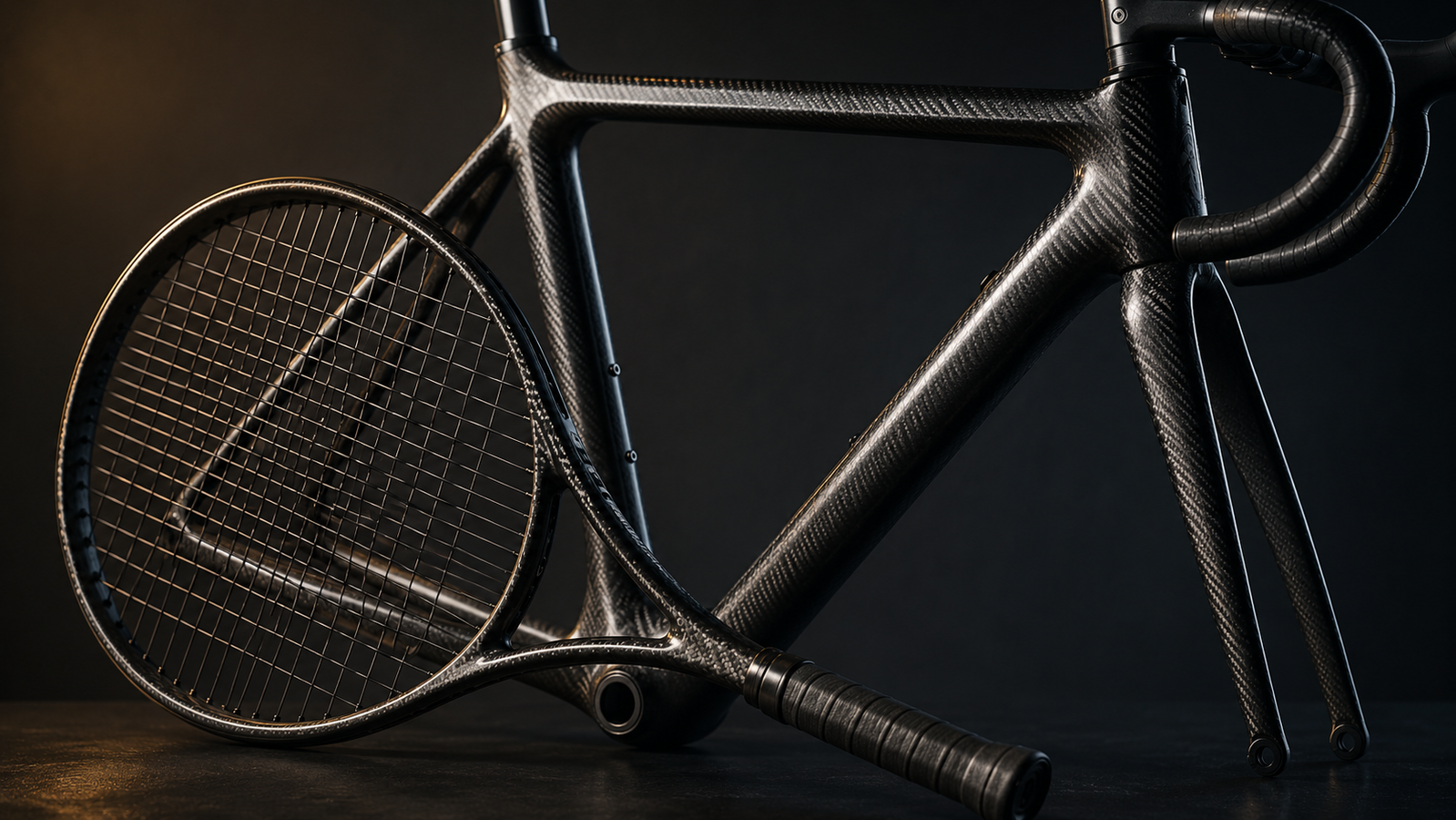
The problem every piece of gear is trying to solve
Sports equipment lives with a contradiction. It has to be light, so the athlete can move it fast and not tire — but it also has to be stiff and strong, so it does not flex wastefully, crack, or wear out. In most materials those two goals fight each other: making something stronger usually means making it heavier. This is the same trade-off that defines aerospace and, at the extreme, it is a fundamental tension in materials design — strength and toughness are often mutually exclusive, and buying more of one tends to cost you the other.1 Athletes feel this directly: a stiffer racket transfers more power but stings the arm; a lighter frame accelerates faster but can feel flimsy or fail sooner.
Graphene is interesting precisely because it pushes on this trade-off. It is a single layer of carbon atoms in a hexagonal lattice, first isolated in 2004,2 and it is simultaneously the strongest material ever measured — an intrinsic strength around 130 GPa and a stiffness near 1 TPa3 — while weighing almost nothing, since a square meter of the single sheet has a mass under a milligram. If you want the full story of where those numbers come from, see our complete guide to graphene. The catch, and the theme of this whole article, is that a finished racket is not made of graphene — it is made of carbon-fiber composite with a small fraction of graphene added to the resin. Understanding what that fraction does, and what it cannot do, is the key to reading the marketing honestly.
Killing the sting: vibration and impact
The most immediate place an athlete feels graphene is not in a lab number but in the hand. Ask a tennis player what they hate and they will say the sting — the buzz that travels into the wrist and elbow when the ball hits off-center. That buzz is the frame vibrating after impact, and how fast it dies away is set by the composite’s damping. Graphene helps here through a different mechanism than stiffening: the enormous surface area of the flakes creates vast internal interfaces where sheets and matrix rub microscopically under strain, dissipating vibrational energy as heat through interfacial “stick–slip” friction. Studies of graphene-filled polymers and fiber composites consistently report higher loss factors — the standard measure of damping — when graphene is added,4,5 with the improvement traced specifically to interfacial sliding at the graphene–matrix boundary.6 The same effect is being engineered into cement and coating systems for structural vibration control.7
The tool below turns this into something you can feel. It models the frame as a damped oscillator: after a hit, the vibration amplitude decays as it rings down, and adding graphene raises the damping ratio so the ringing stops in fewer cycles.
For protective gear the same energy-absorbing behavior matters even more. Graphene-like nanoflakes have been studied specifically for shock absorption,8 and reviews of protective helmets now list graphene among the materials being explored to improve impact performance.9 Some cycling-helmet makers have marketed graphene-enhanced shells or coatings, citing better force distribution and heat management. The honest caveat is that a helmet is a system — shell, liner, foam, fit — and graphene improves specific layers rather than rewriting the physics of head protection; the gains are real but incremental, not a substitute for good design.
How a pinch of graphene stiffens a composite
Damping is only half the story; the same graphene that quiets vibration also stiffens the frame, and that is what lets gear be light without going soft. The idea of dispersing graphene sheets into a matrix to build a composite goes back to the earliest days of the field.10 The mechanism is load transfer. When a composite part is stressed, the soft polymer matrix has to grip the stiff filler tightly enough that the load is actually carried by the strong graphene rather than slipping past it. Researchers have mapped this directly, using Raman spectroscopy to watch stress build from the edges of a single embedded flake toward its center, quantifying the interfacial shear that governs how efficiently reinforcement works.11 The mechanics of these nanocomposites — how much stiffening you get for a given loading — have been reviewed in detail.12,13
The practical upshot is that very small loadings do a lot, and the gains depend on getting the flakes well dispersed and well bonded. Across many studies, adding well under 1 wt% of graphene or graphene oxide to epoxy raises tensile strength and stiffness substantially: reports include tensile-strength gains of roughly 50% at 0.6 wt%,14 modulus and strength improvements that scale with dispersion quality,15 and comparisons showing graphene oxide and reduced graphene oxide each lifting both tensile and flexural properties,16 and similar reinforcement in non-epoxy matrices such as polypropylene.17 Beyond a low optimum the flakes clump and the benefit reverses, which is why studies repeatedly find a sweet spot of a fraction of a percent rather than “more is better.”18 The reason this matters for gear is the second-order consequence: if the material is stiffer, a designer can reach the same stiffness target with less material, and shed weight. The tool below makes that trade-off concrete.
One note on units: the simulator works in volume percent because the Halpin–Tsai model is volume-fraction based, whereas many experimental papers report graphene loading by weight percent. The two are not interchangeable, so read the tool as a teaching comparison rather than a direct conversion. Notice what the simulator is really showing. The stiffness gain does not come from a thick coating of graphene — it comes from a low volume fraction of high-aspect-ratio platelets, well aligned and well bonded, doing the classic composite job described by the Halpin–Tsai model. This is why the same physics that reinforces a Formula 1 chassis or an aerospace panel also reinforces a bike frame, and why the reinforcement grades sold for this work are graphene nanoplatelets and functionalized graphene oxide, chosen for large lateral size and good matrix compatibility.
Lasting longer: fatigue and crack resistance
Gear rarely fails on the first hit. It fails after thousands of them, as tiny cracks grow with each loading cycle — the process called fatigue. This is where graphene’s flat, wide sheets do something structurally clever: when a crack tries to advance through the matrix, it runs into graphene platelets that force it to deflect, bow, and take a longer, more tortuous path, absorbing energy along the way. A landmark study found that just 0.125 wt% of functionalized graphene raised the fracture toughness of epoxy by about 65% and slowed fatigue crack growth roughly 25-fold.19 Later work reported fracture-toughness gains above 140% at low loadings with matching fatigue-life improvements,20 and in fiber-reinforced laminates — the actual construction of a racket or frame — adding graphene nanoplatelets has boosted bending-fatigue life dramatically at optimum loadings.21 Graphene is not the only nanofiller studied this way; the dimensions and dispersion of the filler strongly control the fatigue benefit.22 Radially grown graphene nanoflakes on carbon fiber have been used to make composites that are simultaneously tougher and stronger,23 attacking the strength–toughness conflict head-on.
It is worth noting where the limits are. Graphene itself is astonishingly fatigue-resistant — freestanding sheets survive over a billion loading cycles at stresses no other material tolerates24 — but a composite’s durability is still governed by the matrix and the interface, so real gear benefits by a large but finite margin, not by graphene’s intrinsic ceiling. For the underlying strength story and how a perfect flake’s numbers differ from a real part’s, see our overview of graphene’s strength.
Beyond hard goods: temperature-managing sportswear
Graphene’s role in sport is not limited to rigid equipment. Its thermal conductivity is among the highest of any material — measurements of a suspended single layer put it near 5000 W m⁻¹ K⁻¹25 — which makes it attractive for fabrics that manage body heat — the same multifunctional pairing of thermal, electrical, and mechanical gains seen when graphene oxide is added to carbon/epoxy laminates.26 Coated or printed onto textile fibers, graphene helps spread heat across the garment, and researchers have developed scalable methods to apply reduced graphene oxide to fabric at production speeds while keeping it soft and washable.27 The same conductivity enables smart sportswear: inkjet- and screen-printed graphene patterns turn ordinary fabric into flexible sensors and conductors,28,29 and reviews of textile-based sports monitoring describe garments that track motion and physiology without rigid electronics.30 Companies now sell graphene-enhanced base layers and jackets on exactly these thermal-comfort claims. As always, performance depends on how the graphene is applied and how much survives washing, not on the label alone. The full breadth of graphene’s uses, from electronics to energy, is covered in our graphene properties overview.
Reading the label: real gains versus “graphene-infused” hype
Here is the part the marketing usually skips. Because graphene works at fractions of a percent and its benefit depends entirely on dispersion, alignment, and interfacial bonding, two products both labeled “graphene” can perform very differently. A recent review of graphene in sports equipment stresses that outcomes vary widely with the specific material and manufacturing process,4 and the broader literature is unambiguous that poorly dispersed or over-loaded graphene can do nothing — or even weaken a part as agglomerates seed the very cracks graphene is supposed to stop.18 The term “graphene-infused” carries no guarantee of structural benefit; it can describe a carefully engineered composite or a token addition with no measurable effect.
So how should a buyer or a designer think about it? Treat graphene as a real but conditional upgrade. Ask whether the manufacturer describes how the graphene is integrated and what property actually improved — stiffness, damping, fatigue life — rather than just invoking the word. Look for independent testing where it exists. And keep expectations proportionate: graphene will not turn an amateur into a champion, but at the right loading it delivers measurable, repeatable improvements in weight-for-stiffness, vibration comfort, and durability. Those are exactly the properties this article’s two simulators isolate, and exactly the reason serious equipment makers keep reaching for it. For the reinforcement materials themselves, ACS Material supplies research-grade graphene products — including nanoplatelets and graphene oxide grades formulated for composite work — to the labs and manufacturers turning this science into gear.
References
This article is provided by ACS Material LLC for educational purposes and describes the use of graphene and graphene-related materials in sports and athletic equipment, including composite reinforcement, vibration damping, impact protection, fatigue resistance, and temperature-managing textiles. Property values — strength, stiffness, damping loss factor, thermal conductivity, and the like — are representative figures drawn from the referenced studies and describe idealized single sheets or specific laboratory samples; a real racket, frame, or fabric uses a small fraction of graphene in a composite, and its performance depends on the graphene grade, loading, dispersion, alignment, and manufacturing process. The interactive tools are simplified teaching aids based on the stated models — a damped-harmonic-oscillator ring-down and a Halpin–Tsai stiffness-to-weight estimate — and are not predictive engineering software. Consult product datasheets and safety data sheets for material specifications and handling guidance.