There is no single price for graphene, because "graphene" is not one product. Depending on what you actually buy — a kilogram of graphene-oxide powder or a few square centimeters of monolayer film on copper — the price per gram can differ by a factor of thousands. This guide explains what really drives the cost: the production method, the form, the purity and layer count, and the quantity you order. It gives honest, order-of-magnitude ranges and shows how to match the grade to your application so you do not overpay.
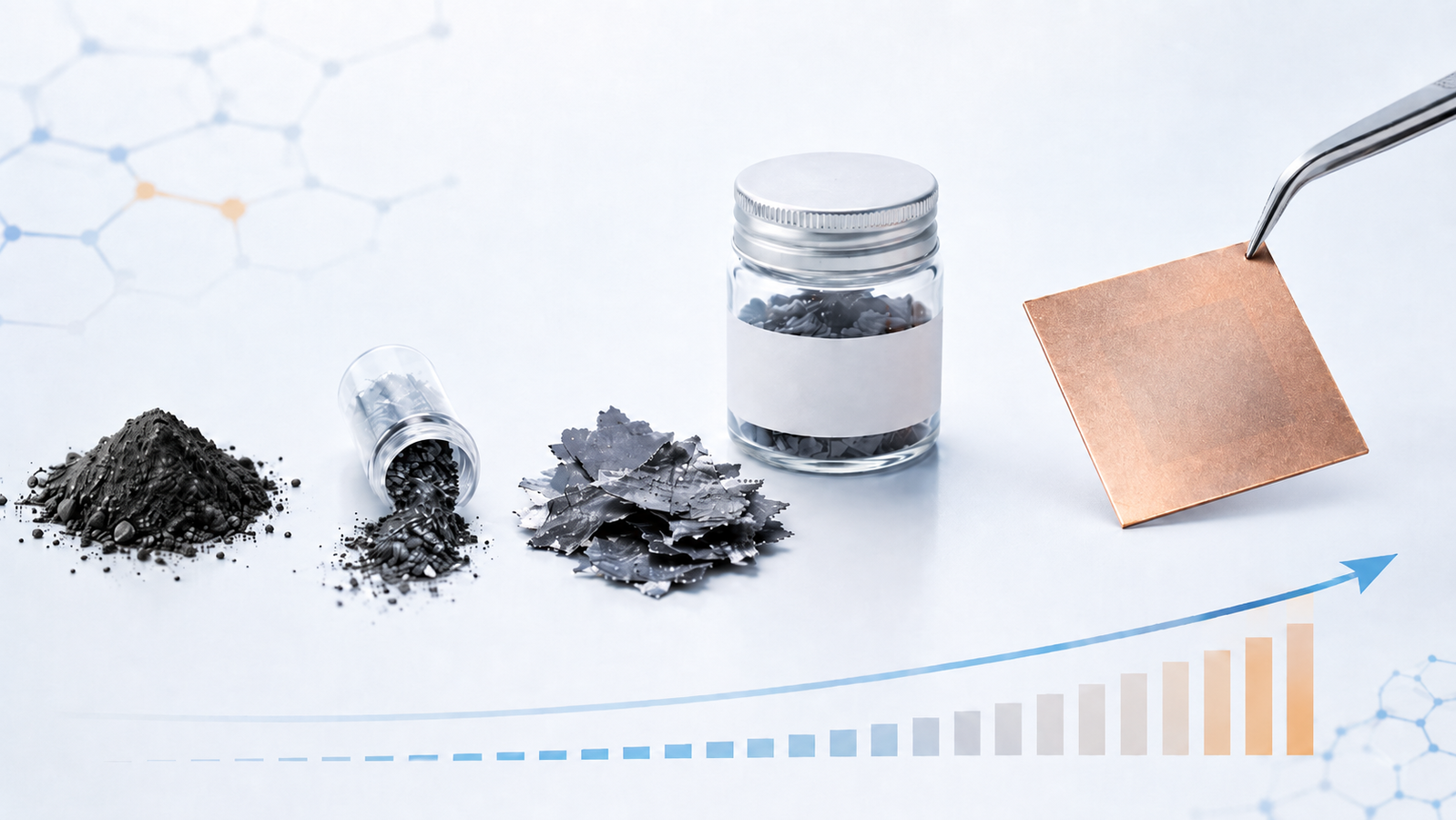
Short answer: graphene materials span an enormous range, and prices have fallen year over year. Bulk powders are the affordable end — graphene nanoplatelets run roughly $10–50 per gram in small research quantities and toward $0.10 per gram in industrial bulk, while graphene oxide runs about $50–200 per gram research-grade and a fraction of that in bulk. Functionalized flakes cost more. CVD film is the premium tier, priced by area rather than weight, so you buy a sheet or wafer, not a mass of carbon. Price is set by four things: production method, form, purity and layer count, and quantity. The figures here are indicative 2026 market ranges for orientation, not quotes — see the linked product pages or request a quote for exact, grade-specific pricing.
Why there is no single price for graphene
Graphene was first isolated in 2004, and within a few years its extraordinary properties — an intrinsic strength near 130 GPa, high electrical and thermal conductivity, and a stiffness approaching 1 TPa — had made it one of the most studied materials in science.1,2,3 That fame is exactly why the question "how much does graphene cost?" rarely has a satisfying answer: the word covers a whole family of materials made by very different processes, at very different quality levels, sold in very different formats.
A pristine single-layer sheet grown by chemical vapor deposition and a tonne of graphene-oxide powder are both called "graphene" in casual use, yet they are not interchangeable and their prices are separated by orders of magnitude. So the useful question is not "what does graphene cost?" but "what does the specific graphene material my application needs cost, at the quantity I need?" The rest of this guide answers that.
First, what are you actually buying?
Before comparing prices, it helps to separate the materials, because a common mistake — one that leads to wildly wrong cost expectations — is to treat graphene and graphene oxide as the same thing. They are not.4
- Monolayer / few-layer graphene — the pristine, conductive carbon sheet. Usually grown by CVD as a film, or exfoliated into flakes. Highest performance, highest price.
- Graphene nanoplatelets (GnP) — small stacks of a few graphene layers in powder form. They keep much of graphene's behavior but are far cheaper to make and easier to handle, which makes them the workhorse filler for composites.
- Graphene oxide (GO) — graphene decorated with oxygen groups. It is water-dispersible and inexpensive to produce in bulk by chemical oxidation, but it is electrically insulating until reduced. GO and graphene are chemically different materials with different price points.
- Reduced graphene oxide (rGO) — GO that has been chemically or thermally reduced to recover much of its conductivity. It sits above GO in cost and carries residual defects.
- Functionalized flakes — graphene or GO with added surface chemistry (for example carboxyl graphene) for compatibility with a specific resin or solvent. The extra processing raises the price.
- CVD film on a substrate — monolayer or few-layer graphene transferred onto copper, quartz, PET, or other carriers (for example graphene on copper foil or graphene on PET). Priced by area, this is the premium tier.
Keep this list in mind: almost every price difference below traces back to which of these you are buying. You can browse all of them in the graphene series.
Cost driver 1: the production method
How graphene is made is the single largest factor in its price. Production routes split into two families, and the literature on graphene synthesis describes a persistent trade-off between quality, cost, and scalability that no single method yet escapes.5
Bottom-up (build the sheet atom by atom). Chemical vapor deposition (CVD) grows graphene layer by layer on a metal substrate from a carbon-containing gas. It produces large, high-quality, low-defect films that are ideal for electronics and transparent conductors — but the high-temperature furnaces, vacuum systems, precise process control, and the transfer step needed to move the film onto a usable carrier all make it expensive, and it yields only modest quantities of material.5,6 Epitaxial growth on silicon carbide gives excellent quality too, but the SiC wafers and very high temperatures push the cost higher still.5
Top-down (break graphite down into graphene). Liquid-phase exfoliation (LPE) uses sonication, shear, or ball-milling to peel graphene flakes off inexpensive graphite in a solvent. It is cheap, scalable to large volumes, and well suited to composites, coatings, and conductive inks, though the flakes are typically few-layer and carry more defects and a wider size distribution than CVD material.5,7 Chemical oxidation (the Hummers method and its variants) converts graphite to graphene oxide in bulk; it is the most scalable and lowest-cost route of all, which is why GO powders are among the most affordable graphene materials.8 Mechanical exfoliation — the original "Scotch-tape" method — produces nearly perfect single-layer flakes, but only in microscopic amounts, so it is a research technique, not a commercial supply route.1,5
In short: the methods that give the highest quality (CVD, epitaxy) are the most expensive and lowest-volume, while the methods that scale cheaply (exfoliation, oxidation) trade away some quality. That trade-off is the backbone of graphene pricing. The map below places the main routes on a quality-versus-scale field, colored by cost — tap a method to see where it wins.
The graphene cost ladder
The simulator below puts the common graphene materials on a single relative-cost scale. Because prices span several orders of magnitude, the axis is logarithmic; each rung is an indicative position, not a quote. Select a material to see what drives its price and which production route it comes from.
The ladder makes the headline point visible: graphite and graphene-oxide powders sit at the bottom, graphene nanoplatelets and reduced GO a step up, functionalized flakes higher still, and CVD films at the top — with each tier reflecting how much processing, how much quality control, and how much yield loss went into the material.
Cost driver 2: form and format
The same material can cost very differently depending on how it is delivered.
Powders, flakes, and dispersions are sold by mass (per gram or per kilogram). This is the most economical way to buy graphene-family material, which is why graphene oxide and nanoplatelet powders dominate composite, coating, and energy-storage use. Dispersions add the cost of the solvent and the stabilization step, but save you the difficult job of dispersing dry powder yourself.
Films on a substrate are sold by area (per sheet or per cm²), because what you are paying for is a continuous, transferred monolayer — not a weight of carbon. A film weighs almost nothing, so quoting it per gram would be meaningless; this is one reason CVD pricing looks so different from powder pricing. The substrate (copper, quartz, PET, SiO₂/Si) and the number of layers also change the price.
Understanding the unit of sale — per gram versus per cm² — is essential before comparing two quotes, because a "per gram" figure and a "per sheet" figure are simply not the same kind of number.
Cost driver 3: purity, layer count, and defects
Within any one material, grade drives price. Three things matter most:
Purity. Higher carbon purity, lower ash and residual-metal content, and tighter batch-to-batch consistency all cost more to achieve and to verify. Research-grade material held to narrow specifications is more expensive than industrial-grade material that meets a looser standard.
Layer count. True monolayer coverage is harder to produce and confirm than few-layer or multilayer material, so monolayer grades command a premium. For many composite and coating uses, few-layer material performs perfectly well at a fraction of the cost.
Defects and functionalization. Fewer defects (verified by Raman spectroscopy and microscopy) cost more, and any added surface chemistry — carboxyl, amine, or other groups — adds processing steps and therefore price. You are paying for the characterization and quality control as much as for the carbon itself.
Cost driver 4: quantity and economies of scale
Like most specialty materials, graphene gets cheaper per gram as you buy more. Small research quantities carry the fixed costs of synthesis, characterization, and packaging spread over very little material, so the per-gram price is high. Larger orders amortize those fixed costs and unlock more efficient production, so the unit price falls — often steeply at first, then leveling off. The simulator below shows that pattern.
The practical takeaway: a price you see for a one-gram research vial is not the price you will pay per gram for a kilogram-scale order. If you are scaling a product, ask the supplier for volume pricing rather than multiplying the small-quantity figure.
What graphene actually costs today — and where prices are heading
With the four drivers in mind, here are indicative 2026 market ranges to set expectations. They are wide because they depend on grade and quantity, and they have been falling year over year — so treat them as orientation, not a fixed quote. Where exact figures matter, follow the product links or request a quote.
Bulk powders — the affordable end. Graphene nanoplatelets in small research quantities commonly run about $10–50 per gram, falling toward roughly $0.10 per gram for industrial bulk. Graphene oxide is similar in spirit: about $50–200 per gram for research-grade material, dropping to well under a dollar per gram — on the order of $1,000 per kilogram or less — in industrial lots, with reduced GO sitting a little higher. As a concrete anchor, ACS lists graphene-oxide grades from around $100 per package, with premium and large-size grades costing more; browse graphene oxide and the wider graphene series for current pricing.
Functionalized flakes — a premium step. Carboxyl, amine, or other surface chemistries (for example carboxyl graphene) add processing, so they sit above plain powders — valuable where compatibility with a specific resin or solvent matters.
CVD film — the premium tier, priced by area. Expressed per gram a monolayer film looks astronomically expensive (hundreds to thousands of dollars per gram), but that number is misleading, because film is sold by area, not weight. In practice you buy a sheet — from a 10×10 mm chip up to a 4-inch or larger wafer — on copper, quartz, PET, or SiO₂/Si. Film is sold by the sheet on these substrates, and per-area prices have trended downward over the years as wafer-scale growth and transfer have matured. See CVD graphene.
Where prices are heading. Graphene follows the familiar path of a material scaling from the laboratory to industry: as cumulative production grows, unit prices fall — the so-called price learning curve. The steepest declines have been in bulk nanoplatelets and graphene oxide, where capacity has expanded fastest, and market-research firms cite falling production cost as a primary reason the overall market is growing at double-digit annual rates.9,10,11 Industry analyses expect bulk graphene to keep moving toward commodity-like pricing — on the order of tens of dollars per kilogram later this decade — and CVD film toward steadily lower per-area prices as wafer-scale growth and transfer mature. The milestone the industry watches is bulk graphene reliably below about one dollar per gram, the point at which it becomes economical for mass-market uses such as coatings, tires, concrete, and automotive composites rather than only high-value niches. None of this is guaranteed — graphite-supply or energy shocks can push the other way — but the multi-year direction has clearly been downward.
Research-grade vs industrial-grade: match cost to your application
The most common way buyers overpay is by purchasing more quality than their application needs. Matching grade to use is the simplest way to control cost.
If you make composites, coatings, inks, or electrodes: bulk powders — GnP, GO, or rGO — usually deliver the performance you need (stiffness, barrier, conductivity, or surface area) at the lowest cost. Few-layer, industrial-grade material is often ideal here, and pristine monolayer quality would be wasted expense.
If you build electronics, sensors, or transparent conductors: a continuous, low-defect CVD film is usually essential, and its higher price buys the layer uniformity and electrical quality those devices require. Here, paying for monolayer film is paying for exactly what the application needs.
If you do fundamental research: you may need small quantities of well-characterized, high-purity material, where consistency matters more than unit price.
In every case, the question to ask is not "what is the cheapest graphene?" but "what is the cheapest material that meets my specification?" Often that answer is a powder, not a film.
Getting an accurate quote — and lowering your cost
Because so much depends on grade, format, and quantity, the only way to get a real number is to specify what you need. A few practical steps keep the cost down:
Specify the material and grade precisely. State whether you need monolayer or few-layer, powder or film, a particular purity, lateral size, or surface chemistry. A precise specification avoids paying for performance you will not use.
Buy at the right scale. If you are past the screening stage, ask for volume pricing rather than ordering many small vials. Per-gram cost usually drops sharply with quantity.
Talk to the supplier early. A good supplier can often suggest a more economical grade that still meets your requirement, or point you to a standard product instead of a custom one. For grade-specific pricing, browse the graphene series or CVD graphene product pages, or request a quote with your specification and quantity.
Frequently asked questions
Why is graphene so expensive?
The premium forms are expensive because the methods that make high-quality graphene — CVD growth and epitaxy — need costly equipment, precise control, and a transfer step, and they yield only small quantities. But not all graphene is expensive: graphene-oxide and nanoplatelet powders, made by scalable chemical routes, are among the more affordable advanced materials. "Expensive" depends entirely on which form you mean.
How much does graphene cost per gram?
It depends on the material. In small research quantities, graphene nanoplatelets are commonly about $10–50 per gram and graphene oxide about $50–200 per gram; in industrial bulk both fall sharply, toward or below $1 per gram. CVD film is not sold by weight at all — it is priced by area, per sheet or wafer. These are indicative 2026 ranges, not quotes; request a quote for exact, grade-specific pricing.
Why is CVD graphene more expensive than graphene powder?
CVD grows a continuous, low-defect film one layer at a time in a high-temperature, controlled process, then that film must be transferred onto a usable substrate. The equipment, process control, low yield, and transfer step all add cost, and you are buying a precise continuous sheet rather than a weight of flakes. Powders are made by cheaper, higher-volume routes, so they cost far less.
What is the difference in price between graphene and graphene oxide?
They are different materials. Graphene oxide is produced in bulk by chemical oxidation of graphite and is inexpensive, but it is electrically insulating until reduced. Pristine graphene — especially CVD film — performs far better electrically and costs much more. Comparing their prices directly only makes sense once you have decided which one your application actually requires.
Is cheaper graphene lower quality?
Not necessarily — it is usually different quality, optimized for a different use. Few-layer exfoliated flakes and GO powders carry more defects than CVD monolayer film, but for composites, coatings, and energy storage those characteristics are perfectly acceptable, and the lower price reflects a cheaper production route rather than a defective product. The right question is whether the material meets your specification.
How can I reduce the cost of graphene for my project?
Match the grade to your application instead of buying the highest quality by default; choose few-layer or industrial-grade material when it meets your needs; buy at volume to lower the per-gram price; and give the supplier a precise specification so they can recommend the most economical option. For composites and coatings, a powder is almost always cheaper and sufficient compared with film.
References
This article is provided by ACS Material LLC for educational purposes and describes graphene and graphene-family materials (monolayer and few-layer graphene, graphene nanoplatelets, graphene oxide, reduced graphene oxide, functionalized flakes, and CVD films). All prices and ranges given are indicative, order-of-magnitude figures for orientation only; actual pricing depends on grade, form, purity, layer count, quantity, and market conditions, and changes over time. Property values cited — such as the strength, stiffness, and conductivity of an ideal single sheet — refer to idealized or single-layer graphene and the specific studies referenced; real powders, flakes, films, and composites will differ. Nothing here is a price quote; consult the linked product pages and request a quote for current, grade-specific pricing and specifications. The interactive simulators are schematic teaching tools that illustrate relative cost relationships, not predictive pricing software.