-
Nanomaterials for Lateral Flow Assays - ICN2/BIST, 2022
May 20, 2026 | ACS MATERIAL LLCSena-Torralba, A., Álvarez-Diduk, R., Parolo, C., Piper, A., & Merkoçi, A. (2022). Toward next generation lateral flow assays: integration of nanomaterials. *Chemical Reviews*. https://doi.org/10.1021/acs.chemrev.1c01012
CSIC and The Barcelona Institute of Science and Technology (BIST) · Chemical Reviews · 2022
ICN2/BIST review in Chem. Rev. shows how gold, quantum dot, carbon, magnetic and nanodiamond labels boost LFA sensitivity up to 10^5-fold for point-of-care diagnostics.
About this research
Researchers at CSIC and The Barcelona Institute of Science and Technology (BIST), writing in Chemical Reviews (2022), present a comprehensive analysis of how nanomaterial integration—gold nanoparticles, quantum dots, magnetic Fe3O4 beads, carbon nanotubes, and fluorescent nanodiamonds—transforms lateral flow assays (LFAs) into next-generation point-of-care diagnostics. The review by Sena-Torralba, Álvarez-Diduk, Parolo, Piper, and Merkoçi maps strategies that deliver sensitivity gains ranging from 10-fold to 10^5-fold over conventional AuNP-based strips, while enabling multiplexing of up to 13 targets and quantitative readouts compatible with smartphones, magnetic readers, thermal contrast cameras, and surface-enhanced Raman scattering (SERS) systems.
Lateral flow assays are the most widely deployed point-of-care diagnostic format, used in pregnancy tests, COVID-19 antigen tests, drug-of-abuse screens, and environmental pathogen monitoring. Yet their core architecture, established decades ago, struggles to meet the WHO ASSURED criteria when biomarkers occur at sub-picomolar concentrations or when samples are optically complex. Sensitivity, multiplexing, and quantification have become the three persistent bottlenecks. By systematically benchmarking nanomaterial-enabled solutions against these limitations, the review provides researchers and assay developers with a decision framework for selecting reporters, flow modifiers, and signal transduction methods aligned with clinical, environmental, or food-safety applications.
The authors organize the nanomaterial toolkit around four functional roles. As signal transducers, gold nanoparticles remain the colorimetric workhorse, but the review documents how alternatives outperform them: carbon nanoparticles yield 3.8-fold lower limits of detection for E. coli, multi-walled carbon nanotubes (MWCNTs) deliver 10-fold gains for methamphetamine detection, and CdSe/ZnS quantum dot nanobeads enable fluorescent readouts at 22 pfu/mL for influenza A. As preconcentrators, superparamagnetic iron oxide nanoparticles (SPIONs) functionalized with antibodies achieve enrichment factors up to 40 and 4000-fold sensitivity gains for valosin-containing protein. As signal amplifiers, AuNPs decorated with ultrathin Pt skins or porous platinum core–shell nanocatalysts (PtNCs) catalyze TMB oxidation to push p24 detection to 0.8 pg/mL. As exotic reporters, fluorescent nanodiamonds coupled with microwave-modulated stripline resonators achieve sub-attomolar (8×10^−19 M) detection of HIV-1 RNA—10^5 times more sensitive than AuNPs.This authoritative Chemical Reviews survey from the ICN2/BIST group maps out how nanomaterial labels — colorimetric gold, fluorescent quantum dots, and upconverting nanoparticles — determine the sensitivity and detection limit of a lateral flow assay. In its discussion of luminescent reporters, the Review cites ACS Material’s technical resources on upconverting nanoparticles. ACS Material supplies oil-dispersible, ligand-free, and surface-modified UCNPs (and a full range of gold/silver nanoparticles) for researchers building next-generation diagnostic assays. Explore our Upconverting Nanoparticles to develop higher-sensitivity LFA reporters of your own.
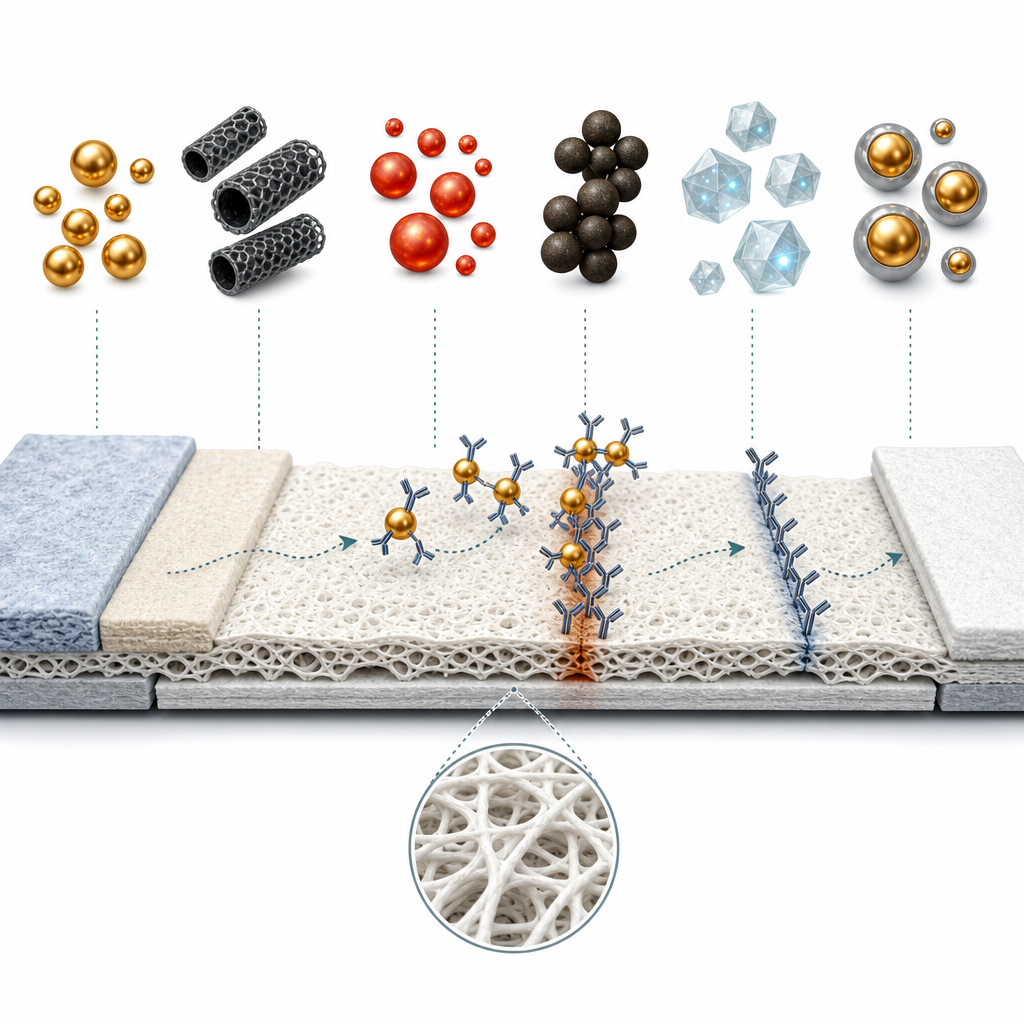
Quantitative performance data populate the review's comparison tables. Cellulose nanofiber aerogels inserted after the conjugate pad slow capillary flow and improve LoDs 1000-fold for mouse IgG. Wax-printed dissolvable barriers deliver 51.7-fold gains for HIgG. Silver staining of bound AuNPs gives 10-fold sensitivity boosts for cardiac troponin I; HRP-conjugated AuNPs add another order of magnitude for HIgG; Pt-coated AuNPs deliver 100-fold gains for PSA. SERS readouts using Fe3O4@Ag magnetic SERS nanotags loaded with DTNB combine preconcentration and signal enhancement for 2000-fold improvements in H1N1 and HAdV detection. Multiplexed formats reach 13 HPV clades, 10 foodborne pathogens, and three cardiac biomarkers in a single strip, with SERS-based AgNBA@Au nanotags spanning six orders of magnitude in dynamic range. Thermal contrast amplification, leveraging the photothermal conversion of plasmonic nanoparticles, achieves 8-fold to 12-fold gains for influenza, malaria, C. difficile, and hCG using portable infrared readers.
Applications span clinical diagnostics, environmental monitoring, and food safety. Cardiac biomarker panels (myoglobin, cTnI, CK-MB), respiratory virus detection (SARS-CoV-2 IgG/IgM, influenza A, H1N1), bacterial pathogen surveillance (E. coli, Salmonella, Cronobacter sakazakii), water quality (E. coli at 10^4 CFU/mL after on-chip filtration), and allergen screening (casein, ovalbumin, hazelnut proteins in biscuits) all benefit from the strategies catalogued. The review also points to emerging directions: paper-based electrophoretic LFAs for tunable flow control, proteinticle bioreceptors for oriented antigen presentation, bacteriophages as antibody alternatives, and machine-learning frameworks for optimizing microarray spot configurations and interpreting multiplexed results.
For researchers building nanomaterial-based diagnostic platforms, this review consolidates the key reporter chemistries and processing strategies in one place. ACS Material supplies many of the relevant building blocks, including gold and silver nanoparticles, CdSe/ZnS quantum dots, fluorescent nanodiamonds, Fe3O4 magnetic nanoparticles, multi-walled and single-walled carbon nanotubes, and upconverting nanoparticles with PEG, COOH, or NH2 surface functionalization. Researchers working on next-generation lateral flow assays, biosensors, or point-of-care diagnostics will find these materials catalogued and available in research-scale quantities suited to assay prototyping.How ACS Material products were used
- Carbon Nanoparticles and Multi-Walled Carbon Nanotubes (Carbon Series) — “Porras et al. have reported a 3.8-fold lower LoD when using carbon nanoparticles compared to AuNPs... Sun et al. have reported that the use of multiwalled carbon nanotubes (MWCNTs) in LFAs can provide a 10-fold sensitivity enhancement.”
- Fluorescent Nanodiamonds (Quantum Diamonds) — “the use of fluorescent nanodiamonds by Miller et al... With this approach, the authors achieve sub-attomolar (8 × 10⁻¹⁹ M) limits of detection in a model biotin LFA, 10^5 times more sensitive than the detection obtained with AuNPs.”
- Gold Nanoparticles (AuNPs) for LFA labeling (Nanoparticles Series) — “Most commercial LFAs rely on the use of low-cost colorimetric AuNPs or dyed beads that quickly generate an optical signal that can be directly inspected by the naked eye.”
- Quantum Dots and Upconverting Nanoparticles (Quantum Dots & Upconverting Nanoparticles) — “Quantum dots (QDs) are among the most used labels due to their narrow emission peaks and high quantum yield... affordable infrared laser diodes for the excitation of upconverting nanoparticles (UCNPs).”
- Superparamagnetic Iron Oxide Nanoparticles (Fe3O4 / SPIONs) (Nanoparticles Series) — “Son Le et al. have used superparamagnetic iron oxide nanoparticles (SPIONs) that provide a magnetic enrichment factor (φ) = 40, for the detection of C-reactive protein.”
Product Performance in this StudyAuNPs are reviewed as the benchmark colorimetric label in lateral flow assays, with multiple sensitivity-enhancement strategies (silver staining, Pt coating, enzyme conjugation) benchmarked against AuNP-based LFAs.
Related product categories
Frequently asked questionsHow do nanomaterials improve lateral flow assay sensitivity?
Nanomaterials boost LFA sensitivity through four mechanisms: stronger signal transduction (quantum dots and fluorescent nanodiamonds deliver up to 10^5-fold gains over gold nanoparticles), preconcentration (SPIONs enrich analytes 40-fold), signal amplification (Pt-coated AuNPs and HRP-conjugated AuNPs catalyze chromogenic substrates), and flow modulation (cellulose nanofiber aerogels increase reaction time). Combined, these approaches push limits of detection into the picogram-per-milliliter or sub-attomolar range for clinical biomarkers.
What nanoparticles are used as labels in point-of-care lateral flow tests?
The most common LFA labels are 20–40 nm gold nanoparticles for colorimetric readout. For higher sensitivity, researchers use CdSe/ZnS quantum dots and upconverting nanoparticles for fluorescence, Fe3O4 magnetic nanoparticles for magnetic particle quantification, carbon nanoparticles and multi-walled carbon nanotubes for stronger black contrast, silver-coated gold for SERS, and fluorescent nanodiamonds for ultra-low detection limits in microwave-modulated readers.
Why are magnetic nanoparticles important for lateral flow assay performance?
Magnetic nanoparticles serve two roles in LFAs. First, they preconcentrate target analytes from dilute or complex samples, with enrichment factors of 40 enabling 26-fold to 4000-fold sensitivity gains. Second, they provide volumetric magnetic readout that is unaffected by sample opacity and offers dynamic ranges spanning up to seven orders of magnitude, making them especially valuable for biological matrices like whole blood or serum where colorimetric detection fails.