-
Photothermally Reduced Graphene Anodes - Rensselaer Polytechnic Institute, 2012
May 22, 2026 | ACS MATERIAL LLCMukherjee, R., Thomas, A. V., Krishnamurthy, A., & Koratkar, N. (2012). Photothermally Reduced Graphene as High-Power Anodes for Lithium-Ion Batteries. *ACS Nano*. https://doi.org/10.1021/nn303145j
Rensselaer Polytechnic Institute · ACS Nano · 2012
Rensselaer researchers use ACS Material graphene oxide to make photothermally reduced graphene paper anodes delivering 156 mAh/g over 1000 cycles at 40 C.
About this research
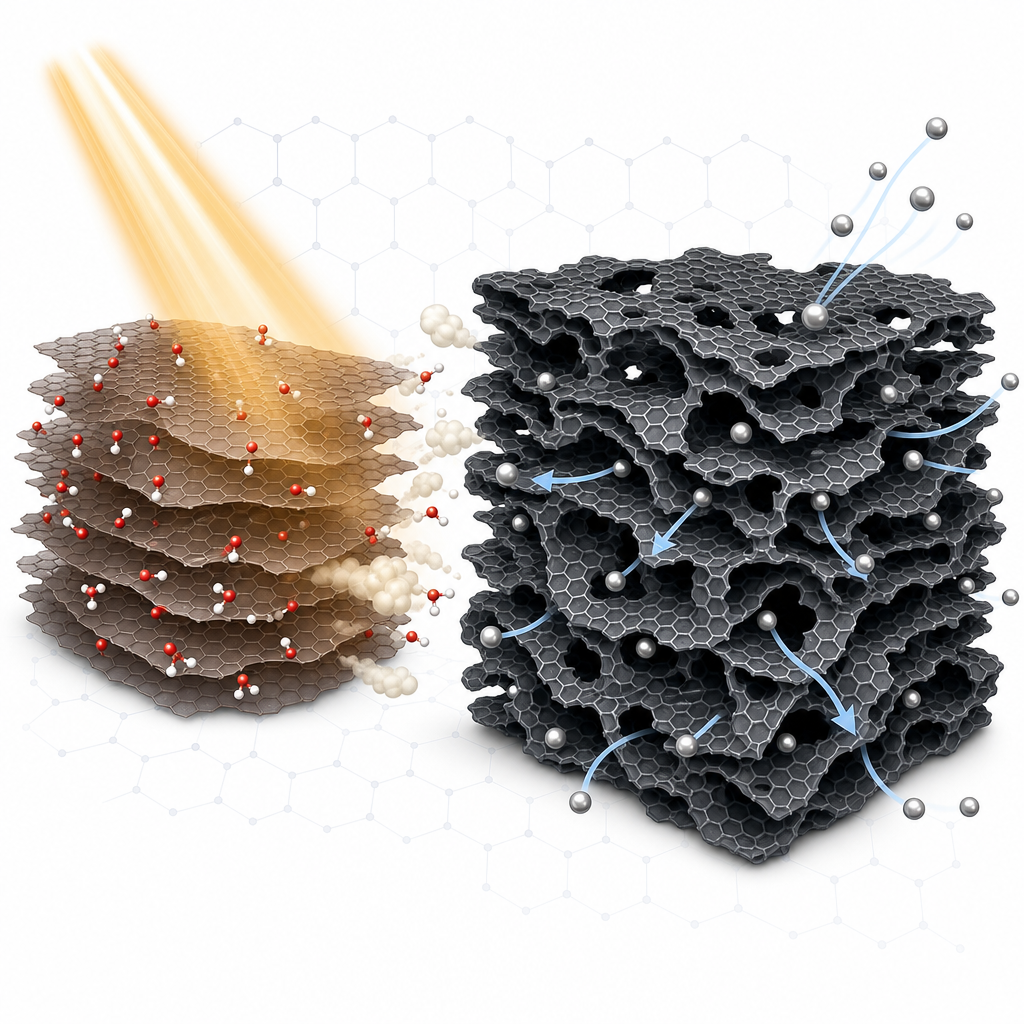
Researchers at Rensselaer Polytechnic Institute used aqueous graphene oxide dispersion supplied by ACS Material as the starting material to produce photothermally reduced, free-standing graphene paper anodes that delivered a stable capacity of about 156 mAh/g over 1000 charge/discharge cycles at ~40 C and an outstanding power density near 10 kW/kg. Published in ACS Nano in 2012 by Mukherjee, Thomas, Krishnamurthy, and Koratkar, the paper demonstrates that simple photoflash and laser reduction of vacuum-filtered graphene oxide paper produces an expanded, porous carbon architecture that supports lithium intercalation kinetics at extreme charge/discharge rates exceeding 100 C, addressing one of the most stubborn limitations of conventional graphitic anodes.
Lithium-ion batteries dominate portable electronics and are central to the electrification of transportation, but conventional graphitic anodes cannot deliver the power densities required for electric vehicles, plug-in hybrids, and grid-buffering applications. Slow solid-state diffusion of Li+ through bulk graphite limits how quickly cells can be charged or discharged without sacrificing capacity or cycle life. Nanostructured anodes shorten Li+ diffusion paths, but they are typically difficult to scale and often deliver too little active mass per unit area to assemble practical cells. A high-power anode that is both mass-scalable and stable over thousands of cycles would unlock fast-charging battery designs for transportation and stationary storage, which is precisely the gap this paper targets.
The ACS Material graphene oxide dispersion (10 mg/mL in deionized water) was the central precursor. The authors diluted it to 0.2 and 2 mg/mL, sonicated each solution for one hour in a Bransonic ultrasonic cleaner to ensure homogeneous dispersion, then centrifuged at 6000 rpm for 30 min to remove heavier aggregates. The supernatant was vacuum-filtered through a 0.2 µm Whatman Anodisc membrane to yield free-standing GO papers 10–20 µm thick. These papers were converted into electrodes via three reduction routes for comparison: a camera photoflash, a CO2 laser scan, and thermal reduction at 700 °C in flowing argon. Photothermal exposure rapidly evolves oxygen-containing groups, generating gas pressure between GO sheets that expands the film into a structure pierced by micrometer-scale pores, cracks, and intersheet voids. The resulting binder-free graphene paper was punched directly into 2032 coin cells using Li-foil counter electrodes, a Celgard 2340 separator, and 1 M LiPF6 in EC:DEC. No conductive additive or polymer binder was required, because the photothermally reduced graphene sheets simultaneously serve as active material and current-collector network.
Electrochemical testing on an Arbin BT2000 covered C-rates from 1 C up to 150 C. At 1 C, the photoflash-reduced graphene anodes delivered an initial capacity around 200 mAh/g, comparable to or exceeding earlier pristine graphene anodes (~540 mAh/g first-cycle but with poor rate retention). Crucially, the photothermally reduced electrodes retained meaningful capacity at extreme rates: at ~40 C, the cells held a steady ~156 mAh/g over 1000 continuous charge/discharge cycles, equivalent to a sustained power density near 10 kW/kg of anode mass. Even at >100 C, where conventional graphite anodes deliver essentially no usable capacity, the photoreduced graphene paper retained measurable storage and recovered its original capacity when the rate was reduced. Control samples of hydrazine-reduced graphene paper, laser-scanned hydrazine-reduced graphene, and conventional activated-carbon slurry anodes performed substantially worse, confirming that the photothermally induced porosity, rather than reduction alone, is responsible for the high-rate behavior. BET analysis and SEM imaging showed the expanded morphology with broad pore-size distribution that gives Li+ open access to the underlying graphene sheets.
The results have direct implications for fast-charging battery architectures for electric vehicles, power tools, grid-frequency regulation, and any application demanding repeated high-current pulses. Because vacuum filtration of GO and photothermal reduction are inherently scalable and avoid hazardous reductants like hydrazine for the active-material step, the approach offers a cleaner manufacturing pathway than many nanostructured-anode strategies. The free-standing, binder-free format also reduces dead mass and simplifies cell assembly. The authors point to further work on combining photothermally reduced graphene with high-capacity active materials such as Si, SnO2, or Fe3O4 nanoparticles, where the porous graphene scaffold could simultaneously deliver electronic conductivity and buffer volume expansion.
For researchers exploring graphene-based electrodes, the work demonstrates that the quality of the starting graphene oxide dispersion is decisive: a well-dispersed, single-layer aqueous GO source enables uniform paper formation and reproducible photothermal expansion. The graphene oxide dispersion used here is available from ACS Material, and the broader graphene oxide and reduced graphene oxide product family supports related studies in supercapacitors, conductive coatings, and composite electrodes.How ACS Material products were used
- Single Layer Graphene Oxide Dispersion (10 mg/mL in water) (Graphene Series) — “Graphene oxide (GO) dispersed in deionized water (ACS Materials, 10 mg/mL) was diluted to concentrations of 0.2 and 2 mg/mL.”
Product Performance in this Study
The ACS Material aqueous graphene oxide dispersion served as the precursor for all photothermally reduced graphene anodes. It dispersed homogeneously under sonication and yielded free-standing GO papers that, after photoflash or laser reduction, delivered stable lithium-ion battery performance at ultrafast charge/discharge rates.
Related product categories
Frequently asked questions
How does photothermal reduction of graphene oxide improve lithium-ion battery anode rate capability?
Photoflash or laser exposure rapidly drives off oxygen-containing groups in graphene oxide paper, generating internal gas pressure that expands the film and creates micrometer-scale pores, cracks, and intersheet voids. This open architecture lets lithium ions reach the underlying graphene sheets without traversing long solid-state diffusion paths, so intercalation kinetics remain fast even at charge/discharge rates above 100 C, where conventional graphite anodes fail.
What capacity and cycle life did the photothermally reduced graphene anode achieve?
At a charge/discharge rate of approximately 40 C, the photothermally reduced graphene paper anode delivered a steady reversible capacity of about 156 mAh per gram of anode over 1000 continuous cycles, corresponding to a sustained power density near 10 kW per kilogram. The electrode also retained measurable capacity at rates exceeding 100 C and recovered its full capacity when the rate was reduced.
Why is graphene oxide dispersion preferred over dry graphene powder for making free-standing battery electrodes?
Aqueous graphene oxide is exfoliated into single layers and remains stably dispersed, which allows vacuum filtration to deposit uniform, mechanically robust films 10 to 20 micrometers thick. Dry graphene powders tend to restack and require binders. A well-dispersed GO source, such as the 10 mg/mL aqueous dispersion from ACS Material used in this study, is essential for reproducible paper morphology and uniform photothermal expansion.