-
rGO-Coated 3D Printed Electrodes for Dopamine — Carnegie Mellon, 2021
May 22, 2026 | ACS MATERIAL LLCAli, M. A., Hu, C., Yuan, B., Jahan, S., Saleh, M. S., Guo, Z., Gellman, A. J., & Panat, R. (2021). Breaking the barrier to biomolecule limit-of-detection via 3D printed multi-length-scale graphene-coated electrodes. *Nature Communications*. https://doi.org/10.1038/s41467-021-27361-x
Nature Communications · 2021
Carnegie Mellon researchers used ACS Material reduced graphene oxide on 3D printed silver micropillars to detect dopamine at a 500 attomolar limit.
About this research
Researchers at Carnegie Mellon University used reduced graphene oxide (rGO) nanoflakes supplied by ACS Material LLC to build a hierarchical electrochemical sensor that detects the neurotransmitter dopamine down to 500 attomoles — a sensitivity that breaks past the femtomolar barrier that has long limited nanostructured electrodes. The device combines aerosol-jet 3D printed silver micropillar arrays with a conformal rGO/Nafion coating, creating a multi-length-scale architecture where the micropillars accelerate analyte transport and the rGO provides nanoscale surface area and electron-transfer pathways. The work was published in Nature Communications in 2021 by Ali, Hu, Yuan, Saleh, Panat and co-workers.
Early detection of neurotransmitters and other circulating biomarkers is central to diagnosing neurological disease, monitoring stress responses and tracking therapeutic outcomes. Yet most electrochemical sensors hit a sensitivity floor in the picomolar range because diffusion of dilute analytes to the electrode becomes the rate-limiting step. Simply roughening or nanostructuring a planar surface increases surface area but does little to overcome diffusional starvation when target concentrations drop into the femtomolar or attomolar regime. The Carnegie Mellon team addressed this by engineering hierarchy: pillars at the tens-of-micron scale set up favorable flow and diffusion fields, while graphene nanoflakes at the nanometer scale provide redox-active sites. This bridges a long-standing gap between purely nanoscale electrode designs and macroscale electrochemical cells.
The rGO nanoflakes were obtained as a powder from ACS Material LLC (Pasadena, CA). According to the supplier specification cited in the Methods section, the rGO was produced from a graphene precursor by hydrazine reduction, with sheets approximately 1 nm thick, a conductivity above 500 S m⁻¹ and a lateral flake diameter of 0.5–10 µm. To functionalize the electrodes, the team dispersed the rGO in deionized water at 1 mg mL⁻¹, mixed it with 5% Nafion solution and sonicated for one hour. A PDMS fence was placed around the printed silver micropillar arrays and a 20 µL aliquot of the rGO–Nafion ink was drop-cast onto the array, then dried at 85 °C for two hours. This drop-cast/dry cycle was repeated three times to ensure uniform coverage of the pillar walls. The Nafion film, in tandem with the rGO, gave the sensor its selectivity by electrostatically repelling negatively charged interferents such as ascorbic acid while admitting cationic dopamine.
The headline electrochemical result is a 500 attomole limit of detection for dopamine — roughly three orders of magnitude better than typical nanostructured planar electrodes. The 3D micropillar construction alone increased geometric surface area by about 260% relative to a planar electrode of equivalent footprint, and adding the rGO coating amplified the response further by providing high-density edge sites for dopamine oxidation. The team benchmarked three geometries: 2D silver blocks, 4×4 pillar arrays and 10×10 pillar arrays, each with and without rGO. The rGO-coated 10×10 hierarchical array produced the steepest calibration slope and the widest dynamic range, spanning from attomolar to micromolar concentrations. The sensor was further validated in complex biofluids, including fetal bovine serum, rabbit serum and an artificial SMx serum matrix, retaining selectivity and quantitative response despite the rich protein background. Selectivity tests against ascorbic acid and other physiologically relevant species confirmed that the Nafion/rGO bilayer effectively suppressed false signals. Silver was chosen for the pillars in part because of its known electrocatalytic activity toward biomolecule oxidation.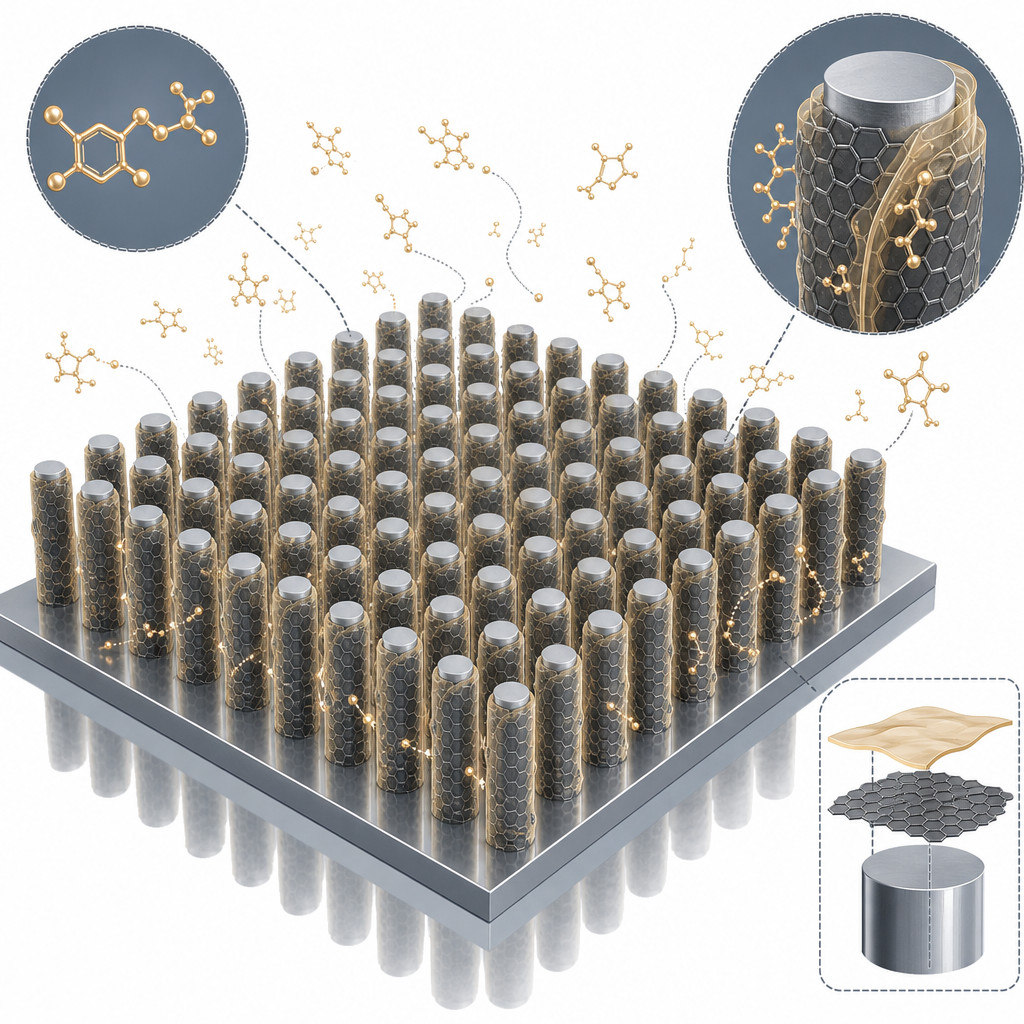
This sensing platform has clear implications for point-of-care diagnostics, neurology research, wearable biosensors and therapeutic drug monitoring. The ability to quantify a neurotransmitter at attomolar levels opens the door to early biomarker tracking in cerebrospinal fluid, sweat or interstitial fluid, where target molecules may be present at concentrations far below conventional detection limits. The architecture is general: any redox-active analyte that interacts with rGO could in principle be detected, including catecholamines, cytokines, microRNAs and certain protein biomarkers, simply by changing the selective overlayer chemistry. The authors also highlight the compatibility of aerosol-jet 3D printing with flexible substrates, suggesting a route to integrated wearable or implantable diagnostic devices.
For researchers building electrochemical sensors, graphene-based supercapacitor electrodes or hybrid 3D-printed devices, the rGO powder used here is available from ACS Material as a standard catalog item, with the conductivity and flake-size specifications quoted in the paper. The hierarchical electrode strategy demonstrated by the Carnegie Mellon group illustrates how a well-characterized, off-the-shelf nanomaterial can be combined with advanced printing to deliver an order-of-magnitude leap in device performance, and provides a useful reference dataset for groups developing the next generation of ultra-sensitive biosensing platforms.How ACS Material products were used
- Reduced Graphene Oxide (rGO) (Graphene Series) — “The rGO nanoflakes in powder form were purchased (CAS‐No. 7782‐42‐5) from ACS Materials LLC, Pasadena, CA, USA. As per the manufacturer, the rGO was synthesized from graphene precursor via a reduction process of hydrazine (N2H4) treatment, and the rGO sheets has a thickness of ~1 nm, a conductivity of >500 Sm−1, and a diameter of 0.5–10 µm.”
Product Performance in this StudyThe rGO nanoflakes from ACS Material formed the nanoscale-active coating on 3D-printed silver micropillars and were essential to achieving the femtomolar/attomolar dopamine detection limit reported in the paper.
Related product categories
Frequently asked questionsHow is reduced graphene oxide used in electrochemical dopamine sensors?
Reduced graphene oxide (rGO) is typically dispersed in water or solvent, often blended with Nafion, and drop-cast or printed onto a conductive electrode surface. The rGO sheets supply high specific surface area, edge-rich electroactive sites, and strong electron-transfer kinetics for dopamine oxidation. When combined with a permselective Nafion overlayer, the rGO film also rejects anionic interferents such as ascorbic acid, giving high selectivity for cationic dopamine in serum and other biofluids.
What detection limit can 3D printed graphene electrodes achieve for neurotransmitters?
Hierarchical 3D printed electrodes coated with reduced graphene oxide have demonstrated dopamine detection limits as low as 500 attomoles, roughly three orders of magnitude better than conventional nanostructured planar electrodes. The improvement comes from combining micropillar arrays, which accelerate analyte diffusion to the electrode at low concentrations, with nanoscale rGO flakes that supply high surface area and fast electron transfer. The dynamic range spans attomolar to micromolar dopamine.
Why are micropillar arrays better than planar electrodes for low-concentration biosensing?
At femtomolar or attomolar analyte concentrations, the rate of mass transport to a planar electrode becomes diffusion-limited and signals become indistinguishable from background. Three-dimensional micropillar arrays create overlapping diffusion fields and increase the geometric area — about 260% in the Carnegie Mellon study — so a larger fraction of analyte molecules can reach an active surface. Coating those pillars with graphene further amplifies the redox response per unit footprint.