-
Silver Nanowire CO2 Electrolyzer Recovers Carbon - Rice University, 2022
May 20, 2026 | ACS MATERIAL LLCKim, J. Y. ‘., Zhu, P., Chen, F., Wu, Z., Cullen, D. A., & Wang, H. (2022). Recovering carbon losses in CO2 electrolysis using a solid electrolyte reactor. *Nature Catalysis*. https://doi.org/10.1038/s41929-022-00763-w
Nature Catalysis · 2022
Rice University used silver nanowire catalysts in a porous solid electrolyte CO2 reduction reactor, recovering >90% of crossover CO2 at >99% purity.
About this research
Researchers at Rice University, led by Haotian Wang, used silver nanowire (Ag NW) catalysts inside a newly designed porous solid electrolyte (PSE) reactor to recover more than 90% of the CO2 normally lost through carbonate crossover during CO2 electrolysis, regenerating it at >99% gas purity while delivering over 90% CO Faradaic efficiency at 200 mA cm⁻². Published in Nature Catalysis (2022), the work tackles one of the most economically damaging but underappreciated barriers to commercial CO2-to-chemicals conversion: the loss of feedstock CO2 to the anode side of conventional membrane electrode assembly (MEA) cells, where it mixes with O2 and cannot be reused.
Electrochemical CO2 reduction (CO2RR) is widely viewed as a route to store renewable electricity in chemical bonds and reduce industrial dependence on fossil feedstocks. Advances in catalysts and gas-diffusion-layer (GDL) reactors have pushed CO and other product Faradaic efficiencies above 90% at industrially relevant current densities. However, in anion-exchange-membrane MEA cells, hydroxide ions generated at the cathode react with feed CO2 to form carbonate. Under an applied field this carbonate migrates to the anode and recombines with protons from oxygen evolution, releasing CO2 mixed with O2. For C2+ products like ethylene, six of every eight CO2 molecules can be lost this way, capping CO2 utilization at around 25%. Addressing this carbon loss is essential to making CO2RR economically viable.In CO₂ electrocatalysis, the geometric structure of the catalyst dictates the reaction pathway. The Rice University breakthrough highlights how the high aspect ratio and abundant edge sites of ACS Material's Silver Nanowires suppress the parasitic HER, achieving extraordinary CO selectivity at high current densities. Whether you are fabricating Gas Diffusion Electrodes (GDEs) or exploring new CCUS pathways, consistent nanowire morphology is crucial. Explore our Highly Purified, Tunable Silver Nanowires to maximize the Faradaic Efficiency of your electrolyzer.
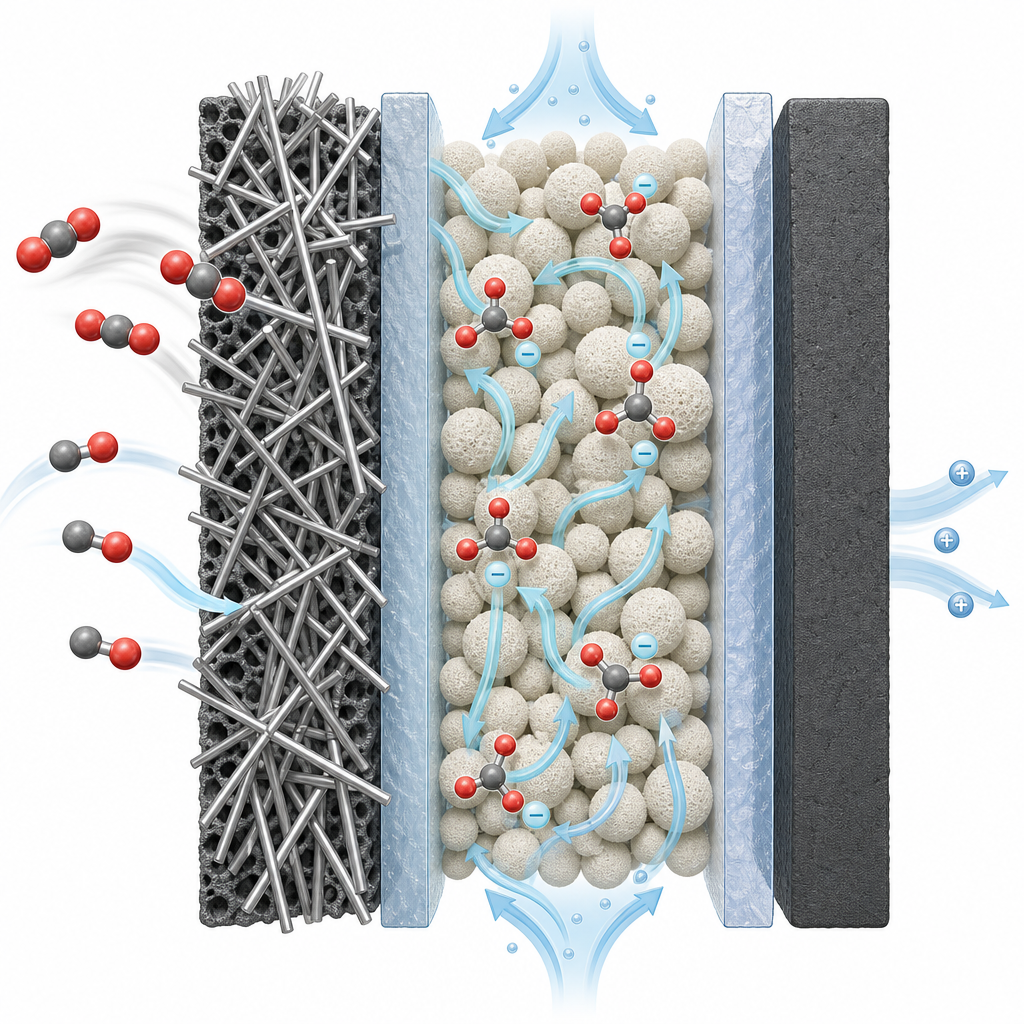
The team built a three-compartment electrolyzer in which a sulfonated polymer porous solid electrolyte buffer layer sits between the cathode (a GDL coated with Ag nanowire catalyst) and the anode. Silver nanowires were chosen because they offer high CO selectivity, an extended one-dimensional morphology that supports efficient electron transport, and well-established CO2-to-CO activity. The Ag NW catalyst layer was paired with an anion exchange membrane on the cathode side and a proton exchange membrane on the anode side, sandwiching the PSE layer. Carbonate ions crossing from the cathode meet protons generated by anode water oxidation inside the PSE, regenerating dissolved and gaseous CO2 that is swept out by a deionized water stream flowing through the porous layer. The authors quantified carbon balance using three independent gas-flow measurements at cathode inlet, cathode outlet, and anode outlet.
In a baseline anion-exchange MEA, the team measured that CO2 lost to crossover was roughly equal to the amount converted to CO, capping CO2 utilization near 50%. With the PSE reactor and Ag nanowire cathode, more than 90% of crossover CO2 was recovered as a high-purity stream exceeding 99% CO2, while CO Faradaic efficiency stayed above 90% at 200 mA cm⁻². Cell voltages remained comparable to a conventional MEA, confirming that the sulfonated polymer layer provides sufficient proton conductivity without imposing a large ohmic penalty. The recovered CO2 was then recycled to the input gas stream, raising single-pass plus recycled CO2 conversion above 90%. The authors further showed the strategy generalizes across catalysts and products: similar recovery was achieved when targeting formate, ethylene, and other C1/C2 species, where carbon loss is otherwise more severe. Stable operation over extended electrolysis demonstrated that the buffer layer is not chemically consumed, in contrast to bicarbonate-salt liquid electrolytes that suffer from precipitation and limited ionic mobility.
This architecture has direct implications for scaling CO2 electrolysis toward industrial deployment in renewable-electricity-driven CO production, formate manufacture, ethylene synthesis, and downstream Fischer-Tropsch-style upgrading. Closing the carbon balance lowers feedstock cost, simplifies anode-gas handling because anode O2 is no longer contaminated with CO2, and reduces the energy penalty associated with regenerating CO2 from amine or carbonate solutions. The reactor concept is compatible with existing GDL electrodes, AEMs, and catalysts, so groups developing copper-based C2+ catalysts, single-atom CO catalysts, or formate-selective bismuth and tin systems can adopt it without redesigning their electrode chemistry. The authors point to further optimization of the sulfonated polymer particle size, water-flushing rate, and integration with downstream gas separation as natural next steps.
For researchers working on CO2 electrocatalysis, transparent conducting nanowire electrodes, or aqueous flow-cell reactors, the silver nanowire materials at the heart of this study are available through the ACS Material nanowire product line, alongside complementary CVD graphene supports, MXenes, and carbon nanotube conductive additives that frequently appear in CO2RR electrode formulations. ACS Material maintains catalog options suitable for prototyping similar PSE-style reactor architectures.How ACS Material products were used
- Silver Nanowire (Ag NW) CO2 reduction catalyst (Nanowire Series) — “Using Ag nanowire (NW) catalyst as a model study, we consistently recovered over 90% of the crossover CO2 gas in an ultrahigh purity form”
Product Performance in this StudyThe Ag nanowire catalyst delivered over 90% CO Faradaic efficiency at 200 mA cm-2 in the porous solid electrolyte reactor, serving as the model CO2-to-CO catalyst that enabled demonstration of >90% crossover-CO2 recovery at >99% gas purity.
Related product categories
Frequently asked questionsHow does carbonate crossover cause carbon loss in CO2 electrolysis?
During CO2 reduction, hydroxide ions generated at the cathode react with feed CO2 to form carbonate. Under the applied electric field, these carbonate ions migrate through the anion exchange membrane to the anode, where they recombine with protons from oxygen evolution and release CO2 mixed with O2. This crossover stream cannot be directly reused, capping CO2 utilization near 50% for CO and as low as 25% for ethylene.
Why are silver nanowires used as CO2 reduction catalysts?
Silver is one of the most selective metals for converting CO2 to CO. The nanowire morphology offers a one-dimensional pathway for electron transport, high surface area for CO2 access, and stable catalyst loading on gas diffusion layers. In this Rice University study, Ag nanowires delivered over 90% CO Faradaic efficiency at 200 mA cm⁻² inside a porous solid electrolyte reactor, making them an ideal model catalyst for evaluating the carbon-recovery architecture.
What is a porous solid electrolyte reactor for CO2 reduction?
It is a three-compartment electrolyzer that places a permeable, sulfonated ion-conducting polymer between the cathode and anode. Carbonate ions crossing from the cathode meet protons generated by anode water oxidation inside this layer, regenerating CO2 that is swept out by a deionized water stream. The architecture separates regenerated CO2 from anode O2, enabling >99% purity recovery and supporting CO2 recycling back to the input.