-
Silver Nanowire Rubbery Epicardial Bioelectronic Patch - University of Houston, 2020
May 20, 2026 | ACS MATERIAL LLCSim, K., Ershad, F., Zhang, Y., Yang, P., Shim, H., Rao, Z., Lu, Y., Thukral, A., Elgalad, A., Xi, Y., Tian, B., Taylor, D. A., & Yu, C. (2020). An epicardial bioelectronic patch made from soft rubbery materials and capable of spatiotemporal mapping of electrophysiological activity. *Nature Electronics*. https://doi.org/10.1038/s41928-020-00493-6
Nature Electronics · 2020
University of Houston researchers built a fully rubbery, AgNW-based epicardial patch that maps electrophysiology, strain and temperature on a beating porcine heart.
About this research
Researchers at the University of Houston, working with collaborators at the Texas Heart Institute, the University of Chicago and UNIST, have demonstrated an epicardial bioelectronic patch built entirely from soft rubbery materials and silver nanowire (AgNW) conductive composites that conformally deforms with a beating porcine heart while spatiotemporally mapping electrophysiological activity. Published in Nature Electronics in 2020, the work shows that a fully rubbery transistor array, together with rubbery strain and temperature sensors, a thermal actuator and a mechanoelectrical transducer, can be integrated on a single patch with moduli matched to heart tissue (tens of kPa to ~1 MPa). The patch was validated in vivo on a living porcine heart, recording electrograms, delivering electrical pacing, performing localized thermal ablation, and harvesting energy from cardiac contractions.
Epicardial bioelectronic devices are central to diagnosing, monitoring and treating cardiovascular disease, the leading cause of mortality worldwide. The ideal device should match the softness of cardiac tissue, conform to the curved, dynamically deforming epicardium and provide multimodal sensing and stimulation. Existing approaches either rely on thin silicon islands and serpentine interconnects, which still impose a hard–soft interface that can overstrain cardiomyocytes, or on bulk conductive elastomers that lack spatial resolution. There is therefore a strong need for intrinsically soft active electronics that can resolve cardiac conduction patterns and physical parameters across the surface of the heart without disturbing its mechanics. This study addresses that gap by replacing rigid conductors with stretchable AgNW–elastomer composites and rubbery semiconducting channels throughout every functional layer.
AgNWs are the key conductive component that makes the rubbery architecture viable. The authors disperse silver nanowires into elastomeric matrices such as polydimethylsiloxane and styrene–ethylene–butylene–styrene to form percolating networks with metallic conductivity that retain their function under repeated cyclic strain consistent with heartbeat-induced deformation. These AgNW composites are used as source and drain electrodes, as gate electrodes and as interconnects for the rubbery active-matrix transistor array, as well as for the resistive strain sensor, the temperature sensor and the thermal actuator. The same nanowire-loaded composites also serve as the electrodes of the rubbery mechanoelectrical transducer that converts heart-beat strain into electrical signals. Encapsulation in soft elastomer layers preserves transistor stability in biofluid for several weeks, an essential requirement for chronic implants.In implantable bioelectronics, mechanical mismatch is the enemy of data fidelity. Rigid electrodes delaminate during dynamic tissue movement, causing severe motion artifacts and impedance spikes. By utilizing a high-aspect-ratio nanowire percolation network, researchers achieved perfectly conformal, stretchable arrays that move seamlessly with the epicardium. ACS Material provides ultra-long, highly pure Silver Nanowires (AgNWs) engineered for maximum stretchability and conductivity in elastomer composites. Explore our Silver Nanowires to eliminate motion artifacts and build the next generation of rubbery bioelectronics.
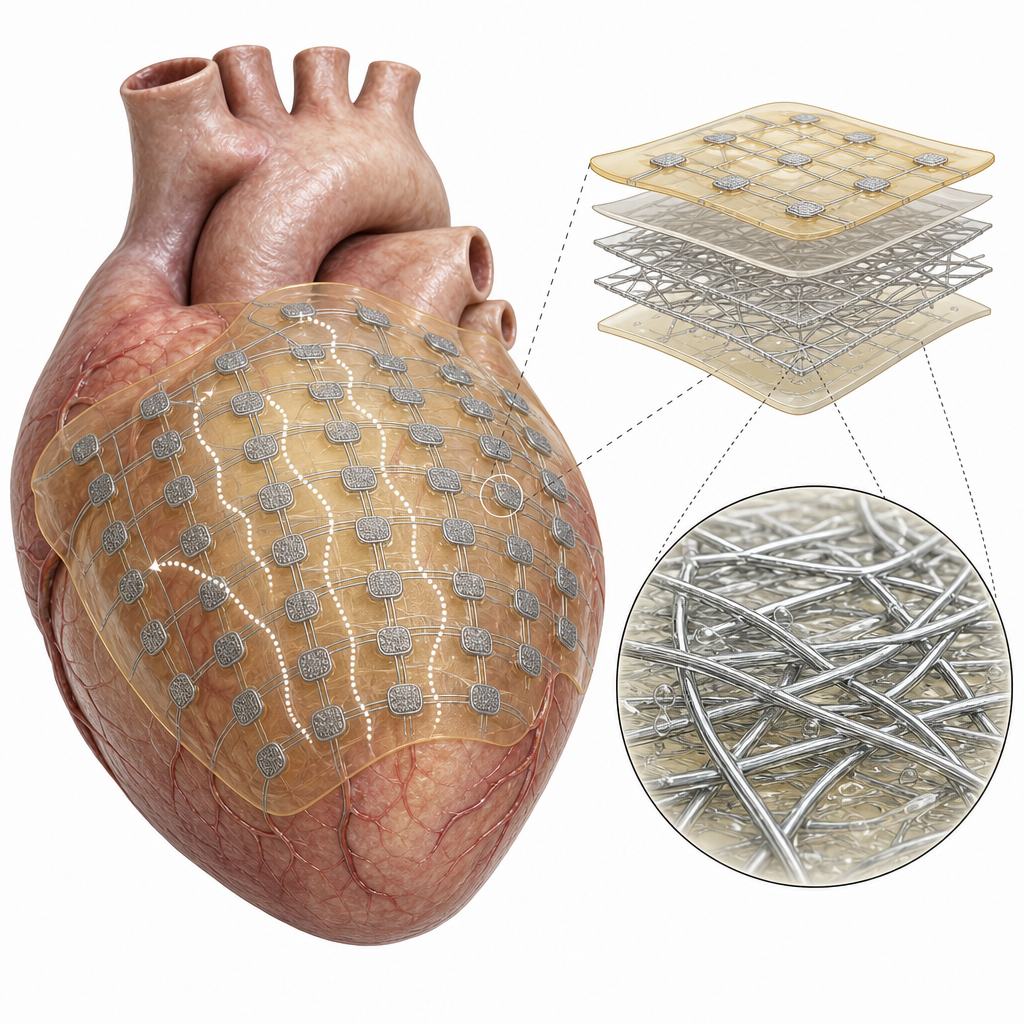
In vivo testing on a six-month-old domestic Yorkshire pig demonstrates the breadth of the device's capabilities. The active-matrix multiplexed transistor array spatially and temporally maps epicardial biopotentials, capturing the propagation of cardiac conduction across the patch footprint. Electrophysiological recordings were successfully repeated five times under both spontaneous and paced conditions, confirming reproducibility. The active matrix delivers electrical pacing to modulate heart rhythm, while the rubbery thermal actuator achieves localized heating suitable for thermal ablation of arrhythmogenic tissue. The integrated strain sensor tracks contraction and relaxation of the heart wall, and the temperature sensor monitors epicardial temperature in real time, both critical parameters during ablation procedures. The mechanoelectrical transducer harvests electrical energy from cyclic cardiac deformation, suggesting a route to self-powered or battery-assisted implantable systems. Encapsulated transistors remained operational after weeks of immersion in biofluid, demonstrating practical durability.
The demonstrated functionality opens applications in cardiac rhythm management, electrophysiology mapping for atrial fibrillation, post-infarction monitoring, and closed-loop therapeutic patches that combine sensing with pacing or ablation. Beyond cardiology, the same soft rubbery platform built on AgNW composites can be extended to other conformal bioelectronic interfaces, including gastric, bladder and neural electrodes, where mechanical compliance and multimodal sensing are equally important. The authors point toward further development of multilayer rubbery integrated circuits, higher channel counts and integration with wireless power and data links as next steps for translation.
For researchers building stretchable bioelectronics, conformal sensors and self-powered implants, silver nanowires are a foundational conductive filler that enables metallic conductivity in elastomer matrices without sacrificing softness. ACS Material supplies silver nanowires in a range of diameters and lengths suitable for composite electrodes, transparent conductive films and soft sensor fabrication, supporting work that builds on the soft rubbery epicardial patch demonstrated in this study.How ACS Material products were used
- Silver Nanowires (Nanowire Series) — “Soft conductive composites of silver nanowires (AgNWs)/styrene–butadiene–styrene have been developed into a cardiac wrap”
Product Performance in this Study
Silver nanowires serve as the conductive filler in stretchable rubbery composites used for interconnects, electrodes and the active matrix, providing electrical conductivity while maintaining the soft tissue-like mechanical properties required for conformal epicardial contact.
Related product categories
Frequently asked questions
Why are silver nanowires used in soft epicardial bioelectronic patches?
Silver nanowires form percolating networks inside elastomer matrices that provide metallic-level electrical conductivity while preserving the softness and stretchability of the surrounding rubber. This combination is essential for epicardial patches because the device must conform to a curved, dynamically beating heart without imposing a hard interface. AgNW composites can serve as transistor electrodes, interconnects, sensor traces and thermal actuators, enabling a fully rubbery multifunctional patch.
How does the rubbery transistor array map cardiac electrophysiology spatiotemporally?
The patch contains an active matrix of fully rubbery transistors with silver nanowire–elastomer electrodes and stretchable semiconducting channels. Each pixel locally records the epicardial biopotential, and active-matrix multiplexing addresses pixels in sequence to reconstruct two-dimensional maps of cardiac conduction over time. Because every layer is intrinsically soft, the array deforms with the beating heart and resolves propagation patterns without straining cardiomyocytes.
What in vivo capabilities were demonstrated on the porcine heart?
On a six-month-old domestic Yorkshire pig heart, the patch spatiotemporally mapped epicardial biopotentials, delivered electrical pacing through the active matrix, performed localized heating suitable for thermal ablation, and sensed strain and temperature in real time. A rubbery mechanoelectrical transducer also harvested electrical energy from cyclic cardiac deformation. Electrophysiological recordings were successfully repeated five times under both spontaneous and paced conditions.