-
TiO2 Nanowires for Stretchable Neural Electrodes - ETH Zurich, 2018
May 20, 2026 | ACS MATERIAL LLCTybrandt, K., Khodagholy, D., Dielacher, B., Stauffer, F., Renz, A. F., Buzsáki, G., & Vörös, J. (2018). High‐density stretchable electrode grids for chronic neural recording. *Advanced Materials*. https://doi.org/10.1002/adma.201706520
Institute for Biomedical Engineering ETH Zurich 8092 Zurich Switzerland · Advanced Materials · 2018
ETH Zurich researchers used ACS Material TiO2 nanowires to build gold-coated stretchable electrode grids enabling 3-month chronic cortical recording in rats.
About this research
A team led by the Institute for Biomedical Engineering ETH Zurich 8092 Zurich Switzerland used TiO2 nanowires supplied by ACS Material (TiO2NW-A) as the structural template for a new gold-coated nanowire composite conductor, and built it into a high-density stretchable electrode grid (SEG) that recorded high-quality neural signals from the rat cortex for three months. Published in Advanced Materials in 2018, the work introduces an inert, all-noble-metal stretchable conductor that combines a sheet resistance of 0.6 Ω with stretchability up to 100%, and demonstrates 32-channel cortical recording with an electrode density of 38 mm⁻². The result establishes a soft, biocompatible electrode platform suited to chronic neural interfacing.
Long-term neural interfaces are limited by the mechanical mismatch between rigid electronics (GPa moduli) and viscoelastic neural tissue (kPa moduli). Stiff implants cause micromotion-induced inflammation, scarring, and signal degradation. Soft, stretchable conductors based on silver nanowires or carbon nanotube composites have been proposed, but silver is cytotoxic and CNT composites often require leachable surfactants or ionic liquids, disqualifying them for chronic implantation. Microcracked gold films are biocompatible but suffer high sheet resistance and resist miniaturization, capping electrode density. A conductor that is simultaneously inert, low-resistance, highly stretchable, and patternable at micrometer scale would unlock high-resolution electrocorticography (ECoG), closed-loop neuromodulation, and bidirectional brain–machine interfaces—an unmet need this paper directly addresses.In the development of implantable brain-machine interfaces and e-skin, mechanical mismatch between rigid electronics and soft tissue leads to device failure and signal loss. As the simulation highlights, embedding high-aspect-ratio TiO2 nanowires creates a mechanically compliant, stretchable network that maintains structural integrity and stable neural impedance under extreme strain. ACS Material supplies ultra-pure, high-aspect-ratio Titanium Dioxide (TiO2) Nanowires engineered for exceptional biocompatibility and uniform dispersion in elastomer matrices. Explore our TiO2 Nanowires to build the next generation of reliable, stretchable neural interfaces.
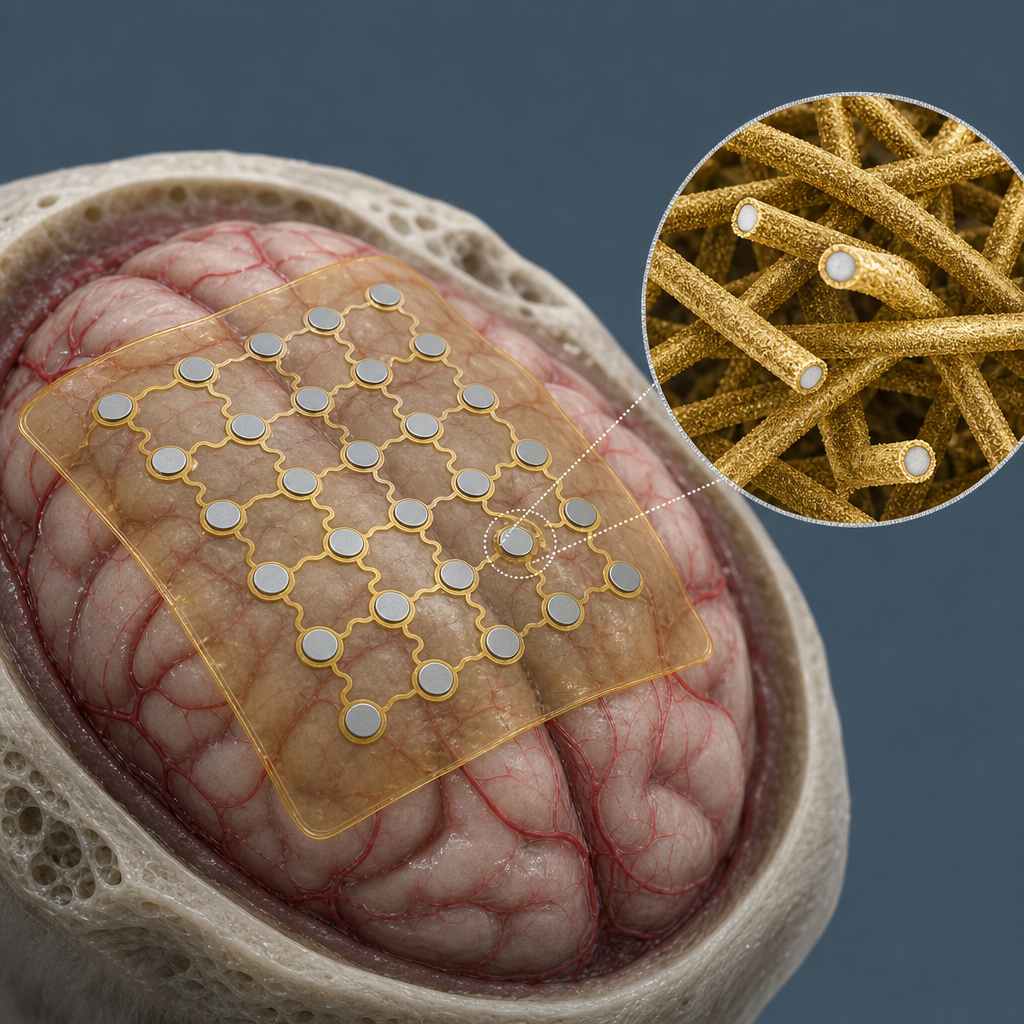
The ACS Material TiO2 nanowires (TiO2NW-A, length ≈10 µm) are the geometric backbone of the composite conductor. In a 9.5 mL aqueous mixture containing 0.15 mg of the nanowires, hydroxylamine, and poly(vinylpyrrolidone), the team slowly infused HAuCl₄ solution via syringe pump (1 mL at 1.4 mL min⁻¹ then 9 mL at 0.7 mL min⁻¹) to deposit a continuous gold shell on the nanowire surfaces, producing Au-TiO2 nanowires (Au-TiO2NWs). The high aspect ratio of the starting TiO2 nanowires enables a percolating, highly conductive network at low solid loading. The Au-TiO2NW dispersion was then wax-assisted vacuum-filtered through a patterned PVDF membrane (0.22 µm pores, Millipore) over a 92 mm² open filter area and transferred onto semi-cured PDMS (Sylgard 184), forming microscale conductor tracks. After PDMS encapsulation, UV-ozone treatment, dry-film resist patterning, RIE etching, and platinum electroplating on the exposed electrode sites, the team produced a fully soft 32-channel stretchable electrode grid.
Electromechanical characterization on 20 mm × 0.5 mm Au-TiO2NW tracks showed a sheet resistance of just 0.6 Ω and stable conduction up to 100% strain, far exceeding prior stretchable neural conductors such as PPy/PCTC (6 Ω, 23% max strain) and 35–50 nm microcracked gold films (≈9 Ω, ≈10–45% strain). The fabricated SEG carried 32 electrodes at a density of 38 mm⁻² with individual electrode area of 3 × 10³ µm², electrochemical impedance of 10 kΩ at 1 kHz, and areal impedance of 0.3 kΩ·cm². These numbers represent more than an order-of-magnitude improvement in electrode density over previously reported stretchable grids while preserving low impedance. Implantation over the somatosensory cortex through a small 2 × 3 mm² craniotomy demonstrated that the device folds for insertion and self-expands onto the pial surface. The grid resolved high spatiotemporal signals and somatosensory evoked potentials in three freely moving rats, with stable recording quality and preserved inter-electrode signal coherence across 13 weeks (3 months) of chronic implantation—matching the best reported chronic durations while delivering ~13× higher electrode density.
The Au-TiO2NW/PDMS device platform is directly relevant to chronic ECoG mapping, closed-loop neuromodulation for epilepsy and Parkinson's disease, brain–machine interfaces, and conformal peripheral nerve cuffs. Because the small craniotomy and conformal placement reduce surgical invasiveness, the grids are well suited to translational neuroscience studies in rodent and potentially larger animal models. Beyond neural interfacing, the inert nanowire–elastomer conductor architecture is generalizable to stretchable bioelectrodes for cardiac mapping, electromyography, and electronic skin. The authors highlight further scaling toward higher channel counts and the potential to integrate active components on the same stretchable substrate.
For researchers building stretchable bioelectronic devices, the role of ACS Material TiO2 nanowires here is instructive: the nanowire morphology directly enables percolation at low loading, which in turn controls both stretchability and sheet resistance of the final composite. ACS Material's TiO2 nanowire offering is available through the Nanowire Series catalog for groups pursuing similar soft conductor, neural electrode, or 1D nanostructure composite work, with related anatase and rutile titania nanostructures suitable for photocatalysis and energy applications.How ACS Material products were used
- TiO2 Nanowire (TiO2NW-A) (Nanowire Series) — “TiO2 nanowires (ACSMaterial, TiO2NW-A, length ≈10 µm, 0.15 mg)”
Product Performance in this StudyThe TiO2 nanowires from ACS Material served as the structural scaffold that was gold-coated to form the Au-TiO2NW composite conductor at the heart of the stretchable electrode grid. The resulting conductor delivered sheet resistance of 0.6 Ω and tolerated up to 100% strain, outperforming all previously reported stretchable neural electrode conductors.
Related product categories
Frequently asked questionsHow do TiO2 nanowires improve stretchable electrode performance?
TiO2 nanowires provide a high-aspect-ratio scaffold that, once gold-coated, forms a densely percolating conductive network at low solid loading inside an elastomer matrix. This geometry decouples electrical conductivity from polymer stiffness, so the Au-TiO2NW/PDMS composite reaches 0.6 Ω sheet resistance while remaining stretchable to 100% strain. The inert oxide core also avoids the toxicity and instability problems of silver nanowire composites for biomedical implantation.
What makes the Au-TiO2 nanowire grid suitable for chronic neural recording?
The grid combines four properties rarely seen together: it is mechanically compliant with neural tissue, electrochemically stable because both gold and TiO2 are inert, micropatternable to a density of 38 electrodes per mm², and low-impedance (10 kΩ at 1 kHz). In freely moving rats, these properties translated into stable cortical signal amplitudes and preserved inter-electrode coherence over 13 weeks, demonstrating real chronic compatibility.
What length and dimensions of TiO2 nanowires were used in this study?
The authors used ACS Material TiO2NW-A nanowires approximately 10 µm in length. A 0.15 mg portion was dispersed in 9.5 mL of aqueous PVP/hydroxylamine solution before gold deposition. The long, slender geometry is key to forming percolating networks at very low loading, which preserves the elasticity of the surrounding PDMS while still delivering metal-like sheet resistance after Au coating.