-
ACS Material Graphite for Si rGO Anode - KOREATECH, 2025
Jun 15, 2026 | ACS MATERIAL LLCYang, E. et al. (2020). Asymmetric mixed-matrix membranes incorporated with nitrogen-doped graphene nanosheets for highly selective gas separation. *Journal of Membrane Science*. https://doi.org/10.1016/j.memsci.2020.118293
Journal of Membrane Science · 2020
Researchers at Korea University of Technology and Education used ACS Material natural graphite to synthesize rGO coatings for Si-LTO lithium-ion battery anodes.
About this research
Researchers at Korea University of Technology and Education (KOREATECH) used natural graphite supplied by ACS Material LLC to fabricate a reduced graphene oxide (rGO) coating that markedly improved the electrochemical performance of silicon-based lithium-ion battery anodes. The team synthesized a silicon-embedded lithium titanium oxide composite (SLTO) by chemical vapor deposition, then coated it with rGO derived from ACS Material graphite to form rGO@SLTO. The coated composite delivered an initial discharge capacity of 1890.1 mAh g-1 at 1 A g-1, an initial Coulombic efficiency of 85.13%, and a charge-transfer resistance reduced from 109.11 Ω to 14.54 Ω, demonstrating a conductive network that stabilizes the silicon anode against volume expansion.
Silicon is one of the most attractive anode materials for next-generation lithium-ion batteries because of its high theoretical capacity of 3579 mAh g-1, far exceeding that of conventional graphite. However, silicon suffers from volume expansion exceeding 300% during lithiation, which causes mechanical pulverization, continuous solid electrolyte interphase (SEI) breakdown, and rapid capacity fade. Its inherently low electronic conductivity further limits rate performance. Addressing these failure modes is central to extending the cycle life and energy density of batteries used in portable electronics, electric vehicles, and grid-scale renewable energy storage. This study tackles the problem by combining a lithium titanium oxide buffer matrix with a graphene-based conductive coating, targeting both the mechanical and electrical limitations of silicon simultaneously.
The ACS Material natural graphite, with a mean particle size of 5 μm, served as the starting material for graphene oxide synthesis via Hummers' method. Graphite was dispersed in a sulfuric/phosphoric acid mixture with potassium permanganate, stirred at 65 °C, then quenched and washed to yield aqueous graphene oxide that was exfoliated by sonication. The purified GO was mixed with SLTO powder at a 5:2 weight ratio, spray-dried (entrance/exit temperatures of 180 °C and 90 °C) to achieve a uniform coating, and finally thermally reduced to rGO by CVD annealing at 400 °C for 4 hours under argon. XRD confirmed the interlayer spacing expanded from 3.35 Å (graphite) to 9.2 Å (GO) and contracted back to 3.5 Å after reduction, while Raman D/G intensity ratios of 0.96 (GO) and 0.87 (rGO) verified successful reduction. The resulting rGO coating measured roughly 115 nm thick and formed a continuous conductive network around the composite powder.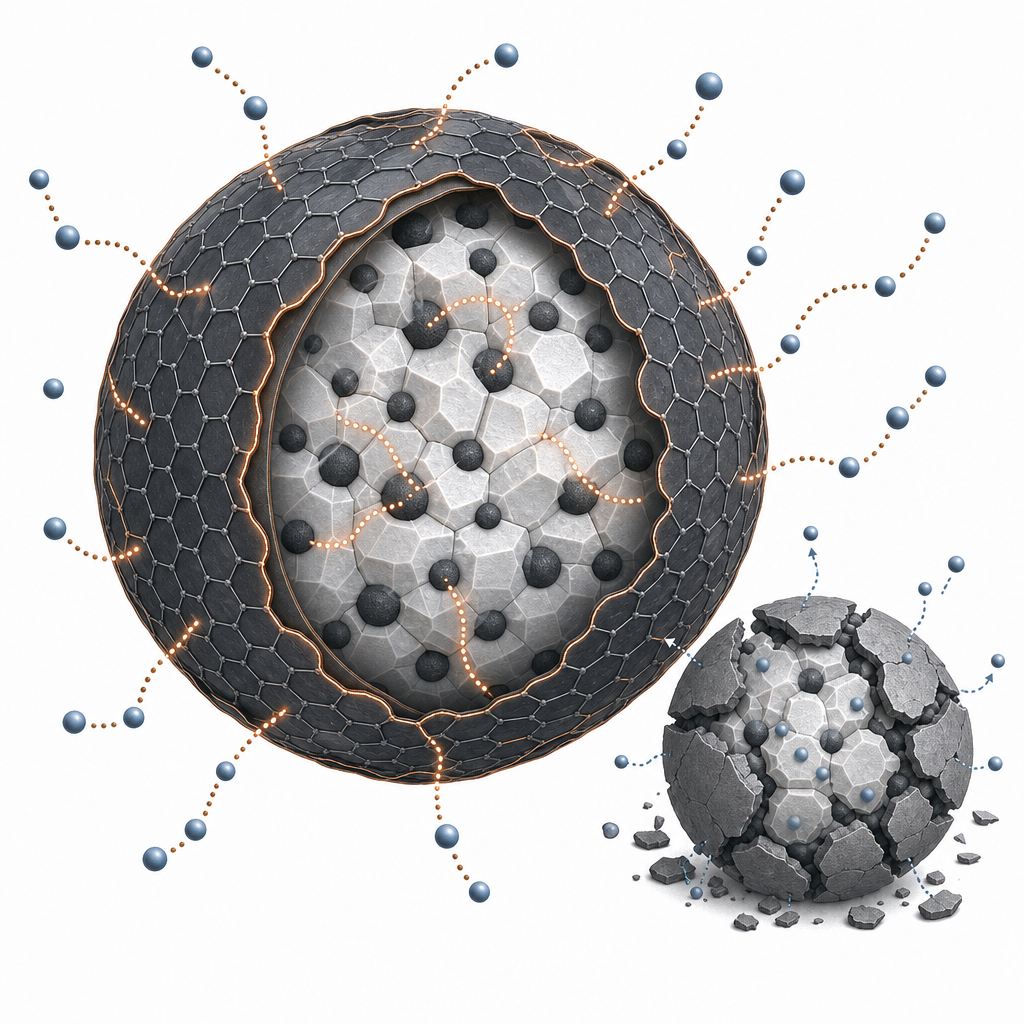
Electrochemically, the rGO@40SLTO composite—with a Si:LTO molar ratio of 40:1—outperformed all other formulations. The initial discharge capacity reached 1890.1 mAh g-1 at 1 A g-1 with an initial Coulombic efficiency of 85.13%. Embedding silicon in the LTO matrix raised the charge-transfer resistance advantage: pure Si showed 45.2 Ω, 40SLTO 30.2 Ω, and rGO@40SLTO only 24.8 Ω in the first cycle. After 400 cycles, the difference grew sharply: rGO@40SLTO showed an RCT of 14.5 Ω versus 109.1 Ω for uncoated 40SLTO, and an RSEI of 10.0 Ω versus 33.1 Ω. Capacity retention improved from 70.4% to 75.7%, and specific capacity after 400 cycles rose from 385.95 mAh g-1 (16.67%) to 759.34 mAh g-1 (39.63%). Cross-sectional SEM revealed that the uncoated electrode swelled from 16 μm to 90 μm after 400 cycles, whereas rGO@40SLTO grew only to 37 μm, confirming the coating's role as a mechanical buffer. Excess silicon (rGO@140SLTO) caused rGO layer exfoliation and cracking, underscoring the importance of optimizing the Si:LTO ratio between 40:1 and 60:1.
The approach offers a scalable, spray-drying-compatible route to high-capacity silicon composite anodes suited to large-volume manufacturing. By simultaneously buffering volume expansion and building a conductive network, the rGO@SLTO design points toward higher-energy-density lithium-ion cells for electric vehicles, portable electronics, and renewable energy storage. The authors highlight that careful control of silicon loading and rGO coating thickness is the key lever for cycle stability, and that the LTO matrix combined with a graphene-based coating provides a generalizable platform for engineering durable silicon anodes in next-generation batteries.
For researchers pursuing similar work, the natural graphite used as the graphene oxide precursor in this study is part of ACS Material's graphene and graphite product line. Battery scientists developing silicon-carbon composites, rGO coatings, or graphene-based conductive additives can source comparable graphite and graphene materials for Hummers'-method GO synthesis and electrode fabrication. The paper's quantitative results—an order-of-magnitude reduction in charge-transfer resistance and near-doubling of retained capacity after 400 cycles—illustrate how a well-controlled graphene-derived coating can meaningfully extend silicon anode lifetime.How ACS Material products were used
- Natural Graphite (5 μm mean size) (Graphene Series) — “Graphite (Nature graphite, ACS Material LLC, USA), a mean size of 5 μm, is procured.”
Product Performance in this StudyThe ACS Material natural graphite was the precursor oxidized via Hummers' method to produce graphene oxide, subsequently reduced to the rGO coating that lowered charge-transfer resistance from 109.1 Ω to 14.5 Ω and improved capacity retention.
Related product categories
Frequently asked questionsHow does a reduced graphene oxide coating improve silicon lithium-ion battery anodes?
An rGO coating forms a continuous conductive network around silicon composite powder, raising electrical conductivity and buffering the more-than-300% volume expansion that silicon undergoes during lithiation. In this study the coating cut charge-transfer resistance from 109.1 Ω to 14.5 Ω after 400 cycles and limited electrode thickness growth, improving capacity retention from 70.4% to 75.7%.
What grade of graphite is used to make graphene oxide for battery research?
This study used natural graphite with a mean particle size of about 5 μm, supplied by ACS Material LLC, as the precursor for Hummers'-method graphene oxide synthesis. Fine, well-defined natural graphite flakes oxidize uniformly, expanding the interlayer spacing from 3.35 Å to roughly 9.2 Å, which aids exfoliation into single- and few-layer graphene oxide sheets.
Why is charge-transfer resistance important for silicon anode performance?
Charge-transfer resistance reflects how easily lithium ions exchange charge at the electrode interface. Lower resistance means faster kinetics and better rate capability. In this work, embedding silicon in lithium titanium oxide and adding an rGO coating reduced charge-transfer resistance by roughly an order of magnitude after 400 cycles, directly improving capacity retention and electrochemical stability.