-
Au-Coated TiO2 Nanowires for Soft Strain Sensors - ETH Zurich, 2018
Jun 17, 2026 | ACS MATERIAL LLCStauffer, F. et al. (2018). Soft Electronic Strain Sensor with Chipless Wireless Readout: Toward Real‐Time Monitoring of Bladder Volume. *Advanced Materials Technologies*. https://doi.org/10.1002/admt.201800031
Laboratory of Biosensors and Bioelectronics ETH Zurich Gloriastrasse 35 8092 Zurich Switzerland · Advanced Materials Technologies · 2018
ETH Zurich built a chipless wireless bladder strain sensor using ACS Material TiO2 nanowires, gold-coated and embedded in soft silicone for 100% strain cycling.
About this research
Researchers at the Laboratory of Biosensors and Bioelectronics ETH Zurich Gloriastrasse 35 8092 Zurich Switzerland used TiO2 nanowires supplied by ACS Material (catalog TiO2NW-A, ≈10 µm length) as the structural backbone for a novel gold-coated nanowire (Au-TiO2NW) conductor, then embedded it in a soft silicone elastomer to build a chipless, wireless implantable strain sensor. The device demonstrates continuous wireless readout up to 50% strain and was validated on an ex vivo porcine bladder, where it tracked filling volumes between roughly 95 and 200 mL. The work, published in Advanced Materials Technologies (2018), targets continuous bladder volume monitoring for patients with neurogenic lower urinary tract dysfunction.
Why this research matters: patients with spinal cord injury or other neurogenic bladder conditions can lose their sense of bladder fullness, and uncontrolled overfilling can drive urinary reflux, upper tract damage, and progression to kidney failure. Current clinical practice depends on intermittent self-catheterization four to six times per day, irrespective of how full the bladder actually is. Existing implantable bladder sensors face problems with biocompatibility, hermetic packaging, drift, power, and incompatibility with imaging. A passive, chipless wireless sensor that mechanically matches bladder tissue could enable long-term, continuous monitoring inside a closed-loop neuroprosthetic bladder control system, and the same technology platform extends to other deformable organs and soft tissues.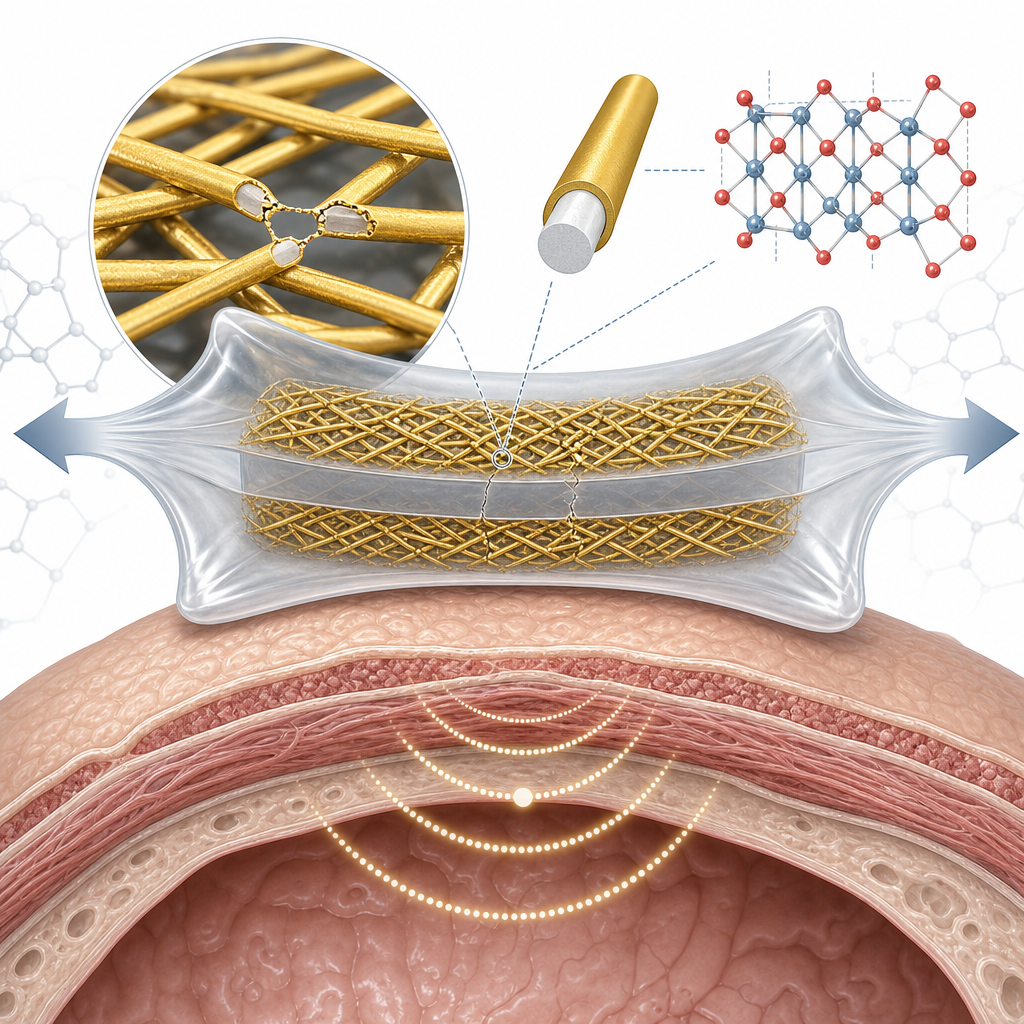
How the ACS Material product was used: the team adopted ACS Material TiO2NW-A nanowires (≈10 µm length) as the starting material for the conductor. Following the Tybrandt et al. protocol, 0.6 mg of TiO2 nanowires were dispersed with hydroxylamine and polyvinylpyrrolidone in deionized water, then gold(III) chloride solution was added by syringe pump under stirring, followed by hydrochloric acid and heating at 80 °C for 15 min. The result is a gold-coated TiO2 nanowire dispersion at 0.625 mg mL−1. The Au-TiO2NW dispersion was vacuum-filtered through wax-patterned PVDF membranes to define 20 mm × 0.5 mm tracks, transferred onto semi-cured Dragon Skin 10 silicone, and encapsulated. Two stacked Au-TiO2NW films separated and capped by Dragon Skin form the stretchable plate capacitor in the implantable RLC resonant circuit. Using TiO2 nanowires rather than silver nanowires gave biocompatibility, oxidation resistance suited to wet body environments, and a microcrack-only failure mode rather than catastrophic cracking under strain.
Key results: the patterned Au-TiO2NW–Dragon Skin tracks had an initial resistance of 21.7 Ω, a sheet resistance of 0.54 Ω/sq, and a conductivity of 4630 S cm−1 for a 4 µm layer. They remained conductive at 100% strain (1250 Ω, 11 Ω/sq). After 500 cycles at 100% strain, resistance recovered to 27.1 Ω, only 24.7% above the initial value, with the loss attributed to irreversible nanowire–nanowire contact changes in the first cycles. The double-layered composite had a Young's modulus of 260 kPa at 40% strain, only 37% above neat Dragon Skin (190 kPa) and roughly five times softer than Sylgard 184 (1.36 MPa), placing it within the 64–526 kPa range reported for porcine bladder wall. The RLC sensor operated at 1–30 MHz with a strain gauge factor of 0.37–0.5 for strains up to 50% and maintained stable wireless readout through the 1000th cycle. On an ex vivo porcine bladder filled to 200 mL through a catheter, the sensor produced a linear response above an unfolding volume of ≈95 mL and returned cleanly to baseline after voiding.
Applications and outlook: the most direct application is a closed-loop neuroprosthetic bladder control system that warns patients when filling exceeds safe thresholds and triggers controlled voiding. Because the sensor is purely passive, with no implanted microchip and no internal battery, it removes a major hurdle in long-term implant regulation, hermetic sealing, and lifetime. The same Au-TiO2NW–elastomer composite is a candidate for strain mapping on other expanding organs, peripheral nerves, and musculoskeletal tissues, and for wearable healthcare devices that demand stretchable conductors with low Young's modulus and stable cyclic performance. The authors point to integration with their broader spinal cord injury research program as a follow-up.
Why this matters for researchers: groups developing implantable bioelectronics, stretchable conductors, or soft strain sensors can reproduce this composite using TiO2 nanowires from ACS Material as a drop-in starting template for gold coating, taking advantage of the same length distribution and dispersibility cited in this paper. ACS Material lists Titanium Oxide B-Nanotubes within its Nanoparticles Series, available to laboratories working on flexible electrodes, neural interfaces, and stretchable composite conductors.How ACS Material products were used
- Titanium Oxide B-Nanotubes (TiO2NW-A) (Nanoparticles Series) — “TiO2 NWs (ACS Material, TiO2NW-A, length ≈10 µm, 0.6 mg), hydroxylamine ... were mixed with DI water to a final volume of 40 mL.”
Product Performance in this StudyThe TiO2 nanowires from ACS Material served as the templating backbone for gold coating, producing Au-TiO2 nanowires that, when embedded in Dragon Skin elastomer, remained conductive up to 100% strain with only a 24.7% resistance increase after 500 cycles.
Related product categories
Frequently asked questionsWhy use TiO2 nanowires instead of silver nanowires for an implantable stretchable conductor?
Silver nanowire networks embedded in soft elastomers like Dragon Skin develop substantial cracks under strain and can suffer oxidation in body fluids, both of which compromise long-term implant stability. Gold-coated TiO2 nanowires retain conductivity through only microcrack formation, resist oxidation, and have demonstrated biocompatibility in long-term brain implants. They also work in softer elastomers without large increases in Young's modulus.
How does a chipless wireless RLC strain sensor measure bladder filling?
The implant is an RLC circuit whose capacitor stretches with the bladder wall. As the capacitance grows with strain, the resonance frequency drops. An external coil inductively couples to the implant and sweeps frequency to find the resonance peak via the voltage standing wave ratio. The frequency shift is converted to strain, and an ellipsoidal bladder model translates strain to filling volume.
What strain and cycling performance can Au-TiO2 nanowire composites achieve?
Tracks of gold-coated TiO2 nanowires in Dragon Skin silicone start at 0.54 Ω/sq sheet resistance and remain conductive at 100% strain. After 500 cycles to 100% strain, resistance recovers to within 24.7% of the initial value. The double-layer composite has a Young's modulus of 260 kPa at 40% strain, comparable to porcine bladder wall and about five times softer than Sylgard 184 PDMS.