-
Beta Zeolite Purification for Hydrate Contact Angle Studies - Colorado School of Mines, 2018
Jul 07, 2026 | ACS MATERIAL LLCBrown, E. P. et al. (2018). Direct measurements of contact angles on cyclopentane hydrates. *Energy & Fuels*. https://doi.org/10.1021/acs.energyfuels.8b00803
Center for Hydrate Research, Chemical and Biological Engineering Department, Colorado School of Mines, Golden, Colorado 80401, United States · Energy & Fuels · 2018
Researchers at Colorado School of Mines used ACS Material beta zeolite to purify cyclopentane, enabling direct contact angle measurements on gas hydrates.
About this research
Researchers from the Center for Hydrate Research, Chemical and Biological Engineering Department, Colorado School of Mines, Golden, Colorado 80401, United States used ACS Material beta zeolite to purify cyclopentane and, with that purified hydrocarbon, performed the first systematic direct contact angle measurements of water on cyclopentane clathrate hydrate surfaces, obtaining 94.2° ± 8.5°. The study, published in Energy & Fuels in 2018 by Brown, Hu, Wells, Wang, and Koh, also updated the cyclopentane/water interfacial tension to 47.8 ± 0.5 mN/m and connected contact angle measurements to cohesion forces measured between hydrate particles in the presence of quaternary-ammonium-salt anti-agglomerants.
Gas hydrate management is one of the most expensive challenges in offshore oil and gas production. Subsea flowlines operate at low temperature and high pressure, the very conditions under which water and light hydrocarbons combine to form clathrate hydrates. Once formed, the ice-like particles agglomerate via capillary liquid bridges and can plug pipelines. The strength of those bridges depends on interfacial tension, particle radius, immersion depth, and the contact angle of water on the hydrate surface, but direct contact angle data on hydrate surfaces have been almost absent from the literature. Filling this gap allows more accurate predictive models for hydrate cohesion, better screening of anti-agglomerant (AA) chemistries, and more reliable flow assurance design for deepwater fields and gas processing facilities.
The ACS Material beta zeolite (a BEA-framework aluminosilicate) was used as the adsorbent in a packed cylindrical bed to clean reagent-grade cyclopentane before any interfacial measurement. The authors note that previous attempts to measure the cyclopentane/water interfacial tension had been corrupted by trace surfactant-like impurities, which caused the apparent IFT to drift downward with time. By passing cyclopentane through the beta zeolite column four to five times, the team obtained a hydrocarbon phase whose IFT against deionized water was constant with time, a signature of a clean, surfactant-free system. The purified cyclopentane was then used both in pendant-drop IFT measurements on a KSV Cam 200 instrument and as the bulk phase in the micromechanical force (MMF) apparatus where hydrate particles were grown on calibrated glass cantilevers and brought into contact for pull-off measurements. The beta zeolite step therefore underpinned every downstream quantitative result in the paper.
The directly measured water-on-cyclopentane-hydrate contact angle of 94.2° ± 8.5° (70 measurements across more than 35 droplets) is notably higher than the value of 29° previously inferred from analog Freon hydrate systems and far above the ~12° reported for ice in air. With the updated IFT of 47.8 ± 0.5 mN/m (revised from a pentane-based estimate of 50.9 mN/m) and a measured baseline cohesion force of 4.2 ± 0.4 mN/m at 3 °C, the authors back-calculated immersion depth and liquid bridge height for the capillary-bridge model. Four quaternary ammonium salt (QAS) anti-agglomerants - QAS-39, QAS-25, QAS-15, and QAS-2 - were tested at 0.1 wt % in the hydrocarbon phase. The MMF apparatus successfully ranked their performance, and a clear correlation emerged: lower cohesion forces aligned with higher contact angles, i.e., more hydrophobic hydrate surfaces. The authors also documented two morphological responses of hydrate particles to AA addition - water extrusion and hydrate sloughing - which provide visual diagnostics for AA mechanism studies.
The findings directly support flow assurance engineering for subsea pipelines, gas hydrate slurry transport, and CO2 hydrate handling. Quantitative contact-angle and cohesion data enable more accurate population-balance and CFD models of hydrate agglomeration, and the demonstrated ranking capability of the MMF apparatus offers a practical screening tool for new low-dose hydrate inhibitor (LDHI) chemistries before costly loop or field trials. The work also opens adjacent research questions about hydrate surface roughness, the comparison of ice versus hydrate wettability in the same bulk phase, and contact-angle behavior under structure I (methane) hydrate conditions, all relevant to natural gas hydrate resource recovery and carbon storage in hydrate form.
For researchers working on hydrate cohesion, interfacial tension measurements, or any system where hydrocarbon purity controls the data, the beta zeolite product used here is available from ACS Material in the Molecular Sieves catalog. This paper is a useful reminder that BEA-framework zeolites can serve as a low-cost purification step for hydrocarbon solvents prior to surface and interfacial measurements, and that solvent purity should be verified by time-resolved IFT rather than assumed from the supplier specification alone.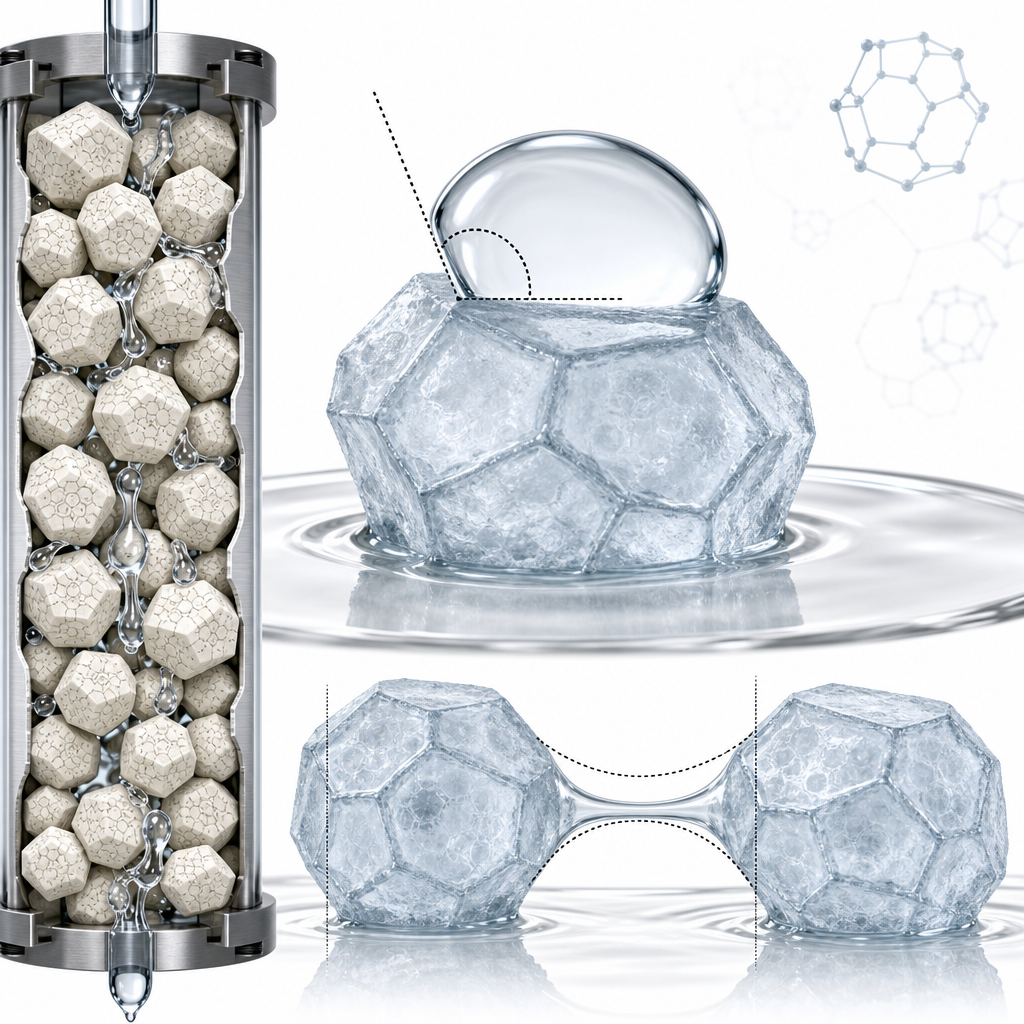
How ACS Material products were used
- Beta Zeolite (Molecular Sieves) — “The cyclopentane phase was purified using a zeolite column (beta zeolite, ACS Material) to remove any residual impurities... A purification system consisting of a packed cylindrical bed containing beta zeolite spheres (SiO2/Al2O3, ACS Materials) was employed, where cyclopentane was poured over the spheres 4−5 times.”
Product Performance in this Study
The ACS Material beta zeolite was used as a packed-bed purification medium to remove surfactant-like impurities from cyclopentane. The purification was essential to obtaining a stable, time-independent interfacial tension value of 47.8 ± 0.5 mN/m between cyclopentane and water, which underpins the paper's updated capillary-bridge analysis.
Related product categories
Frequently asked questions
Why is beta zeolite used to purify cyclopentane before interfacial tension measurements?
Reagent-grade cyclopentane contains trace surfactant-like impurities that cause the apparent water/cyclopentane interfacial tension to drift downward over time. Passing the cyclopentane through a packed bed of beta zeolite (a BEA-framework aluminosilicate) four to five times adsorbs these impurities. After purification the IFT becomes time-independent, a signature of a clean system, and the authors obtained a reliable value of 47.8 ± 0.5 mN/m.
What is the contact angle of water on a cyclopentane hydrate surface?
Direct micromechanical force measurements on more than 35 water droplets gave a contact angle of 94.2° ± 8.5° for water on cyclopentane hydrate in a bulk cyclopentane phase. This is much higher than older estimates near 29° derived from analog Freon hydrate systems, indicating that hydrate surfaces are considerably more hydrophobic than the water-rich shell composition would suggest.
How do anti-agglomerants reduce hydrate cohesion in pipelines?
Quaternary ammonium salt anti-agglomerants adsorb on the hydrate surface and make it more hydrophobic, which raises the water contact angle. A higher contact angle reduces the curvature and immersion depth of the capillary liquid bridge connecting two hydrate particles, lowering the cohesion force. The paper showed that ranking AAs by contact angle correlates directly with the cohesion forces measured in the micromechanical force apparatus.