-
Carboxyl Graphene Oxide for DNA-Tuned Fluorescence Quenching — SUNY Albany, 2014
Jun 11, 2026 | ACS MATERIAL LLCBalcioglu, M., Rana, M., & Robertson, N. (2014). DNA-Length-Dependent Quenching of Fluorescently Labeled Iron Oxide Nanoparticles with Gold, Graphene Oxide and MoS2 Nanostructures. *ACS Applied Materials & Interfaces*. https://doi.org/10.1021/am503553h
ACS Applied Materials & Interfaces · 2014
SUNY Albany researchers used ACS Material carboxyl graphene oxide as a nanoquencher of cy5.5-labeled iron oxide nanoparticles, with DNA-length-tunable quenching up to 58%.
About this research
Researchers at the University at Albany, SUNY used ACS Material carboxyl graphene water dispersion as the precursor for nanographene oxide (nGO) and demonstrated DNA-length-dependent fluorescence quenching of cy5.5-labeled iron oxide nanoparticles, with quenching efficiency tunable from 58% down to 32% by varying single-stranded DNA spacer length. The work, published in ACS Applied Materials & Interfaces in 2014, systematically compares three nanoquenchers — gold nanoparticles, nGO, and MoS2 — paired with a fluorescent iron oxide nanoparticle (MNcy5.5).
Controlling the distance between a fluorophore and a quencher at the nanoscale is central to designing FRET-based biosensors, drug delivery probes, and diagnostic assays. Because the geometry of DNA on a nanoparticle surface does not always scale linearly with oligonucleotide length, mapping how DNA spacers actually modulate quenching is important for rational probe design.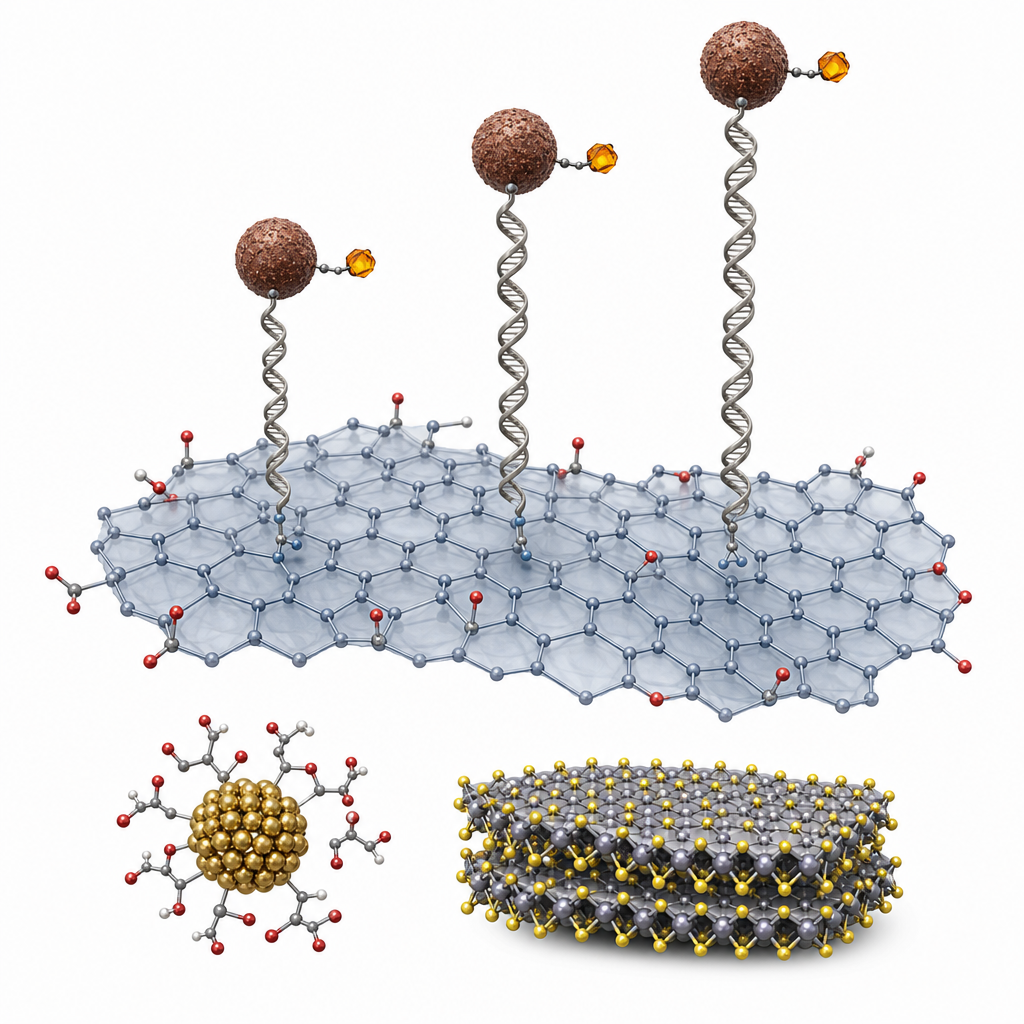
The carboxyl graphene water dispersion purchased from ACS Material was sonicated for 7 h in an ice bath to produce nGO sheets with an average lateral size of 100 ± 15 nm, confirmed by dynamic light scattering and TEM. Amine-modified 12mer, 23mer, and 36mer DNA strands were covalently coupled to the nGO via EDC chemistry, and the resulting nGO–DNA conjugates were titrated against MNcy5.5 to monitor fluorescence at 695 nm (excitation 670 nm). Parallel experiments were carried out with citrate-stabilized 13 nm AuNPs and with sonication-exfoliated MoS2 nanosheets for direct comparison.
Quenching efficiencies with 12mer, 23mer, and 36mer DNA on the iron oxide surface were 56%, 54%, and 53% for AuNP; 58%, 38%, and 32% for nGO; and 46%, 38%, and 35% for MoS2. Covalent immobilization of DNA on nGO reduced quenching to ~22%, while noncovalent adsorption gave ~25%, showing that both DNA length and conjugation mode govern the spacer geometry. The ACS Material carboxyl graphene oxide thus functioned as a reliable, high-efficiency two-dimensional nanoquencher whose performance could be predictably tuned through surface DNA chemistry.How ACS Material products were used
- Carboxyl Graphene Water Dispersion (Graphene Series) — “Carboxyl graphene water dispersion was purchased from ACS Material, Medford, MA, USA.”
Product Performance in this StudyThe ACS Material carboxyl graphene water dispersion served as the precursor for sonication-prepared nanographene oxide (nGO), one of the three nanoquenchers central to the study. As the DNA-functionalized nGO quencher, it delivered up to ~62% quenching of cy5.5-labeled iron oxide nanoparticles at the shortest DNA length tested.
Related product categories