-
Carboxyl Graphene Oxide miRNA Biosensor - University at Albany SUNY, 2017
Jun 05, 2026 | ACS MATERIAL LLCRobertson, N. M. et al. (2017). Unlocked Nucleic Acids for miRNA detection using two dimensional nano-graphene oxide. *Biosensors and Bioelectronics*. https://doi.org/10.1016/j.bios.2016.02.058
Biosensors and Bioelectronics · 2017
University at Albany SUNY researchers used ACS Material carboxyl graphene oxide with UNA probes and dsDNase to detect miR-10b with 70-fold specificity.
About this research
Researchers at the University at Albany, State University of New York used carboxyl graphene oxide water dispersion from ACS Material to construct a two-dimensional fluorescent biosensor that detects the breast cancer oncomiR miR-10b and distinguishes it from closely related family members miR-10a and miR-10c with up to 70-fold specificity. The work, published in Biosensors and Bioelectronics in 2017 by Robertson, Yigit and co-workers, introduces Unlocked Nucleic Acid (UNA) monomers into the DNA probe sequence and combines this strategy with a duplex-specific endonuclease (dsDNase) to enhance both selectivity and signal amplitude. The result is a simple, easy-to-operate nano-graphene oxide nanoassembly that addresses two of the most persistent challenges in miRNA biosensing: specificity against single- and double-nucleotide mismatches and sensitivity without elevated background noise.
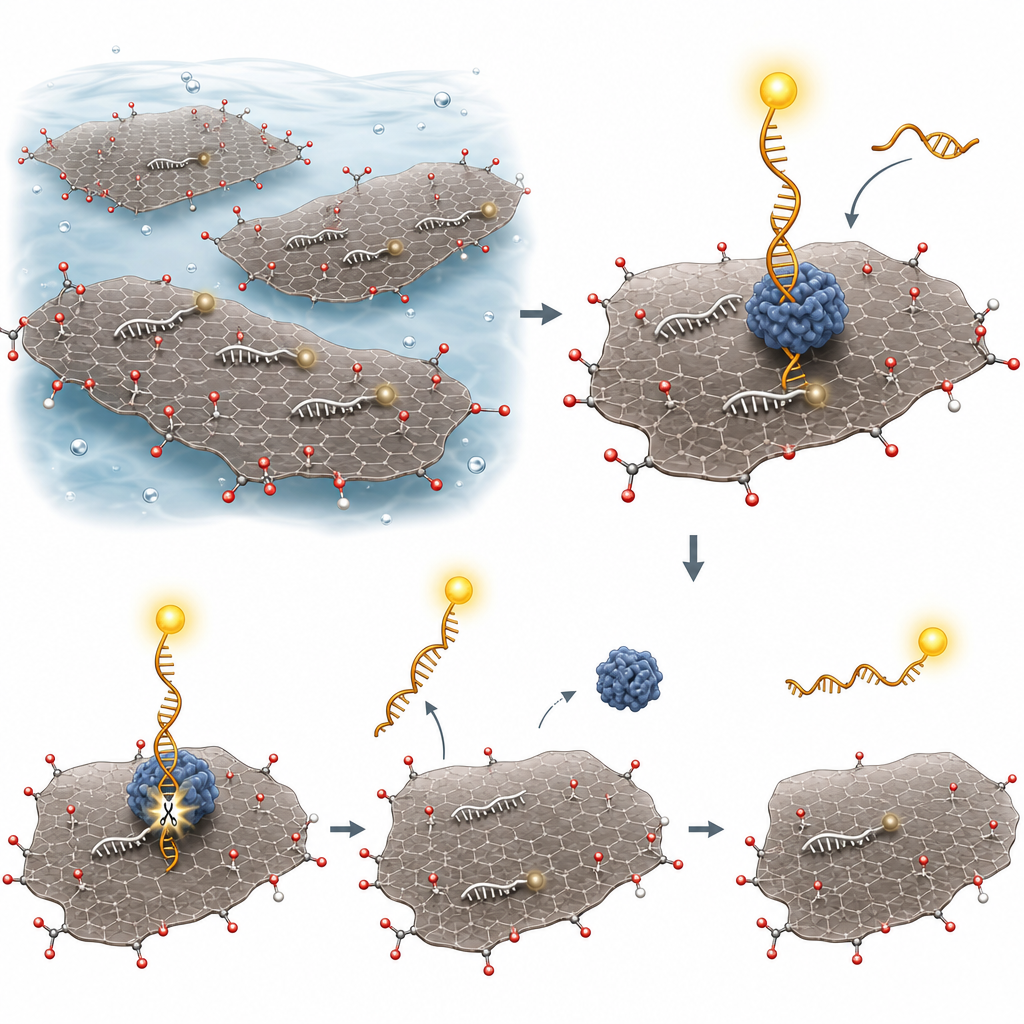
microRNA biomarkers such as miR-10b are increasingly recognized as diagnostic and prognostic indicators for metastatic cancers, but they are short, exist at low concentration, and often co-occur with sequence-similar family members that differ by only one or two nucleotides. Conventional fully complementary DNA probes adsorbed onto graphene oxide can detect miRNA via fluorescence recovery, but they generate strong non-specific signals from off-target miRNAs in the same family. While Locked Nucleic Acids (LNAs) are widely used to increase duplex stability, the opposite property - the destabilizing effect of UNA monomers, which lower duplex melting temperature by up to 10 °C per insertion - has been comparatively underexplored. Exploiting this controlled destabilization is precisely how the authors achieve mismatch discrimination on a graphene oxide platform.
The ACS Material carboxyl graphene oxide was supplied as a water dispersion and sonicated for 12 hours to obtain a water-soluble nanosized graphene oxide (nGO) solution. Dynamic light scattering on a Malvern Zetasizer Nano ZS gave an average particle size of 283.3 ± 15 nm and a zeta potential of -23.7 ± 2.9 mV, confirming a well-dispersed, negatively charged nanosheet population. The nGO functioned as both adsorbent and fluorescence quencher: FAM-labeled DNA probes (the fully complementary DNAfull, a two-UNA variant UNA2, and a two-mismatch DNAM2) were assembled at 50 nM with 3 µg/mL nGO in Tris-HCl buffer. Probe adsorption produced approximately 95% fluorescence quenching with a loading capacity of 16.7 nmol/mg (probe per nGO). Target miRNA hybridization desorbs the probe and recovers FAM emission, providing the readout. The carboxyl-functionalized graphene oxide was central to the assembly: its high surface area, colloidal stability, and quenching efficiency enabled the low background needed to resolve fold-differences between sequence-similar miRNAs.
Inserting two UNA monomers lowered the melting temperature of the UNA2/miR-10b duplex by approximately 11 °C versus DNAfull/miR-10b, and rendered the UNA2/miR-10c interaction effectively non-cooperative (no standard melting curve). At 37 °C, nGO/UNA2 gave miR-10b signal essentially equivalent to nGO/DNAfull but was 50 times more powerful than DNAfull at discriminating miR-10b from miR-10c. Specifically, miR-10b signal was 70-fold greater than miR-10c using UNA2, versus only ~1.3-fold using DNAfull. Raising the temperature to 45 °C - above the UNA2/miR-10a Tm (~44 °C) but below UNA2/miR-10b Tm (~52 °C) - further suppressed off-target recovery while maintaining strong miR-10b response. Incorporation of dsDNase, a duplex-specific endonuclease, then approximately doubled the recovered fluorescence by cleaving the DNA probe within hybridized duplexes and recycling target miRNA. Critically, unlike DNase I, dsDNase showed no activity on surface-adsorbed single-stranded probes even at 10 U, eliminating background drift and removing the need for the labor-intensive PEGMA surface passivation used in earlier work.
This platform points directly toward practical liquid-biopsy diagnostics for cancer-associated miRNAs, where distinguishing oncomiR isoforms in the miR-10 family is clinically meaningful for breast-cancer metastasis monitoring. The UNA-tuned Tm strategy is generalizable: by choosing UNA insertion positions, researchers can program the working temperature window for any miRNA target so that it falls within the dsDNase activity range. Applications extend to multiplexed miRNA panels, point-of-care fluorescence assays, and integration with paper- or chip-based graphene biosensors. The authors note that the same UNA-plus-endonuclease combination should transfer cleanly to other miRNAs of diagnostic interest.
For researchers developing graphene-oxide-based biosensors, this study illustrates why probe chemistry and the quality of the graphene oxide dispersion matter equally. The carboxyl graphene oxide used here, supplied by ACS Material, provided the consistent quenching efficiency and colloidal stability the assay requires. ACS Material offers carboxyl graphene oxide and related single-layer graphene oxide products suitable for nucleic-acid biosensing, nanomedicine, and 2D-materials research. Groups working on miRNA detection, aptamer assays, or fluorescent probe platforms can adopt similar nGO formulations to reproduce or extend the assay reported here.How ACS Material products were used
- Carboxyl Graphene Oxide (water dispersion) (Graphene Series) — “A carboxyl graphene oxide (Fig. S4) water dispersion was purchased from ACS Material (Medford, MA, USA) and sonicated 12 h before use to obtain a water-soluble nanosized graphene oxide (nGO) solution.”
Product Performance in this Study
The carboxyl graphene oxide from ACS Material served as the two-dimensional fluorescence-quenching biosensing platform. It adsorbed the FAM-labeled DNA/UNA probes with ~95% quenching and a 16.7 nmol/mg loading capacity, enabling specific miR-10b detection with up to 70-fold discrimination over miR-10c.
Related product categories
Frequently asked questions
How does carboxyl graphene oxide enable fluorescence-based miRNA detection?
Carboxyl graphene oxide adsorbs single-stranded fluorophore-labeled DNA probes through aromatic stacking, hydrogen bonding, hydrophobic interactions, and van der Waals forces, quenching the dye by roughly 95%. When a complementary miRNA hybridizes to the probe, the resulting double-stranded duplex loses affinity for the graphene surface, desorbs, and recovers fluorescence. This turn-on signal forms the basis of nGO miRNA biosensors.
Why do Unlocked Nucleic Acid (UNA) monomers improve miRNA discrimination?
UNAs are acyclic DNA analogues lacking the C2'-C3' bond of the ribose ring, which adds flexibility and reduces duplex stability. Each UNA insertion can lower melting temperature by up to 10 °C. This destabilization disproportionately suppresses off-target hybridization with mismatched miRNAs, giving up to 70-fold better discrimination of miR-10b from miR-10c without sacrificing signal from the fully complementary target.
What role does dsDNase play in graphene oxide miRNA biosensors?
dsDNase is a duplex-specific endonuclease that cleaves DNA only inside DNA:RNA or DNA:DNA duplexes. In a nano-graphene oxide assay it digests probes that have hybridized to target miRNA, releasing the miRNA to bind additional surface-adsorbed probes and amplifying fluorescence. Unlike DNase I, it does not degrade single-stranded probes adsorbed on graphene, so the background remains low even at 10 U.