-
CMK-3 Mesoporous Carbon for Antibiotic Adsorption - UASLP, 2014
Jun 29, 2026 | ACS MATERIAL LLCCarrales-Alvarado, D. et al. (2014). Removal of the antibiotic metronidazole by adsorption on various carbon materials from aqueous phase. *Journal of Colloid and Interface Science*. https://doi.org/10.1016/j.jcis.2014.08.023
Journal of Colloid and Interface Science · 2014
Researchers at UASLP benchmarked ACS Material CMK-3 ordered mesoporous carbon against activated carbons and MWCNTs for removing metronidazole from water.
About this research
Researchers at Universidad Autónoma de San Luis Potosí, working with collaborators at Universidad de Granada, used ordered mesoporous carbon CMK-3 from ACS Material as one of six benchmark adsorbents to investigate the removal of the antibiotic metronidazole (MNZ) from aqueous solution. Published in the Journal of Colloid and Interface Science, the study compared CMK-3 against granular activated carbon (Filtrasorb 400), activated carbon felt (ACF), multiwalled carbon nanotubes (MWCNT), and HNO3-modified variants. The work establishes a quantitative ordering of carbon adsorbents for nitroimidazole removal and elucidates the surface-chemistry factors controlling antibiotic adsorption from contaminated water.
Nitroimidazole antibiotics such as metronidazole are heavily prescribed in human and veterinary medicine and have been detected in sewage treatment plant effluents at mg/L concentrations. They are highly water-soluble, poorly biodegradable, mutagenic, and carcinogenic, and they contribute to the spread of antibiotic resistance. Conventional treatments such as UV photolysis require impractical doses, while advanced oxidation processes (Fenton, ozonation, gamma radiation) produce partially mineralized byproducts of uncertain toxicity. Adsorption on porous carbons is therefore an attractive alternative, but the rational selection of adsorbents requires understanding how surface area, pore-size distribution, and surface chemistry jointly determine uptake. This study addresses that gap by systematically comparing carbons spanning microporous, mesoporous, and macroporous textures, both pristine and acid-functionalized.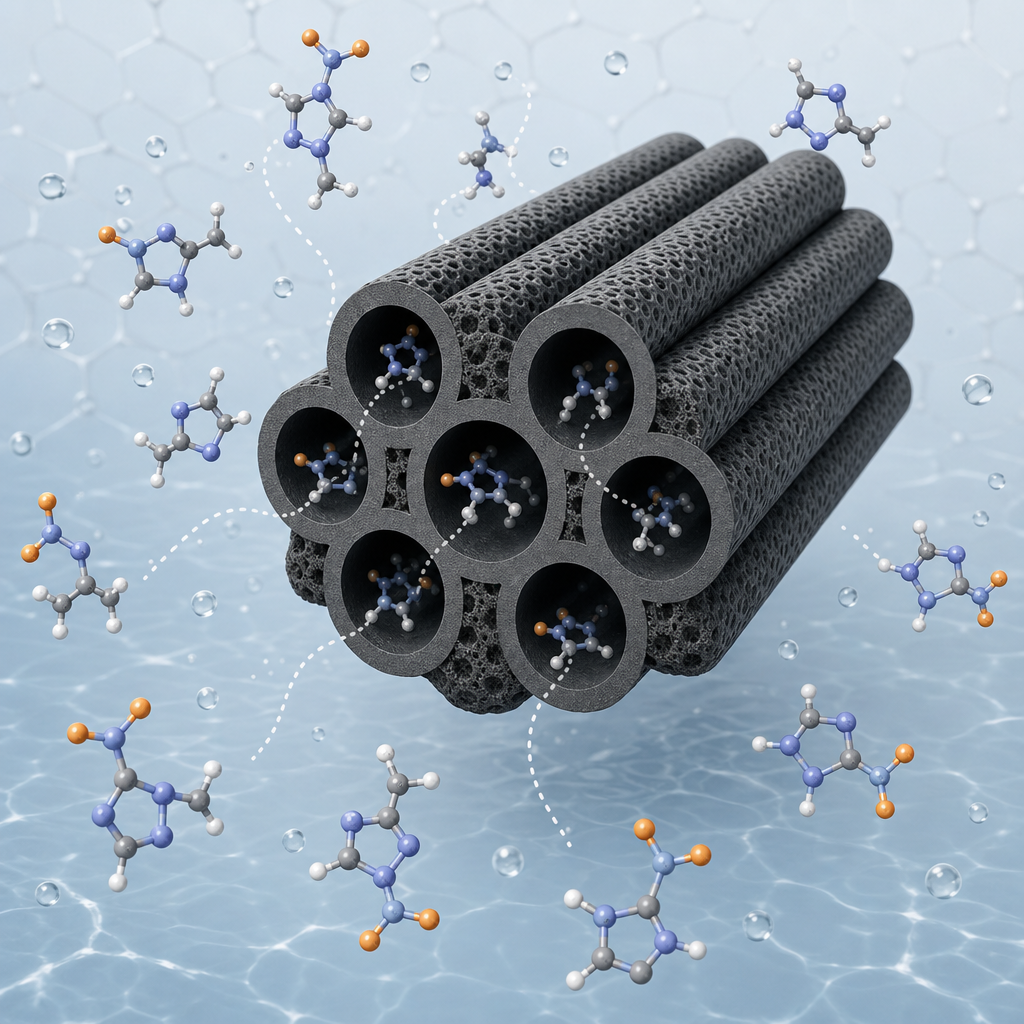
CMK-3 from ACS Material was used as the ordered mesoporous carbon reference. The material was characterized by N2 physisorption at 77 K on a Micromeritics ASAP 2020, yielding a BET surface area of 917 m2/g and a total pore volume of 1.40 cm3/g. The N2 isotherm was type IV with an H2 hysteresis loop, consistent with the templated mesostructure derived from SBA-15 silica. Pore-size analysis showed that CMK-3 was 4% microporous, 76% mesoporous, and 20% macroporous, with a mean pore diameter of 6.10 nm. Boehm titration revealed the highest total acidic site concentration of any sample tested at 1.055 meq/g, dominated by carboxylic groups (0.906 meq/g). The point of zero charge was 3.52, the most acidic of the carbons studied. The material was washed with deionized water to remove carbon dust, then deployed in 50 mL batch adsorbers with MNZ solutions of 50–1000 mg/L at controlled pH, ionic strength, and temperature.
The adsorption capacity ranking, expressed as descending uptake of MNZ, was F400 > ACF > F400-HNO3 > CMK-3 > MWCNT > MWCNT-HNO3. Although CMK-3 had a surface area comparable to F400 (917 vs. 919 m2/g), its capacity was lower because MNZ molecules (projected area 4.186 × 10⁻19 m2) preferentially populated the narrow micropores of F400 and ACF, where dispersive adsorbent–adsorbate interactions are maximized. HNO3 oxidation of F400 and MWCNT reduced their capacity by increasing acidic surface groups that hydrogen-bond with water, blocking the hydrophobic adsorption sites needed for the neutral MNZ molecule (predominant between pH 4–12). Adsorption was largely insensitive to ionic strength (0.01–1 N NaCl) and temperature (15–35 °C), confirming weak, physisorption-dominated interactions. Notably, MNZ uptake was enhanced when solutions were prepared in treated municipal wastewater rather than deionized water, indicating that background electrolytes cooperated with, rather than competed against, the antibiotic for adsorption sites. Desorption experiments on all six carbons demonstrated reversibility, further corroborating weak adsorbate–adsorbent bonding.
The findings have direct implications for designing carbon-based polishing units in wastewater treatment plants serving pharmaceutical manufacturers, hospitals, fish-farms, and meat-processing facilities, all of which discharge nitroimidazoles. The reversibility of adsorption is doubly significant: it means saturated adsorbents can in principle be regenerated, but it also means that downstream pH or matrix changes could re-release the antibiotic if process control is poor. The data also clarify when ordered mesoporous carbons such as CMK-3 are and are not the right choice: for small antibiotic molecules like MNZ, microporous activated carbons outperform mesoporous templated carbons, but CMK-3 remains attractive for larger pharmaceutical molecules or for applications requiring fast intra-particle diffusion. Follow-up studies on kinetics, fixed-bed breakthrough, and regeneration cycles are natural extensions.
For researchers screening carbon adsorbents for pharmaceutical contaminants, ACS Material supplies CMK-3 ordered mesoporous carbon along with a broad range of activated carbons, multiwalled carbon nanotubes, and functionalized variants in the Carbon Series. The well-defined SBA-15-templated mesostructure of CMK-3 makes it a useful reference material when investigating how pore architecture, rather than surface area alone, governs adsorption performance for emerging organic micropollutants.How ACS Material products were used
- Ordered Mesoporous Carbon CMK-3 (Carbon Series) — “The MWCNT and OMC were supplied by SUN Nanotech Co. Ltd. and ACS Material, respectively, and the latter had the trade name of CMK-3.”
Product Performance in this StudyCMK-3 from ACS Material served as one of four benchmark carbon adsorbents for metronidazole removal. Its ordered mesoporous structure (76% mesopore volume, SBET = 917 m2/g) provided an intermediate adsorption capacity, ranking fourth in the series F400 > ACF > F400-HNO3 > CMK-3 > MWCNT > MWCNT-HNO3, with the highest total acidic site concentration (1.055 meq/g) among all materials tested.
Related product categories
Frequently asked questionsHow does CMK-3 ordered mesoporous carbon perform for antibiotic adsorption compared to activated carbon?
In this study, CMK-3 ranked fourth among six carbons for metronidazole adsorption, behind microporous activated carbons F400, ACF, and F400-HNO3, but ahead of multiwalled carbon nanotubes. Although CMK-3 had a comparable BET surface area to F400 (917 vs 919 m2/g), its predominantly mesoporous structure (76% mesopores, 6.10 nm mean pore diameter) provided weaker dispersive interactions with the small metronidazole molecule than F400's narrow micropores.
Why does HNO3 functionalization reduce metronidazole adsorption on carbon materials?
HNO3 treatment increases surface concentrations of carboxylic, lactonic, and phenolic groups, lowering the point of zero charge. These polar oxygen functionalities hydrogen-bond strongly with water molecules, which preferentially occupy adsorption sites and block hydrophobic interactions with neutral metronidazole. Both F400-HNO3 and MWCNT-HNO3 showed reduced capacity compared to their unmodified counterparts, confirming that hydrophobic, dispersive interactions dominate metronidazole uptake.
What is CMK-3 mesoporous carbon used for in water treatment research?
CMK-3 is an SBA-15-templated ordered mesoporous carbon with high surface area and uniform 6 nm mesopores, used as a model adsorbent for pharmaceuticals, dyes, heavy metals, and other organic micropollutants. Its well-defined pore architecture makes it valuable for fundamental studies separating the effects of pore size, surface area, and surface chemistry on adsorption, and as a benchmark when evaluating new mesoporous carbon adsorbents.