-
CMK-3 Mesoporous Carbon for Ionic-Liquid EDLCs - Fraunhofer ICT, 2015
Jul 09, 2026 | ACS MATERIAL LLCRoznyatovskaya, N. et al. (2015). Sieving Effects in Electrical Double-Layer Capacitors Based on Neat [Al(Hfip)4]−and [NTf2]−Ionic Liquids. *ChemElectroChem*. https://doi.org/10.1002/celc.201500024
ChemElectroChem · 2015
Fraunhofer ICT and University of Freiburg use ACS Material CMK-3 ordered mesoporous carbon to demonstrate the sieving effect in neat ionic-liquid supercapacitors.
About this research
Researchers at the Fraunhofer Institute for Chemical Technology (ICT), working together with the Institute for Inorganic and Analytical Chemistry at the University of Freiburg, used ACS Material ordered mesoporous carbon CMK-3 as a key electrode material to demonstrate the sieving effect in electrical double-layer capacitors (EDLCs) built with neat fluorinated alkoxyaluminate [Al(hfip)4]- and bis(trifluoromethylsulfonyl)imide [NTf2]- ionic liquids. By comparing micro-, meso-, and macroporous carbon electrodes against eight different ionic liquids, the team showed that ion-size/pore-size matching, rather than transport properties alone, governs capacitance in neat IL electrolytes. The work was published in ChemElectroChem in 2015.
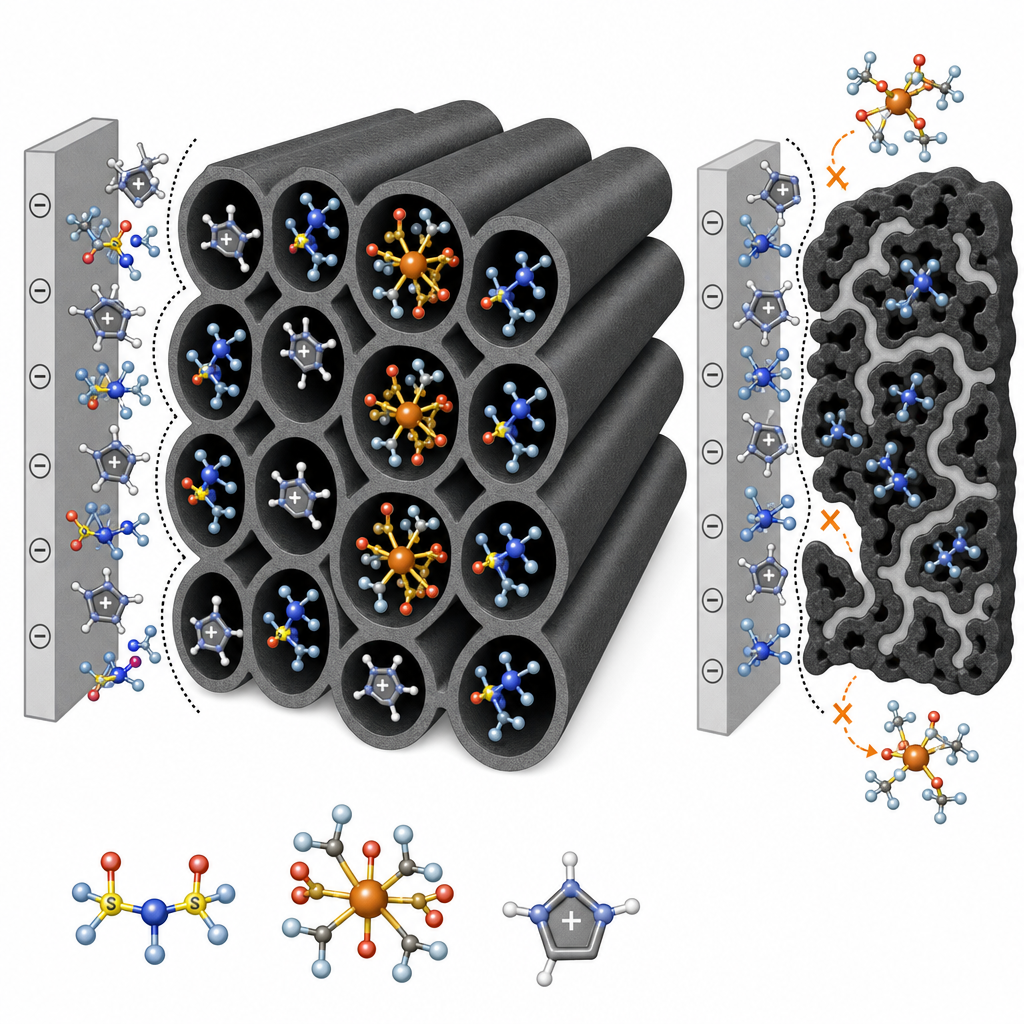
Ionic liquids are attractive EDLC electrolytes because they are non-volatile, hydrophobic, and electrochemically stable over wide windows, allowing solvent-free operation in supercapacitors aimed at hybrid-electric vehicles and pulsed-power electronics. However, the link between IL ion size and electrode pore size is still controversial: some reports show that solvated ions can enter sub-nanometer pores, while others argue that the pore-size distribution must clearly exceed the ion size for efficient charging. The new weakly coordinating aluminate anion [Al(hfip)4]- offers high ionicity, low ion pairing, and competitive viscosities and conductivities versus [NTf2]-, but it is roughly 150% larger by volume (0.58 vs 0.23 nm3). That made it an excellent probe to isolate the geometric (sieving) contribution from the dynamic transport contribution.
The ACS Material ordered mesoporous carbon CMK-3 was spray-coated from an ethanol suspension with 5 wt% PTFE binder onto a Sigracet AA10 carbon-paper gas-diffusion-layer support to create the AA10cm electrode (1.0 cm discs, loading 0.94-1.04 mg). The CMK-3 layer combined with the carbon-paper support exhibited a BET surface area of 110 m2/g, total pore volume of 0.137 cm3/g, and an average pore size of 1.5-1.9 nm, while the neat CMK-3 powder is specified at 1431 m2/g, 1.51 cm3/g, and 1.9 nm pores. After drying at 130 degC, electrodes were assembled in a modified Swagelok cell with a glass-microfiber separator, stainless-steel current collectors, and 20-40 microliters of ionic liquid. CMK-3 was used alongside Ketjenblack EC-600 JD (AA10K), thermally reduced graphene oxide (AA10Gr), and microporous activated carbon cloth ACC-5902-20 (AC20) to span pore regimes from below ion size to well above.
Impedance spectroscopy, cyclic voltammetry, and galvanostatic charge-discharge between 0 and 1.7 V revealed clear sieving behavior. On the microporous AC20 cloth (0.86 nm pores, 1699 m2/g), [C2MIm][NTf2] reached high specific capacitance consistent with literature, while the larger [Al(hfip)4]- ILs lost one to two orders of magnitude of capacitance because their 1.166 nm anions cannot enter the sub-nanometer micropores. On the mesoporous CMK-3-based AA10cm electrodes, that handicap disappeared: [C4MMIm][Al(hfip)4] and [N1444][Al(hfip)4] delivered specific capacitances similar to or even exceeding their [NTf2]- analogues. The order of suitability from low-frequency capacitance and equivalent series resistance was [C4MIm][NTf2] > [C4MMIm][Al(hfip)4] > [N1444][Al(hfip)4] > [N1444][NTf2]. Ragone-plot analysis showed a maximum specific energy of 10-12 Wh/kg for complete capacitors with [Al(hfip)4]- or [NTf2]- ILs on optimized carbon over 0-1.7 V, with mesoporous electrodes (including the CMK-3 layer) showing nearly IL-independent capacitance. The team also confirmed that the first counter-ion layer governs screening: an [Al(hfip)4]- ion covers ~1.07 nm2 versus 0.41 nm2 for [NTf2]-, and its charge center sits 0.58 nm from the electrode versus 0.27 nm, partly offsetting its better bulk transport.
The findings have direct implications for designing high-voltage, solvent-free supercapacitors for transport and grid applications, where ionic liquids based on weakly coordinating anions are increasingly considered. They show that pairing bulky, low-ion-pairing aluminate ILs with carbons whose pores comfortably exceed the anion diameter, such as ordered mesoporous CMK-3, is essential to translate good transport into real capacitance. The work points toward further studies on neat ILs in mesoporous and hierarchical carbons, on tuning anion size for specific pore distributions, and on combining aluminate ILs with high-surface-area mesoporous frameworks or graphene-based macroporous coatings used in flexible and high-temperature supercapacitors.
For researchers developing supercapacitor electrodes, ionic-liquid electrolytes, or porous-carbon-based electrochemical devices, this paper highlights the importance of using a well-characterized mesoporous carbon when probing ion-size effects. ACS Material supplies ordered mesoporous carbon CMK-3 with the high surface area and narrow mesopore distribution used here, alongside related porous carbons, MXenes, and graphene materials suitable for EDLC, hybrid capacitor, and electrocatalysis studies.How ACS Material products were used
- Ordered Mesoporous Carbon CMK-3 (Carbon Series) — “ordered mesoporous carbon (cmk-3, ACS Material Advanced Chemicals)”
Product Performance in this Study
CMK-3 served as one of the mesoporous carbon electrode materials (electrode AA10cm) used to probe the sieving effect. With its ~1.9 nm mesopores it accommodated both [NTf2]- and the larger [Al(hfip)4]- anions, allowing the bulky aluminate ionic liquids to deliver specific capacitances comparable to those obtained with [NTf2]- analogues, in contrast to the sharp capacitance drop seen on microporous carbon.
Related product categories
Frequently asked questions
What is the sieving effect in ionic-liquid supercapacitors?
The sieving effect describes how electrode pores must be at least as large as the ions of the electrolyte to be electrochemically accessible. In this study, when neat [Al(hfip)4]- ionic liquids were paired with microporous carbon ACC-5902 (0.86 nm pores), the 1.166 nm aluminate anion could not enter the pores and the capacitance dropped by one to two orders of magnitude relative to smaller [NTf2]- ionic liquids.
Why was ordered mesoporous carbon CMK-3 chosen as an electrode material?
CMK-3 has narrow mesopores around 1.9 nm and a high BET surface area of about 1431 m2/g, which is larger than both [NTf2]- (0.23 nm3) and [Al(hfip)4]- (0.58 nm3) anions. This makes it an ideal platform to test whether bulky weakly coordinating anions can deliver their intrinsic capacitance once pore accessibility is no longer limiting, isolating sieving effects from ion-transport effects.
How does [Al(hfip)4]- ionic liquid perform compared to [NTf2]- in mesoporous carbon electrodes?
On mesoporous electrodes such as the AA10cm layer prepared from CMK-3, [Al(hfip)4]- ionic liquids reach specific capacitances similar to or even slightly higher than their [NTf2]- analogues. Full cells deliver up to 10-12 Wh/kg between 0 and 1.7 V. The advantage of low ion pairing and good transport is fully expressed only when the carbon mesopores comfortably accommodate the larger aluminate anion.