-
CMK-3 Mesoporous Carbon for s-Tetrazine Li-Ion Batteries - Seoul National University, 2019
Jun 15, 2026 | ACS MATERIAL LLCMin, D. J. et al. (2019). s‐Tetrazines as a New Electrode‐Active Material for Secondary Batteries. *ChemSusChem*. https://doi.org/10.1002/cssc.201802290
Center for Supramolecular Optoelectronic Materials (CSOM) Research Institute of Advanced Materials (RIAM) Department of Materials Science and Engineering Seoul National University Seoul 08826 Republic of Korea · ChemSusChem · 2019
Researchers at Seoul National University used ACS Material CMK-3 ordered mesoporous carbon to encapsulate s-tetrazine electrode molecules, achieving 100% theoretical capacity and 82.5% retention over 300 cycles.
About this research
Researchers from the Center for Supramolecular Optoelectronic Materials (CSOM) Research Institute of Advanced Materials (RIAM) Department of Materials Science and Engineering Seoul National University Seoul 08826 Republic of Korea, working with collaborators at ENS Paris-Saclay, used ordered mesoporous carbon CMK-3 from ACS Material to encapsulate s-tetrazine derivatives and demonstrate them, for the first time, as electrode-active materials in lithium-ion secondary batteries. The DPT/CMK-3 composite at a 1:2 weight ratio reached essentially 100% of the theoretical capacity (116 mAh/g) of 3,6-diphenyl-1,2,4,5-tetrazine (DPT) and retained 82.5% of its discharge capacity over 300 cycles at 1 C, validating both the new redox chemistry and the carbon-confinement strategy used to suppress dissolution of small organic redox molecules into the electrolyte.
Organic electrodes are increasingly attractive replacements for transition-metal oxide cathodes because they offer low cost, natural abundance, environmental friendliness, and broad structural diversity. However, the field has so far relied on only a handful of redox-active motifs: conjugated carbonyls, organosulfurs, conducting polymers, and nitroxide radicals. Each of these suffers from limitations in rate capability, cycle life, or dissolution into liquid electrolytes. Expanding the library of stable, reversible redox-active organic groups is therefore a central challenge for next-generation rechargeable batteries, including not only Li-ion cells but also sodium, magnesium, zinc, and organic redox flow systems where standard reduction potentials and electrolyte compatibility differ significantly from those of conventional inorganic cathodes.
The authors selected 1,2,4,5-tetrazine (s-tetrazine), the most electron-deficient stable six-membered C–N aromatic ring, because it undergoes a clean one-electron reduction to a stable anion radical. They synthesized four derivatives—DPT, DCT, CET, and DMT—with substituents that tune the LUMO and redox potential from −0.54 to −1.18 V vs Ag+/Ag. Because the small tetrazine molecules dissolve readily in carbonate and even ether electrolytes, the team turned to ACS Material's ordered mesoporous carbon CMK-3 (BET1000 grade, 99% purity) as a confinement host. DPT and CMK-3 were dispersed in dimethylformamide at three weight ratios (2:1, 1:1, 1:2), sonicated, and dried under vacuum. FE-SEM, FT-IR, and PXRD confirmed that at the 1:2 ratio (composite C) the DPT molecules were almost fully infiltrated inside the CMK-3 mesopores, with negligible external aggregation. The composite was then formulated with Super P carbon black and PVDF (8:1:1 by weight) and coated on aluminum foil for CR2032 coin-cell testing against lithium metal.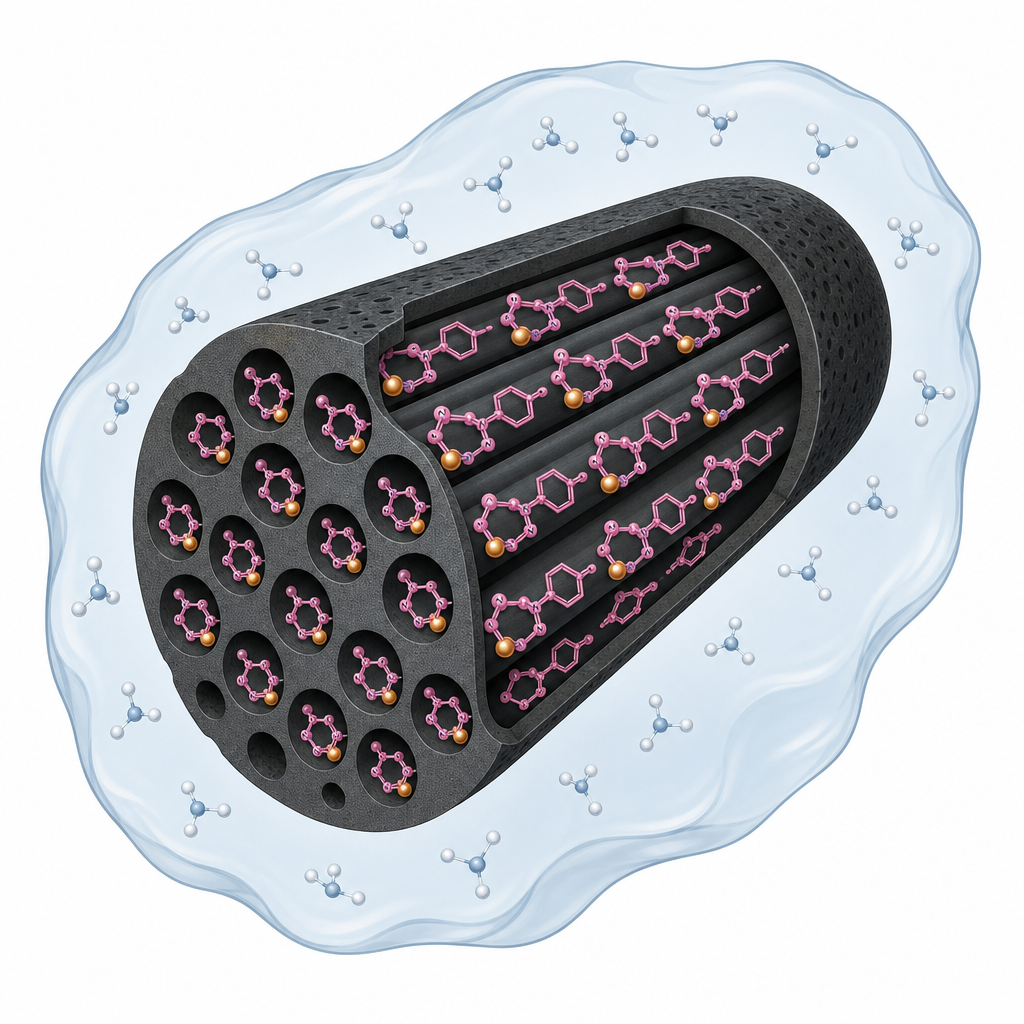
The quantitative benefits of CMK-3 encapsulation were substantial. Bare DPT in a 2 M LiTFSI DOL/DME (2DD) electrolyte delivered only 72 mAh/g at the first cycle and retained 58% after 20 cycles. In contrast, composite C delivered 116 mAh/g at the first cycle—essentially identical to the theoretical capacity of DPT—and retained 80% of that capacity after 20 cycles at 0.1 C. When cycled at 1 C, composite C still delivered 99 mAh/g after 300 cycles, corresponding to 82.5% of the second-cycle capacity. A dissolution test in 2DD electrolyte showed that composite C produced only a very faint color change after 12 hours, whereas bare DPT and the 2:1 and 1:1 composites rapidly tinted the electrolyte pink, confirming that the CMK-3 nanopores physically trap the tetrazine. Ex-situ XPS analysis (Li 1s at 55.6 eV, N 1s shift of ~0.6 eV) demonstrated reversible Li+ binding through resonance-delocalized electron storage across all four nitrogens of the tetrazine ring, while the chlorinated analog DCT showed irreversible Li–Cl formation.
This work opens s-tetrazines as a new class of redox-active organic electrode group, with potential beyond Li-ion cells. Because DPT's redox potential (2.3 V vs Li+/Li) sits between typical anodes and cathodes, the authors specifically note that s-tetrazines could serve as anodes in Na-ion or Mg-ion batteries, and as flexible redox couples in organic redox flow batteries. The easy derivatization of the tetrazine ring also allows researchers to tune the redox potential across more than 600 mV simply by changing substituents, useful for matching electrode pairs and electrolyte windows. Beyond batteries, the CMK-3 confinement strategy demonstrated here is broadly transferable to any small-molecule redox-active organic that suffers from electrolyte dissolution.
For researchers developing organic electrodes, sulfur cathodes, or any system requiring confinement of small redox-active molecules, the ordered mesoporous carbon CMK-3 used in this study is available from ACS Material. Its high surface area (~1000 m²/g) and well-defined hexagonal mesopore array make it a practical scaffold for translating molecular electrochemistry into stable, cyclable composite electrodes. This paper provides a clear, quantitative benchmark of what CMK-3 confinement can deliver: full theoretical capacity utilization and several-hundred-cycle stability for a previously untested organic redox group.How ACS Material products were used
- Ordered Mesoporous Carbon CMK-3 (Carbon Series) — “DPT and CMK-3 (BET1000, 99%, ACS Material) were mixed in dimethylformamide (DMF) with various mixing ratios (DPT:CMK-3 = 1:2, 1:1, and 2:1 by weight, respectively).”
Product Performance in this StudyCMK-3 mesoporous carbon was used to encapsulate s-tetrazine molecules in its nanopores, effectively preventing their dissolution in the electrolyte. The 1:2 DPT:CMK-3 composite achieved ~100% theoretical capacity utilization (116 mAh/g) and retained 82.5% of capacity after 300 cycles at 1 C.
Related product categories
Frequently asked questionsWhy is CMK-3 mesoporous carbon used to host organic electrode molecules?
CMK-3 has a highly ordered hexagonal array of mesopores with a surface area near 1000 m²/g, which physically traps small redox-active organic molecules inside the pore network. This confinement prevents the molecules from dissolving into liquid electrolytes during cycling. In this study, encapsulating DPT inside CMK-3 raised first-cycle capacity to 100% of theoretical value and enabled 82.5% capacity retention over 300 cycles at 1 C.
What is the optimal weight ratio for a DPT/CMK-3 composite electrode?
The authors tested DPT:CMK-3 ratios of 2:1, 1:1, and 1:2 by weight. Only at 1:2 were the DPT molecules almost fully confined inside the CMK-3 mesopores, as shown by reduced FT-IR and PXRD signals and SEM imaging. The 1:2 composite delivered 116 mAh/g (theoretical), while higher DPT loadings showed external aggregates that dissolved into the electrolyte and faded quickly during cycling.
How do s-tetrazines store lithium ions reversibly?
The four nitrogen atoms in the s-tetrazine ring share an added electron through resonance, allowing a single electron and a Li+ ion to bind reversibly during discharge. Ex-situ XPS showed a clean Li 1s peak at 55.6 eV emerging on discharge and disappearing on recharge, plus a small ~0.6 eV N 1s shift consistent with delocalized charge storage. The redox plateau for DPT occurs near 2.3 V vs Li+/Li.