-
CMK-3 Mesoporous Carbon Host for Triptycene Quinone Li-ion Cathodes - Seoul National University, 2018
Jun 04, 2026 | ACS MATERIAL LLCKwon, J. E. et al. (2018). Triptycene-Based quinone molecules showing multi-Electron redox reactions for large capacity and high energy organic cathode materials in Li-Ion batteries. *Journal of Materials Chemistry A*. https://doi.org/10.1039/c7ta09968a
Center for Supramolecular Optoelectronic Materials (CSOM) · Journal of Materials Chemistry A · 2018
Researchers used CMK-3 ordered mesoporous carbon (BET1000, ACS Material) to confine triptycene-tribenzoquinone cathodes, delivering 387 mAh/g and 1032 Wh/kg with 80% retention after 100 cycles.
About this research
Chemists at the Center for Supramolecular Optoelectronic Materials (CSOM), working with collaborators at the Catholic University of Korea and POSTECH, used CMK-3 ordered mesoporous carbon supplied by ACS Material to stabilize a new triptycene-based organic cathode that delivered 387 mAh/g and an energy density of 1032 Wh/kg in lithium-ion coin cells. The active material, triptycene-tribenzoquinone (TT), undergoes a five-electron redox reaction enabled by three benzoquinone fins arranged in a rigid 3-D tripod. Confining TT inside the CMK-3 host pushed capacity retention from roughly 11% to about 80% after 100 cycles at 1 C, turning a high-capacity but soluble organic redox molecule into a practically cyclable cathode.
Quinone-based organic cathodes are an attractive alternative to cobalt- and nickel-rich oxides because they are made from earth-abundant elements, can be tuned by synthetic chemistry, and can store multiple electrons per molecule. The theoretical capacity of p-benzoquinone (BQ) is 496 mAh/g, but volatility and high solubility in liquid electrolytes have prevented its direct use. Earlier strategies, such as linking BQ units into polymers or covalent organic frameworks, add redox-inactive mass and dilute the achievable capacity. The challenge for the field is therefore to maximize the fraction of redox-active C=O sites while still preventing dissolution and parasitic side reactions, and to keep the redox potential high enough to deliver competitive energy density.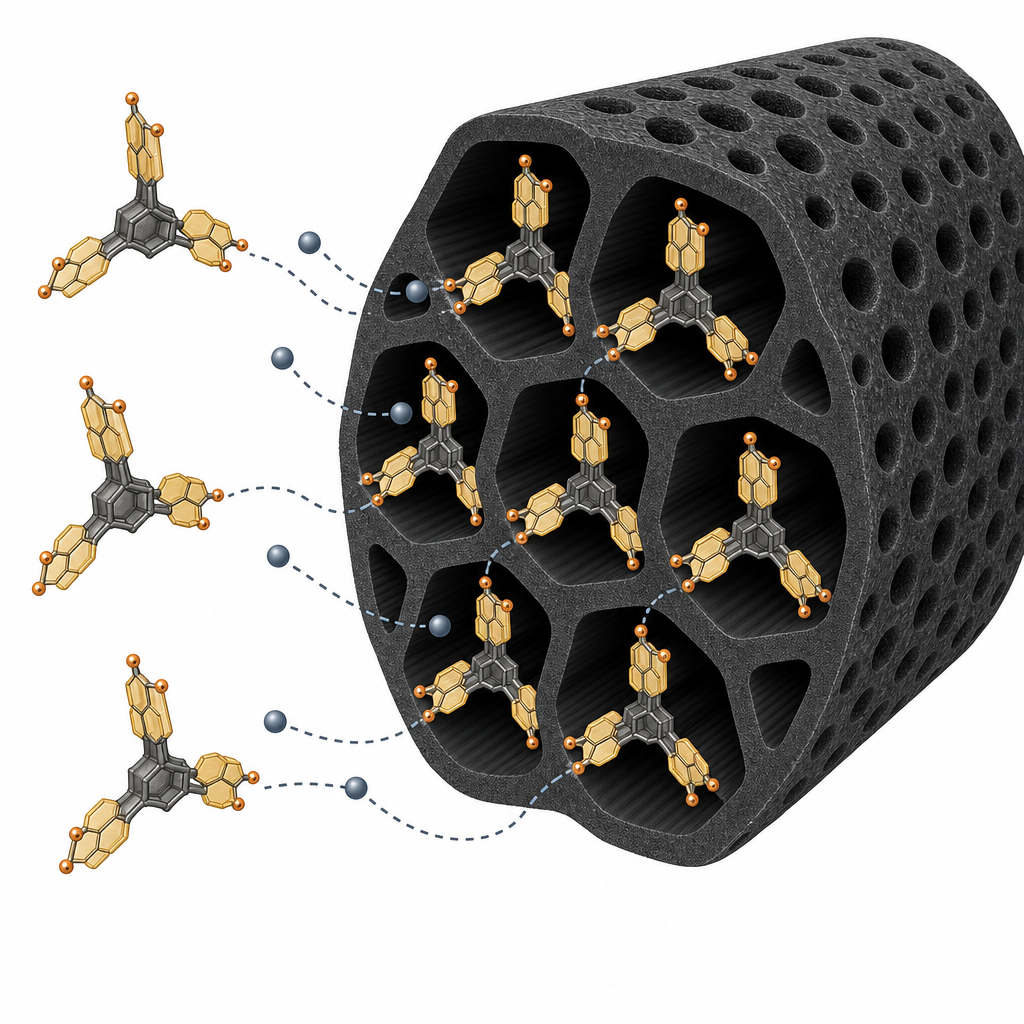 In this work, three BQ units are fused onto a rigid triptycene scaffold to give TT, the smallest 3-D iptycene-like quinone with six C=O sites. Cyclic and differential pulse voltammetry, combined with DFT calculations, show that the triptycene linker delocalizes the LUMO and increases the electron affinity from 2.22 eV (BQ) to 3.07 eV (TT), raising the first reduction potential while still allowing five reversible electrons. Because pristine TT is slightly soluble in ether-based electrolytes, the authors prepared TT/CMK-3 nanocomposites by dissolving TT and CMK-3 (BET1000, 99%, ACS Material) in DMF, ultrasonicating for 1 h, and slowly evaporating the solvent under ambient and then vacuum conditions. FTIR, PXRD, and FE-SEM confirmed that at TT:CMK-3 ratios of 2:3 and 1:2, the TT molecules were confined inside the mesoporous channels of the CMK-3 carbon rather than crystallized on the outside.
The TT cathode in a Li/2 M LiTFSI in DME:DOL (1:1) + 1 wt% LiNO3 ("2DD1L") cell delivered an initial discharge capacity of 387 mAh/g, corresponding to the insertion of 5.0 Li+ per molecule, and an average lithiation/de-lithiation voltage of 2.90/2.96 V vs. Li/Li+. The resulting practical energy density of 1032 Wh/kg is about twice that of LiCoO2 (546 Wh/kg) or LiFePO4 (578 Wh/kg) on an active-material basis. However, bare TT lost most of its capacity, retaining only 37 mAh/g (11%) after 100 cycles at 1 C due to dissolution into the electrolyte. The TT-CMK-3-11 composite (1:1 by weight) only partially solved this, because excess TT remained outside the pores. By contrast, TT-CMK-3-23 (2:3) and TT-CMK-3-12 (1:2) cathodes showed gradual capacity activation over the first cycles and then stabilized, retaining approximately 80% of their initial capacity after 100 cycles at 1 C while preserving rate capability comparable to bare TT from 0.1 to 1 C. A composite polymer electrolyte alone could not stop fading, underscoring that physical confinement inside CMK-3 was the decisive factor.
The results have direct implications for next-generation lithium and post-lithium batteries targeted at electric vehicles and grid storage, where sustainability, capacity, and energy density all matter. The same host-guest strategy is transferable to other small redox-active organics, from carbonyl molecules and organosulfurs to redox-active COFs, and the triptycene design principle offers a template for compact multi-electron quinones. Ordered mesoporous carbons such as CMK-3 are already widely used in Li-S chemistry to trap polysulfides; this study extends their role to high-capacity organic cathodes and suggests that pore size, surface area (here ~1000 m2/g), and loading ratio can be tuned to balance ion access, electronic conductivity, and dissolution suppression.
For researchers developing organic electrodes, redox-flow chemistries, or molecularly confined catalysts, ordered mesoporous carbon CMK-3 of the BET1000 grade described here is available from ACS Material as part of the Carbon Series. This paper illustrates a clear, reproducible protocol for turning a soluble multi-electron organic redox molecule into a stable composite cathode, and it provides quantitative benchmarks (387 mAh/g, 1032 Wh/kg, ~80% retention after 100 cycles at 1 C) that downstream studies can target.How ACS Material products were used
- Ordered Mesoporous Carbon CMK-3 (BET1000) (Carbon Series) — “The different amount of TT and CMK3 (BET1000, 99%, ACS Material) were dissolved in dimethylformamide (DMF).”
Product Performance in this Study
CMK-3 served as a porous host that encapsulated the triptycene tribenzoquinone (TT) molecules to suppress their dissolution into the liquid electrolyte. With CMK-3 confinement, the TT-CMK3-23 and TT-CMK3-12 nanocomposite cathodes retained roughly 80% of their initial capacity after 100 cycles at 1 C, compared to only 11% retention for bare TT, demonstrating that CMK-3 is critical to achieving stable cycling.
Related product categories
Frequently asked questions
Why is CMK-3 used as a host for organic cathode materials?
CMK-3 is an ordered mesoporous carbon with a high BET surface area (around 1000 m2/g in this study) and uniform mesopores. When small organic redox molecules such as triptycene-tribenzoquinone are infiltrated into these pores, the carbon walls trap the molecules and prevent them from dissolving into the liquid electrolyte. In this paper, CMK-3 confinement raised 100-cycle capacity retention from about 11% to roughly 80% at 1 C while preserving rate capability.
What capacity and energy density did the triptycene-tribenzoquinone cathode achieve?
The triptycene-tribenzoquinone (TT) cathode delivered an initial discharge capacity of 387 mAh/g at 0.1 C in Li-ion coin cells, corresponding to insertion of 5.0 Li+ per molecule via a five-electron redox reaction. With first lithiation/de-lithiation voltages of 2.90/2.96 V vs. Li/Li+, the practical energy density reached 1032 Wh/kg, nearly twice that of conventional LiCoO2 (546 Wh/kg) or LiFePO4 (578 Wh/kg) on an active-material basis.
How is a quinone/CMK-3 nanocomposite electrode prepared?
In this study, the quinone and CMK-3 were dissolved or dispersed together in dimethylformamide at a chosen weight ratio (1:1, 2:3, or 1:2), ultrasonicated for one hour, then the solvent was evaporated slowly overnight under ambient conditions and the residue dried under vacuum. The composite was mixed with carbon black and PVDF binder in NMP at 8:1:1, cast on aluminum foil, and dried at 120 °C before coin-cell assembly.