-
CMK-3 Mesoporous Carbon Supercapacitor Benchmark - KAIST, 2014
Jun 15, 2026 | ACS MATERIAL LLCZhang, J., & Lee, J. W. (2014). Supercapacitor Electrodes Derived from Carbon Dioxide. *ACS Sustainable Chemistry & Engineering*. https://doi.org/10.1021/sc400414r
Korea Advanced Institute of Science and Technology (KAIST) · ACS Sustainable Chemistry & Engineering · 2014
KAIST researchers benchmark CO2-derived boron-doped porous carbons against ACS Material CMK-3, achieving ~133 F/g specific capacitance in 1 M Na2SO4.
About this research
Researchers at Korea Advanced Institute of Science and Technology (KAIST) used Ordered Mesoporous Carbon CMK-3 supplied by ACS Material as the benchmark electrode to validate a new class of supercapacitor carbons synthesized directly from carbon dioxide, ultimately reaching a specific capacitance of around 133 F/g in 1 M Na2SO4. The paper, published in ACS Sustainable Chemistry & Engineering in 2014 by Junshe Zhang and Jae W. Lee, demonstrates that boron-doped porous carbons (BPCs) produced by the reaction of CO2 with NaBH4 at ~500 °C, followed by KOH activation, can outperform well-ordered mesoporous carbons as electric double-layer capacitor (EDLC) electrodes. CMK-3 served as the reference point that gave the new BPC electrodes a credible, literature-recognized basis for comparison.
The broader context of this research is the persistent gap between supercapacitor power density and battery-level energy density. While EDLCs offer fast charge-discharge and million-cycle lifetimes, their energy density (2-5 Wh/kg) is an order of magnitude lower than batteries. Improving the specific capacitance of carbon electrodes - typically 100-200 F/g in organic electrolytes - is a primary lever. The work also addresses sustainability: turning waste CO2 into a value-added electrode material couples carbon capture with energy storage. Boron doping has previously been shown to enhance capacitance in mesoporous carbons by introducing pseudocapacitive contributions and modifying electronic structure, but CO2-derived BPCs had never before been evaluated as EDLC electrodes.
ACS Material's CMK-3 ordered mesoporous carbon was used as a comparison electrode in cyclic voltammetry (CV) testing. Working electrodes were prepared by mixing the active carbon, carbon black, and PTFE binder in an 80:10:10 mass ratio, dispersing the paste onto pretreated nickel foam current collectors as 1 cm × 1 cm sheets, pressing, and drying at 105 °C overnight. Electrochemical performance was measured in a three-electrode cell with Ag/AgCl reference and Pt counter electrode in 1 M Na2SO4 aqueous electrolyte using a CHI 600D analyzer. CMK-3 was tested alongside untreated BPC (U-BPC) and KOH-activated BPC (K-BPC) under identical conditions at a scan rate of 20 mV/s in the -0.4 to 0.6 V window. The CMK-3 reference provided a quantitative ordered-mesoporous-carbon baseline against which microporosity-driven enhancements in the new materials could be judged.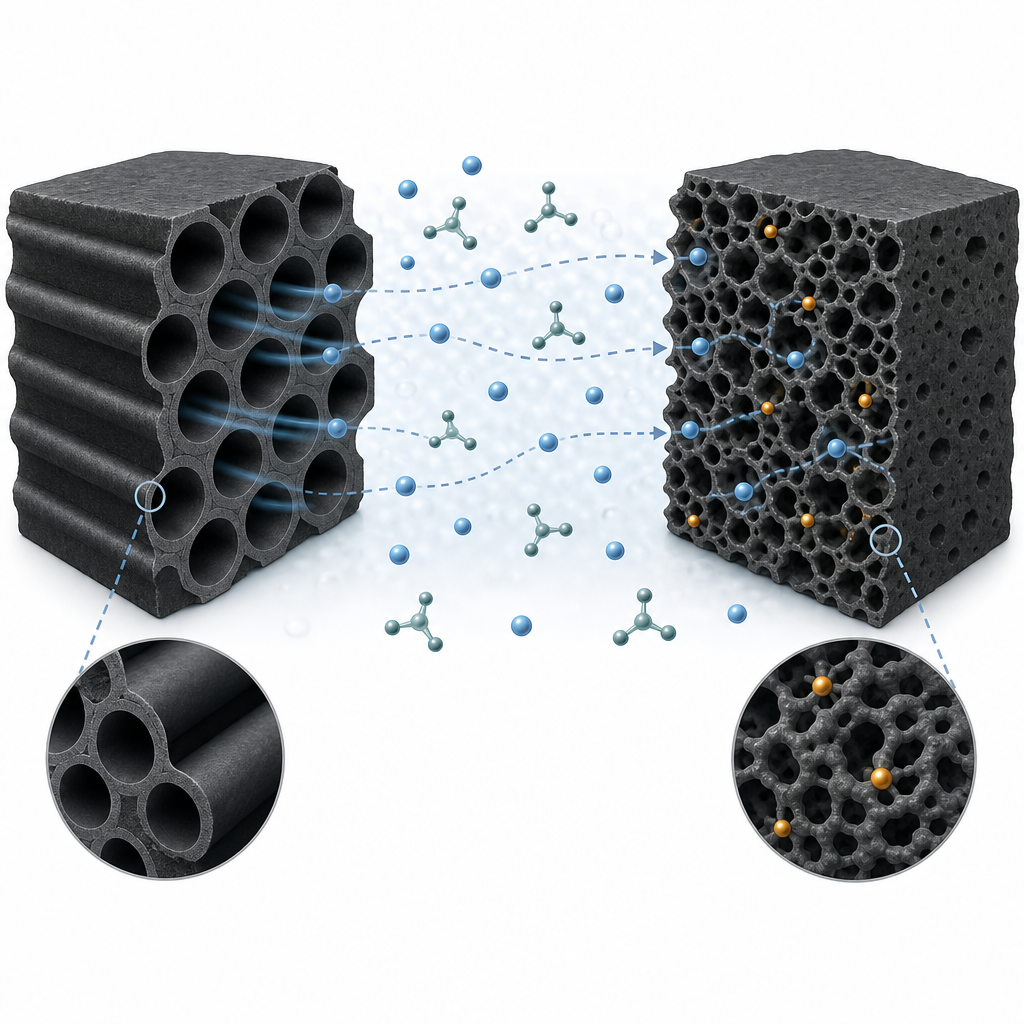
The quantitative results are striking. The CV enclosed areas were 0.68 AV/g for untreated BPC, 2.94 AV/g for ACS Material CMK-3, and 4.79 AV/g for KOH-activated BPC, showing the KOH activation roughly septupled capacitance and exceeded the ordered mesoporous benchmark. Galvanostatic discharge gave specific capacitances of ~133 F/g for K-BPC across current densities of 1.35 to 6.76 A/g, with an initial IR drop of 0.065 V at 1.35 A/g corresponding to an internal resistance of 3.25 Ω. Cycling stability tests at 3.3 A/g showed 139 F/g initially, dropping to 130 F/g after 3510 cycles - 93% capacitance retention. Nitrogen adsorption gave a BET surface area of ~1800 m²/g (about 5x the untreated BPC), total pore volume 1.2 cm³/g, and micropore volume 0.7 cm³/g (t-plot). Pore size distribution showed a principal micropore peak at 0.63 nm plus mesopore peaks at 3.8 and 22.8 nm. Raman analysis showed an increased D/G ratio after KOH activation, indicating greater disorder. XPS detected B-C (188 eV) and O-B-C (191 eV) species in U-BPC; elemental analysis estimated bulk boron at ~0.034 atomic fraction in K-BPC. The authors conclude that the high BET surface area and well-defined micropores, rather than boron doping, dominate the enhanced capacitance.
The findings open multiple application avenues. CO2-derived carbons could feed sustainable supercapacitor manufacturing for portable electronics, hybrid electric vehicles, grid-scale storage buffers, and industrial backup power - all areas where EDLCs are already deployed but where lower-cost, lower-carbon-footprint electrode materials would expand adoption. The KOH activation route is compatible with existing porous-carbon production infrastructure. The authors point to ongoing work on engineering CO2-derived carbons with narrow but small pores, targeting simultaneous improvements in energy density and power density. Adjacent fields - electrocatalysis, oxygen reduction reaction, lithium-ion battery anodes, and CO2 capture-and-conversion processes - could also benefit from the boron-doped microporous architecture demonstrated here.
For researchers benchmarking new porous carbons against an established reference, ACS Material's Ordered Mesoporous Carbon CMK-3 provides a reproducible, literature-anchored standard with well-characterized hexagonal mesopore structure and reproducible electrochemical signatures. Its appearance in this peer-reviewed comparison illustrates why CMK-3 remains a common reference in EDLC electrode development. The same Carbon Series catalog also offers CMK-8, N-doped mesoporous carbons, hollow carbon spheres, and a range of carbon nanotubes that researchers working on supercapacitors, electrocatalysis, or carbon-based composites can use to extend the type of comparative study showcased in this paper.How ACS Material products were used
- Ordered Mesoporous Carbon CMK-3 (Carbon Series) — “For comparison, the CV curve for ordered mesoporous carbon (MC) CMK-3 (ACS MATERIALS) is also presented in Figure 1.”
Product Performance in this StudyCMK-3 from ACS Material served as a benchmark ordered mesoporous carbon supercapacitor electrode. Its enclosed CV area (2.94 AV/g at 20 mV/s) outperformed the untreated boron-doped porous carbon (0.68 AV/g) but was lower than the KOH-activated BPC (4.79 AV/g), establishing CMK-3 as a reliable mid-range reference electrode for evaluating the new CO2-derived carbons.
Related product categories
Frequently asked questionsWhy is CMK-3 mesoporous carbon used as a benchmark in supercapacitor research?
CMK-3 is an ordered hexagonal mesoporous carbon with reproducible structure, surface area and pore size, making it a widely cited reference electrode in electric double-layer capacitor research. In this KAIST study, CMK-3 from ACS Material gave a CV enclosed area of 2.94 AV/g at 20 mV/s in 1 M Na2SO4, providing a literature-anchored midpoint between untreated boron-doped porous carbon and the new KOH-activated electrode.
How does KOH activation improve porous carbon capacitance?
KOH activation at 850 °C etches the carbon framework, dramatically increasing BET surface area and creating well-defined micropores below 2 nm. In this work, activation raised the surface area to about 1800 m²/g (roughly 5x the untreated material) and produced a micropore peak at 0.63 nm. These micropores match the size of solvated ions in 1 M Na2SO4, maximizing double-layer charge storage and lifting specific capacitance to around 133 F/g.
What specific capacitance can CO2-derived boron-doped porous carbons achieve?
The KAIST team reported specific capacitances of 130-140 F/g in 1 M Na2SO4 aqueous electrolyte across discharge current densities from 1.35 to 6.76 A/g. After 3510 galvanostatic cycles at 3.3 A/g, the electrode retained 93% of its initial 139 F/g capacitance. These values exceed those of typical undoped and heteroatom-doped ordered mesoporous carbons in comparable electrolytes.