-
Commercial SSZ-13 Zeolite for CuCHA SCR Catalysis - DTU, 2024
Jul 08, 2026 | ACS MATERIAL LLCGao, Q., Nielsen, D., & Mossin, S. (2024). Dependence of the Al Distribution in CHA Zeolite on the Presence of Na+ during the Synthesis. An EPR Investigation of Cu Species in CuCHA. *ChemCatChem*. https://doi.org/10.1002/cctc.202301377
Centre for Catalysis and Sustainable Chemistry Department of Chemistry Technical University of Denmark Kemitorvet 207 2800 Kgs. Lyngby Denmark · ChemCatChem · 2024
EPR study at the Technical University of Denmark uses commercial ACS Material NH4-SSZ-13 to probe how Na+ in synthesis controls Al and Cu distribution in CuCHA SCR catalysts.
About this research
Researchers at the Technical University of Denmark used commercially available NH4-SSZ-13 (a chabazite/CHA zeolite) purchased from ACS Material, with Si/Al = 10–15, Na2O < 500 ppm and a BET surface area of ~671 m²/g, as a benchmark CuCHA catalyst in an in-situ EPR investigation that links the mineralizing agent used during zeolite synthesis to the final aluminium and copper distribution. The study compares CHA prepared by the NaOH-route, the sodium-free OH-route, the HF-route, and the commercial product, then ion-exchanges or impregnates each with copper to form CuCHA. The central finding is that the presence of Na+ during crystallization boosts the formation of "paired" Al close to Cu but simultaneously limits ion-exchange capacity and redox-active copper, directly shaping catalytic behaviour.
Copper-exchanged chabazite (Cu-SSZ-13/CuCHA) is the state-of-the-art catalyst for the selective catalytic reduction (SCR) of NOx by ammonia in diesel exhaust after-treatment. Its wide active-temperature window and high hydrothermal stability have made it the industry standard, yet the exact identity of the active Cu sites and the SCR mechanism remain incompletely understood. A key complication is that the ion-exchange properties and Cu speciation depend strongly on the zeolite synthesis conditions—particularly on the sodium concentration during crystallization, which governs how aluminium is distributed across framework T-sites. Because the negative charge of each framework Al must be balanced by extra-framework cations (H+, Na+, Cu+ or Cu2+), the Al distribution dictates whether copper sits as Z2Cu (two Al) or ZCuOH (one Al plus hydroxide) species. Understanding this relationship is essential for the rational design of more active, more durable emission-control catalysts.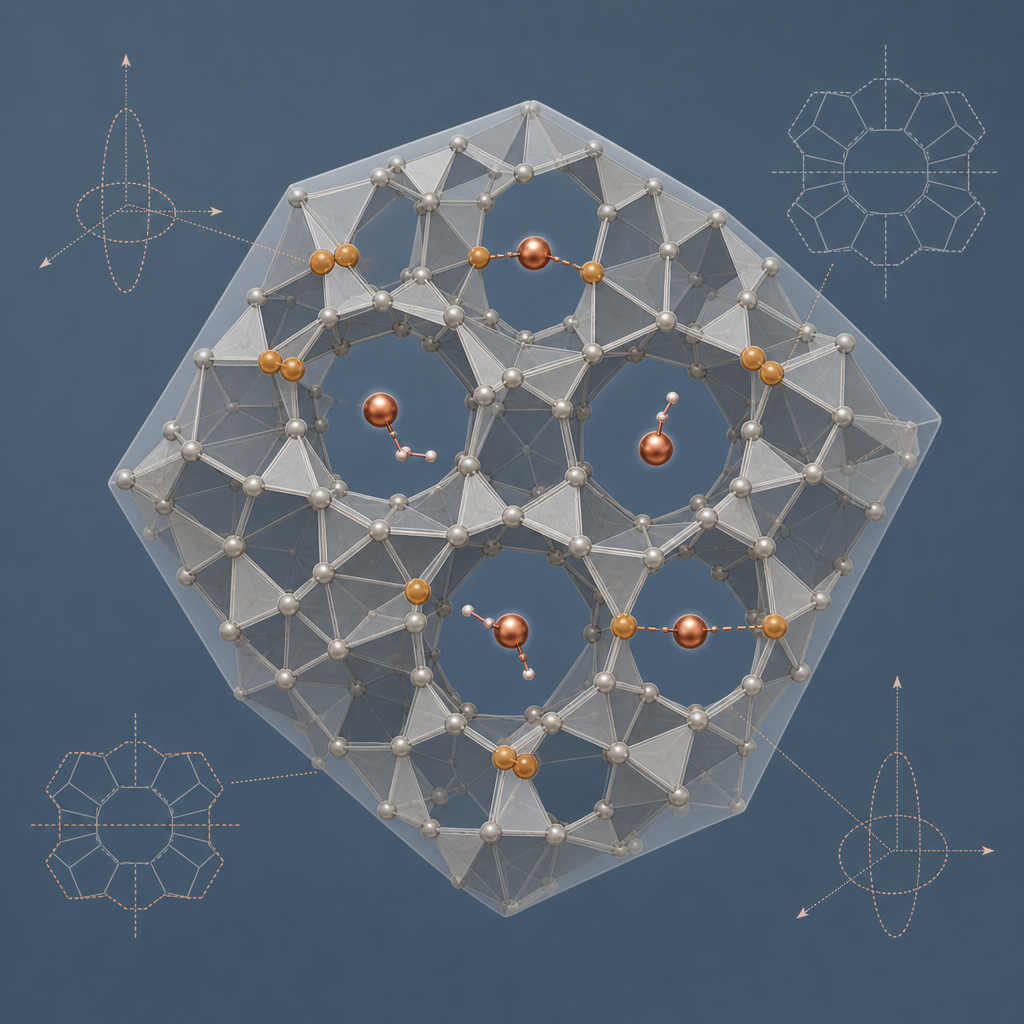
The commercial ACS Material NH4-SSZ-13 entered the workflow as a representative, independently sourced CHA reference. It was calcined at 580 °C for 5 h to remove the ammonium and convert it to the H-form, then ion-exchanged with aqueous Cu(NO3)2 solutions (0.5 mM and 50 mM, ~170 mL per gram of zeolite) and calcined again at 580 °C for 5 h to yield commercial CuCHA samples (denoted COM). Powder XRD confirmed that the commercial material exhibited all characteristic CHA reflections, plotted alongside the lab-synthesized NaOH- and OH-route zeolites. The commercial product's defined specifications—Si/Al 10–15, very low residual sodium, and ~671 m²/g surface area—made it a useful, well-characterized point of comparison against in-house materials whose Si/Al ratios (measured by XRF and 29Si/27Al solid-state NMR) and extra-framework Al content varied considerably with synthesis route. The combination of XRF, NMR, TEM, ICP-OES and X-band continuous-wave EPR (9.46 GHz) provided a multi-technique cross-check of the same materials.
Quantitatively, the NaOH-route CHA showed Si/Al = 5.8 by XRF but 8.4 by NMR, indicating roughly 30% extra-framework Al, while the OH-route CHA gave Si/Al = 11.7 (XRF) and 13.2 (NMR), about 11% extra-framework Al. EPR and ICP Cu quantifications differed by up to 30%, with EPR systematically higher (overestimating by up to 0.25 wt% Cu). Ion-exchange saturated near 1.4–1.7 wt% Cu for the NaOH-route material versus up to 2.5 wt% Cu for the OH-route material at 500 mM Cu2+, showing that copper exchanges more readily into the sodium-free zeolite. EPR spectral simulation (EasySpin) resolved distinct sites: Site A (gꓲꓲ ≈ 2.328, Aꓲꓲ ≈ 490 MHz), Site B (gꓲꓲ ≈ 2.358, Aꓲꓲ ≈ 456 MHz) and a broad Site C. Site B was stable and redox-active in all ten CuCHA-OH and CuCHA-Na samples. For NaOH-route CuCHA, much of Site A was not redox-active, attributed to copper near "framework-associated" Al revealed by a 27Al NMR shoulder. Isotope-labelling experiments with 15NH3/14NH3 showed complete ligand exchange within 10 minutes at 100 °C, demonstrating a highly dynamic system.
The work clarifies why literature reports on CuCHA SCR catalysts disagree: nominally similar zeolites can host very different Cu speciation depending on whether Na+ was present during synthesis. For emission-control applications, the practical message is that maximizing the desirable, redox-active Site B copper requires CHA zeolites engineered with abundant paired Al and minimal extra-framework or framework-associated Al. The paper points toward synthetic strategies that control the Na+:SDA ratio and mineralizing agent to tune Al pairing. The in-situ EPR methodology itself is presented as a powerful, broadly applicable tool for directly mapping Cu distribution and indirectly probing Al siting, relevant to other transition-metal-exchanged zeolites used in catalysis and gas separation.
For researchers working on zeolite catalysis, the study illustrates the value of a well-specified commercial CHA reference—here the NH4-SSZ-13 from ACS Material's molecular sieves catalog—when benchmarking custom-synthesized frameworks. The same SSZ-13/chabazite and related zeolite products are available to groups studying SCR catalysts, methanol-to-olefins chemistry, CO2 adsorption and ion-exchange phenomena, where reproducible Si/Al ratio and low sodium content are decisive for reliable comparison.How ACS Material products were used
- Commercial NH4-SSZ-13 (CHA/chabazite zeolite), Si/Al = 10–15, Na2O < 500 ppm, BET ~671 m²/g (Molecular Sieves) — “Commercially available NH4-SSZ-13 was purchased (ACSmaterial) with a Si/Al=10–15, Na2O <500 ppm, surface area determined by BET: ~671 m2/g. This material was made by the hydrothermal method and was calcined at 580°C for 5 h before use.”
Product Performance in this StudyThe ACS Material NH4-SSZ-13 served as a commercial CHA reference. After calcination, ion exchange with Cu, and thermal activation, it produced well-defined XRD patterns matching the CHA topology and provided a benchmark CuCHA material against which the lab-synthesized OH-, NaOH-, and HF-route zeolites were compared.
Related product categories
Frequently asked questionsHow does sodium during synthesis affect Al distribution in SSZ-13 zeolite?
Adding Na+ during chabazite synthesis promotes the formation of paired aluminium sites located close to copper, favouring Z2Cu species. However, the same sodium presence lowers the zeolite's ion-exchange capacity and reduces the amount of redox-active copper. The study found NaOH-route CHA had about 30% extra-framework Al, while the sodium-free OH-route material had only about 11%.
What is commercial NH4-SSZ-13 zeolite used for in catalysis research?
Commercial NH4-SSZ-13, a chabazite-framework zeolite, is converted to the H-form by calcination and then copper-exchanged to make CuCHA, the leading catalyst for selective catalytic reduction (SCR) of NOx by ammonia in diesel exhaust. In this study it served as a well-specified reference material (Si/Al 10–15, low Na2O, ~671 m²/g) for benchmarking lab-synthesized CHA zeolites.
Why is the Si/Al ratio important for CuCHA SCR catalyst performance?
The Si/Al ratio governs how many framework aluminium sites are available to charge-balance copper. Lower Si/Al provides more Al and more paired-Al sites that host stable, redox-active Z2Cu (Site B) species, while extra-framework or framework-associated Al traps copper in catalytically inactive states. Controlling Si/Al and Al pairing therefore directly tunes the active-copper population and the catalyst's redox window.