-
Commercial Zeolite-A Catalyst for Biomass Pyrolysis - University of Lampung, 2021
Jun 30, 2026 | ACS MATERIAL LLCSimanjuntak, W. et al. (2021). The effect of crystallization time on structure, microstructure, and catalytic activity of zeolite-A synthesized from rice husk silica and food-grade aluminum foil. *Biomass and Bioenergy*. https://doi.org/10.1016/j.biombioe.2021.106050
Biomass and Bioenergy · 2021
University of Lampung benchmarked ACS Material commercial zeolite-A against rice-husk-silica zeolite-A for biomass pyrolysis, reaching 97.52% biogasoline yield.
About this research
Researchers at the University of Lampung used commercial zeolite-A purchased from ACS Material as the benchmark catalyst to evaluate a low-cost zeolite-A synthesized from rice husk silica and food-grade aluminum foil, achieving up to 91.47% biogasoline-fraction bio-crude oil against the 97.52% delivered by the commercial reference. The study examined how hydrothermal crystallization time (48, 72, 96 h) controls the structure, microstructure, and catalytic activity of the synthesized material, then tested all catalysts in the co-pyrolysis of solid cassava residue and palm oil. The commercial ACS Material zeolite-A provided the monophasic, well-defined cubic-crystal standard against which the home-grown catalyst's phase purity and performance were measured.
This research matters because pyrolysis is a flexible route for converting biomass and agricultural waste into liquid fuels and valuable chemicals, and the catalyst largely governs both the yield and the chemical composition of the resulting bio-crude oil (BCO). Zeolite catalysts are favored for their deoxygenating activity, which suppresses oxygenated compounds and enriches hydrocarbons. However, conventional zeolite-A synthesis depends on relatively expensive alumina and silica precursors. By demonstrating that rice husk silica and food-grade aluminum foil can substitute for these reagents, the work addresses the broader challenge of lowering catalyst cost while valorizing abundant agricultural residues. A trustworthy commercial benchmark is essential to prove that the cheaper material genuinely performs as a zeolite-A and not merely a related aluminosilicate.
The commercial zeolite-A (CAS 70955-01-0) from ACS Material was used as a comparison catalyst and characterization standard. It was characterized by XRD using a PANalytical Empyrean diffractometer and by SEM using a Zeiss EVO MA 10 instrument, exactly as the synthesized samples were. XRD analysis with Match! software confirmed the commercial product was monophasic zeolite-A, matching the International Zeolite Association (IZA) standard, with all six prominent diffraction peaks present. SEM revealed obvious, well-separated cubic crystals with no secondary phases or agglomeration, providing the morphological reference for assessing the synthesized samples. In the catalytic test, 10 g of the commercial zeolite-A was mixed with a feedstock of 50 g solid cassava residue and 150 mL palm oil and pyrolyzed at a peak temperature of 400 °C for 60 minutes in a laboratory-scale stainless-steel unit. The condensed liquid was separated, filtered, and analyzed by GC-MS (Shimadzu GCMS-QP2010 SE) using NIST12 and WILEY229 libraries, providing a direct quantitative benchmark for the relative percentages of hydrocarbon classes in the BCO.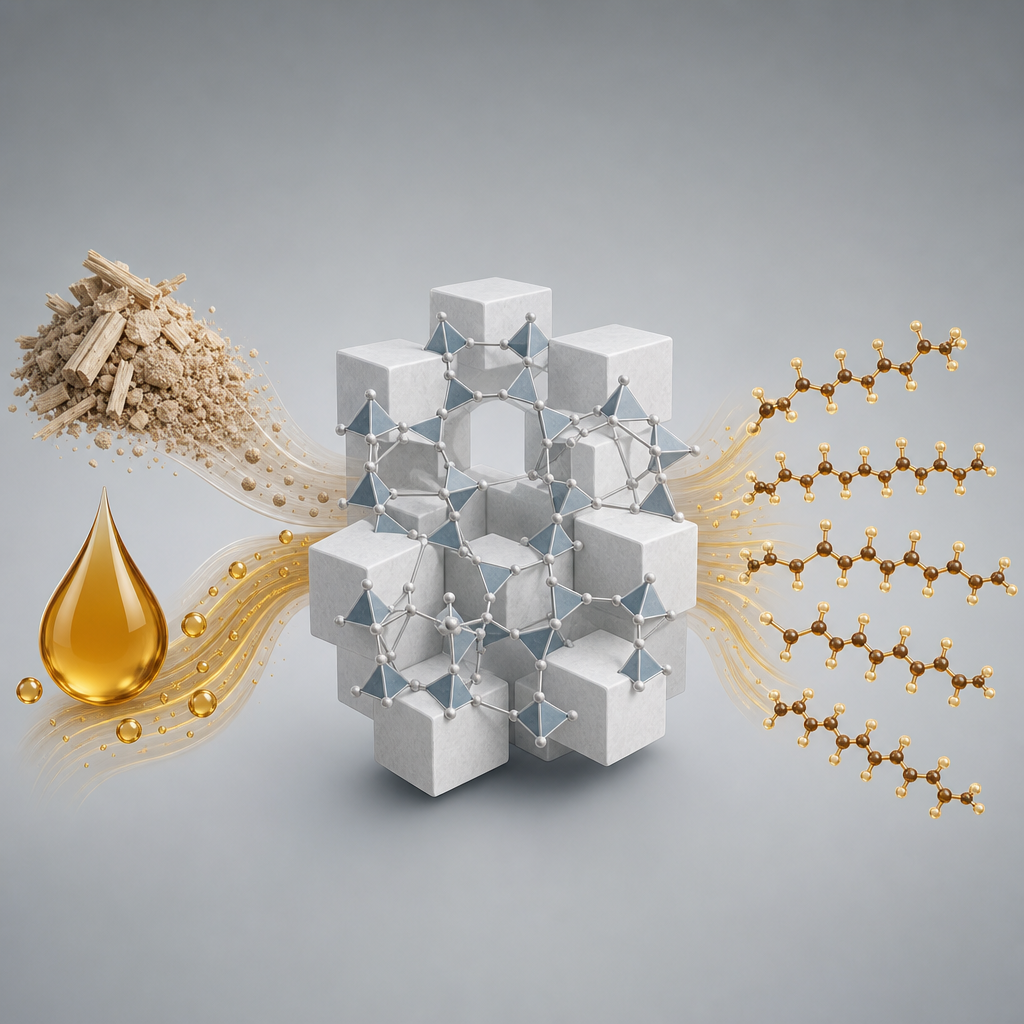
The key results show clear, quantifiable performance differences. XRD confirmed zeolite-A formed even at 48 h crystallization, with sodalite as a minor secondary phase; 72 h gave optimum zeolite-A growth and minimal sodalite, while 96 h promoted reformation of sodalite. SEM corroborated this, with the most distinct cubic crystals appearing in the 72 h sample, which most closely resembled the ACS Material commercial zeolite-A. In the pyrolysis tests, the biogasoline fraction (C6–C12) of BCO from the synthesized catalysts ranged from 71.88% to 91.47%, compared with 97.52% for the commercial zeolite-A. The BCO produced was predominantly hydrocarbons, reflecting the deoxygenating role of zeolites; only the 48 h sample retained traces of ketones (e.g., acetone, 2-heptadecanone). Dodecane was a major component across all catalysts (16.28% for commercial, 16.60–25.69% for synthesized). The rice husk silica feedstock had 97.86% purity by XRF, and the aluminum foil was 99.9% pure, demonstrating that high-purity, hydrocarbon-rich BCO can be obtained from inexpensive precursors that approach commercial catalyst performance.
This research enables lower-cost production of zeolite-A catalysts for biomass-to-fuel conversion, with direct relevance to renewable energy, biogasoline production, and agricultural waste valorization. The demonstrated substitution of rice husk silica and food-grade aluminum foil for costly precursors could lower the barrier for decentralized or developing-region biofuel processing. Beyond pyrolysis catalysis, zeolite-A also serves as an adsorbent for heavy-metal removal from wastewater and as a transesterification catalyst for biodiesel, so the synthesis route has broad applicability. The authors point to crystallization time as a key tunable parameter, suggesting that further optimization of synthesis conditions could narrow the performance gap with commercial material and that the approach merits extension to other biomass feedstocks and reactor configurations.
For researchers, this paper illustrates the value of a reliable commercial zeolite-A standard when validating new low-cost synthesis routes. The commercial zeolite-A used here is available within ACS Material's molecular sieves catalog, which includes a range of zeolites suitable for catalysis, adsorption, and separation studies. Groups working on catalytic biomass pyrolysis, biodiesel transesterification, or wastewater adsorption can use such well-characterized reference materials to benchmark their own synthesized aluminosilicates against an IZA-conforming monophasic standard.How ACS Material products were used
- Commercial Zeolite-A (CAS 70955-01-0) (Molecular Sieves) — “Commercial zeolite-A (CAS NO:70955-01-0) was purchased from ACS MATERIAL, Advanced Chemicals Supplier.”
Product Performance in this StudyThe ACS Material commercial zeolite-A served as the benchmark catalyst and reference material. It was a monophasic zeolite-A and produced bio-crude oil with the highest biogasoline (C6–C12) content of 97.52%, against which the synthesized zeolites were compared.
Related product categories
Frequently asked questionsWhat is commercial zeolite-A used for in biomass pyrolysis?
Commercial zeolite-A serves as both a reference catalyst and a characterization standard in biomass pyrolysis. In this study it catalyzed the co-pyrolysis of solid cassava residue and palm oil at 400 °C, producing bio-crude oil with 97.52% biogasoline-fraction (C6–C12) hydrocarbons. Its monophasic, cubic-crystal structure provided the benchmark for evaluating lab-synthesized zeolite-A made from cheaper precursors.
Why is crystallization time important for zeolite-A synthesis?
Crystallization time controls phase purity and catalytic activity. At 48 hours zeolite-A formed with significant sodalite impurity; at 72 hours zeolite-A growth was optimal with minimal sodalite and the most distinct cubic crystals; at 96 hours sodalite re-formed, degrading the structure. The 72-hour sample most closely matched commercial zeolite-A and gave the best biogasoline yield among the synthesized catalysts.
How does zeolite-A improve bio-crude oil quality?
Zeolite-A enhances deoxygenation during pyrolysis, suppressing oxygenated compounds and enriching hydrocarbons. In this work, the bio-crude oil produced was practically pure hydrocarbons, with biogasoline-range (C6–C12) species making up 71.88–91.47% for synthesized catalysts and 97.52% for the commercial reference, yielding a fuel-grade liquid with low oxygen content.