-
CVD Graphene Barrier for Vanadium Crossover - NREL, 2021
Jun 03, 2026 | ACS MATERIAL LLCBukola, S. et al. (2021). Single-layer graphene as a highly selective barrier for vanadium crossover with high proton selectivity. *Journal of Energy Chemistry*. https://doi.org/10.1016/j.jechem.2020.11.025
Journal of Energy Chemistry · 2021
NREL used ACS Material CVD graphene on copper to block vanadium crossover in redox flow battery membranes, giving proton selectivity 10,000x over vanadium.
About this research
Researchers at the National Renewable Energy Laboratory (NREL) demonstrated that ACS Material single-layer CVD graphene on copper foil, immobilized between two Nafion membranes, achieves near-zero vanadium crossover while preserving high proton conductivity. The headline result is a proton-to-vanadium transmission selectivity of about four orders of magnitude, with proton transport roughly 10,000 times faster than vanadium ion transport. Resistivity values reached 0.02 ± 0.005 Ω cm² for protons versus 223 ± 4 Ω cm² for vanadium ions through a single atomic layer of graphene. By transferring high-quality monolayer graphene onto a polymer electrolyte membrane, the team converted a conventional, leaky cation separator into a highly ion-selective barrier suitable for redox flow battery (RFB) applications.
This research addresses a persistent challenge in large-scale energy storage. Vanadium redox flow batteries rely on membranes that allow proton flux while blocking cross-permeation of vanadium species. Conventional Nafion separators have high proton conductivity and chemical stability but offer poor selectivity, allowing vanadium crossover that drives self-discharge, capacity fade, water imbalance, and coulombic efficiency loss. Prior membrane modifications using SiO2, TiO2, graphene oxide, zirconium phosphate, or polybenzimidazole improved selectivity factors only to roughly 2–32, and none completely eliminated transmembrane vanadium diffusion at adequate proton conductivity. Two-dimensional materials such as graphene and hexagonal boron nitride, with angstrom-scale thickness and atomic-scale openings well matched to proton size, offer a route to far higher selectivity. Solving this crossover problem improves operational viability and lifetime for grid-scale flow batteries and other electrochemical devices where proton conduction is required but transport of other species is detrimental.
The ACS Material product was central to the methodology. The authors state that single-layer CVD graphene on 45 mm copper foil was obtained from ACS Materials, LLC, with a grain size of 50 µm, sheet resistance below 600 Ω/sq, and transparency above 95%. Approximately 2.5 cm × 2.5 cm of CVD graphene on copper was hot pressed at 140 °C and 900 lbf for 3 minutes onto a Nafion-211 membrane supported on fiberglass. The copper foil was etched in 0.3 M ammonium persulfate, leaving a graphene layer on the Nafion. A second Nafion sheet was added and hot pressed again to form a Nafion | graphene | Nafion composite, then supported with two polyethylene terephthalate (PET) sheets. Confocal Raman microscopy confirmed single-layer graphene quality through G-band position (1585–1595 cm⁻¹), a symmetric 2D band, and low-intensity D-band near 1320 cm⁻¹. XPS showed a dominant sp² carbon C1s peak at 284.1 eV, and SEM/EDS plus DMA confirmed successful transfer and a 30 °C increase in glass transition temperature.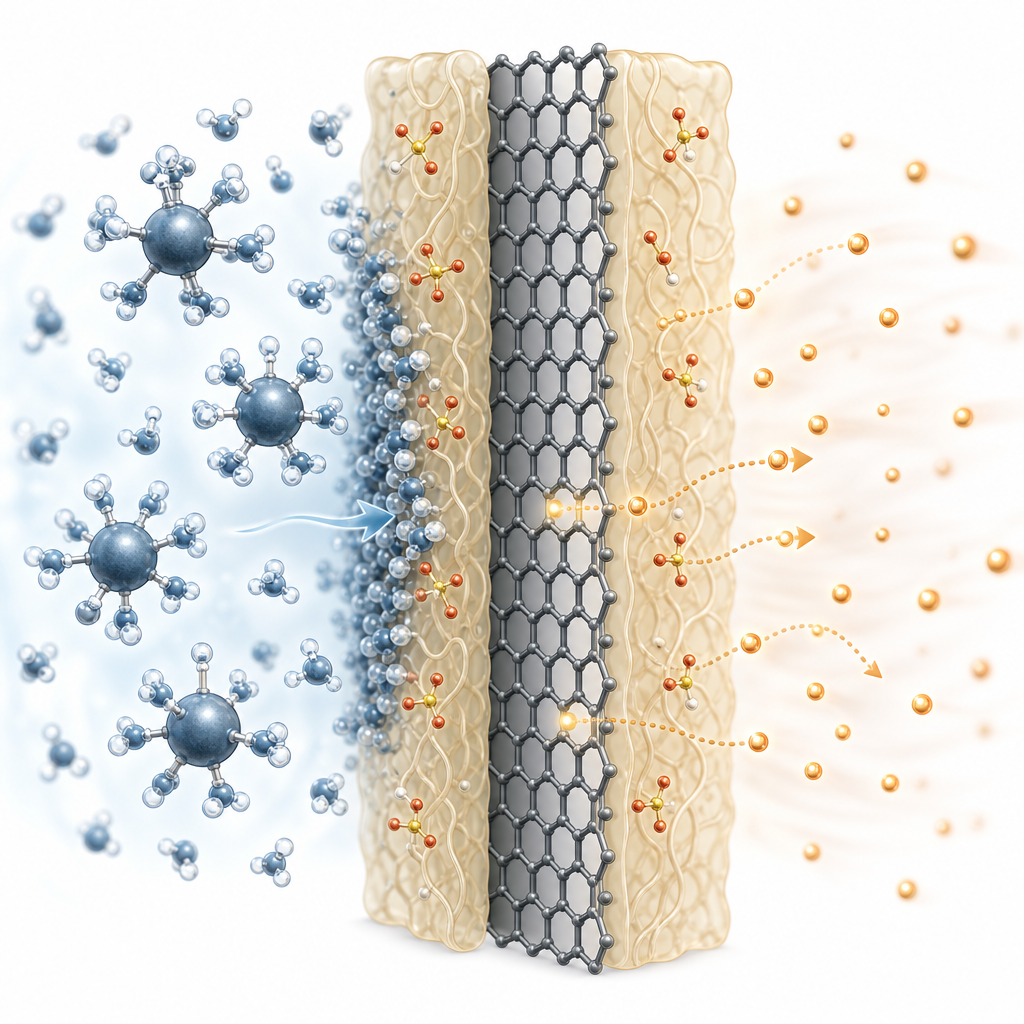 The quantitative results are striking. In diffusion cells, vanadium permeability through bare Nafion was about 2.13 × 10⁻⁸ cm² s⁻¹, in agreement with literature, while vanadium permeability through the Nafion | graphene | Nafion composite was below the instrument detection limit over a 7-day window, with no visible blue color change in the blank half-cell. In electrically driven cells using ±0.1 V cyclic voltammetry scans, graphene added only modest proton resistance (proton resistivity 0.02 Ω cm²) but increased vanadium and magnesium ion resistivity by roughly four orders of magnitude (223 ± 4 Ω cm² for vanadium, 206 ± 5 Ω cm² for magnesium). The resulting relative ion selectivity reached 10,000–11,000. Under chronoamperometric testing from 0.2 to 1.3 V, vanadium concentration in the blank half-cell stayed near zero for graphene composites while increasing significantly for bare Nafion. Single-layer graphene completely inhibited vanadium ion diffusion and mitigated vanadium migration below 200 mA cm⁻², though high current densities (75–100 mA over extended times) produced slight crossover, indicating defect-mediated transport that warrants further study.
These findings enable improved membrane designs for vanadium redox flow batteries and related grid-scale energy storage, where eliminating crossover extends cycle life and reduces balance-of-system costs. The approach is also relevant to mixed redox systems such as iron-chromium or iron-cadmium batteries, where crossover causes irreversible electrolyte degradation, and to other electrochemical devices including fuel cells and methanol crossover mitigation. The authors point toward future work optimizing graphene durability under sustained current, working with thinner Nafion layers to lower resistance, and studying the nature of intrinsic graphene defect sites that govern selective proton transmission at high current density. The single-layer graphene barrier concept thus offers a path to nearly infinite ion selectivity in membrane separators.
For researchers working on ion-selective membranes, flow battery separators, or 2D material barrier layers, single-layer CVD graphene on copper foil of the grade used here is available from ACS Material. The paper's results show that high-quality monolayer CVD graphene, when carefully transferred and characterized, can act as an effective selective barrier, making this catalog category a practical starting material for membrane and electrochemical device research.How ACS Material products were used
- CVD Graphene on Copper Foil (CVD Graphene) — “Single-layer chemical vapor deposition (CVD) graphene on 45 mm copper foil was obtained from ACS Materials, LLC. It has a grain size of 50 mm, sheet resistance of < 600 X/sq, and transparency > 95%.”
Product Performance in this StudyThe single-layer CVD graphene on copper acted as a highly selective barrier, essentially eliminating vanadium ion crossover while allowing fast proton transport, yielding selectivity four orders of magnitude in favor of protons.
Related product categories
Frequently asked questionsHow does single-layer graphene reduce vanadium crossover in flow battery membranes?
Single-layer CVD graphene placed between two Nafion membranes acts as an angstrom-thin selective barrier. Its interatomic openings (about 0.064 nm) match the effective proton size but are too small for larger hydrated vanadium ions. In NREL's study, vanadium permeability through the graphene composite fell below the detection limit, while protons passed with only 0.02 Ω cm² added resistance.
What proton selectivity did the graphene-modified Nafion membrane achieve?
The Nafion | graphene | Nafion composite achieved a relative ion selectivity of roughly 10,000–11,000, meaning proton transport was four orders of magnitude faster than vanadium ion transport. Measured resistivities were 0.02 Ω cm² for protons versus 223 Ω cm² for vanadium ions through a single atomic layer of graphene.
What grade of CVD graphene was used to block vanadium ion crossover?
The researchers used single-layer CVD graphene grown on 45 mm copper foil from ACS Materials, LLC, with a 50 µm grain size, sheet resistance below 600 Ω/sq, and transparency above 95%. The graphene was hot pressed at 140 °C onto Nafion-211 and the copper was etched in ammonium persulfate, leaving a clean monolayer confirmed by Raman and XPS.