-
CVD Graphene Diaphragm for Acoustic Sensing - Beihang, 2023
Jun 10, 2026 | ACS MATERIAL LLCLiu, Y. et al. (2023). Ultrasensitive acoustic detection using an enlarged Fabry–Perot cavity with a graphene diaphragm. *ACS Applied Materials & Interfaces*. https://doi.org/10.1021/acsami.3c11220
Beihang University · ACS Applied Materials & Interfaces · 2023
Beihang University built a graphene-diaphragm Fabry–Perot acoustic sensor reaching 187.32 nm/Pa@16 kHz using ACS Material 10-layer CVD graphene on copper.
About this research
Researchers at Beihang University developed an ultrasensitive Fabry–Perot (F–P) optical acoustic sensor built around a 10-layer copper-based CVD graphene diaphragm purchased from ACS Material, achieving a peak mechanical sensitivity (SM) of 187.32 nm/Pa@16 kHz. The key innovation is an enlarged backing air cavity (EBC) that reduces the air-damping pressure coupling resisting the graphene membrane's vibration. By radially expanding the F–P cavity independently of the diaphragm dimensions, the team raised sensitivity dramatically over conventional small-backing-cavity designs. The result is a compact, electromagnetic-immune sensor capable of weak acoustic sensing and speech recognition.
Acoustic detection underpins applications ranging from environmental noise monitoring and acoustic source localization to artificial-intelligence-driven speech interfaces. Optical-fiber F–P acoustic sensors are attractive for their compact size, low cost, and immunity to electromagnetic interference, yet achieving high sensitivity remains a persistent challenge. Conventional metal and silicon diaphragms are hard to fabricate below 100 nm thickness, capping their sensitivity. Graphene's ultrathin, airtight, high-elasticity nature makes it an ideal sensitive membrane, but its extreme thinness makes the diaphragm-pressure coupling inside the sealed cavity especially detrimental. This work directly addresses that limitation, showing that cavity engineering—rather than membrane modification—can unlock graphene's full sensing potential.
The ACS Material graphene was central to the device. The Methods section states plainly that "Ten-layer copper-based graphene is purchased from ACS Material (America)." Raman spectroscopy and atomic force microscopy confirmed a thickness of 3.67 nm, very close to the theoretical 3.35 nm for 10-layer graphene. The copper–graphene sample was cut into 1 mm square pieces and the copper etched away in 5% FeCl3 solution; after dilution with deionized water to remove residual FeCl3, the released graphene was transferred onto a ceramic ferrule (125 µm inner diameter) by van der Waals force. Suspended graphene was verified by SEM and optical microscopy. The graphene-covered end cap was then spliced with a housing containing a single-mode fiber, with the gap between housing and end cap forming the EBC. The F–P interference length was set to 70 µm via an optical spectrum analyzer, and the assembly sealed with epoxy to maintain cavity airtightness and stability.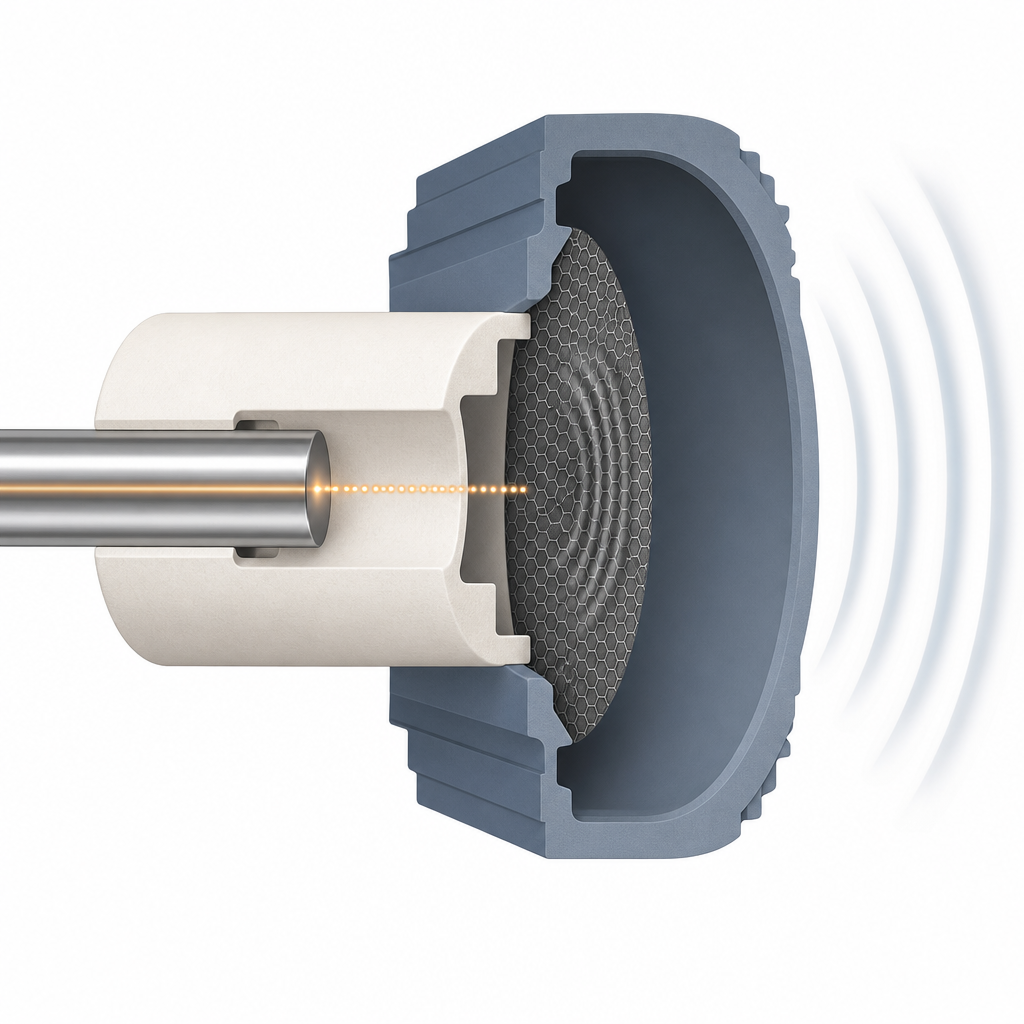
The quantitative results are striking. COMSOL acoustic-field simulation identified optimal EBC dimensions of length 0.2 mm and radius 1.5 mm, yielding a simulated SM of 26.16 nm/Pa@1 kHz versus only 0.98 nm/Pa for the conventional small-backing-cavity (SBC) structure. Experimentally, the fabricated sensor with the EBC showed a frequency response enhanced by 5.73–79.33 times across 0.5–18 kHz compared with the SBC device. At 1 kHz, the measured voltage sensitivity was 877.68 mV/Pa (SM = 31.58 nm/Pa); the maximum SV reached 5205.60 mV/Pa@16 kHz, corresponding to SM = 187.32 nm/Pa—at least 17% higher than the 1.1–160 nm/Pa range of previously reported F–P sensors and roughly 100× higher than other graphene-based F–P sensors. The sensor delivered a signal-to-noise ratio of 60–75 dB, an average minimum detectable pressure of 94.35 µPa/Hz^1/2 (29.33 µPa/Hz^1/2@2 kHz), time stability within ±1.5–2.2% over 90 min, and a detection resolution of 0.01 Hz. High-fidelity speech detection of the Chinese word "hello" from both male and female voices matched a commercial B&K 4189 microphone with cross-correlation coefficients greater than 0.9.
These performances enable practical weak-acoustic sensing and speech-recognition applications. The directional sensitivity (68% reduction from 0° to 180° alignment) lets the sensor suppress environmental noise and supports sensor-array sound-source localization. The 0.01 Hz resolution allows clean separation of closely spaced frequency components, useful in acoustic spectroscopy, sound-speed and absorption measurement, and machine-learning-assisted voice interfaces. Importantly, the authors note the EBC structure can be applied to F–P acoustic sensors using other diaphragm materials, making the approach broadly transferable. Future work points toward frequency-response flattening through calibration and integration into multi-element sensing arrays.
For researchers pursuing optical acoustic sensing, flexible photonics, or 2D-material membrane devices, this study illustrates how the quality and uniformity of multilayer CVD graphene on copper directly govern diaphragm performance. The 10-layer copper-based CVD graphene used here is representative of ACS Material's CVD graphene-on-copper offering, available to groups working on similar Fabry–Perot transducers, pressure sensors, and graphene membrane platforms. The results stand on documented metrics rather than promotional claims, reinforcing graphene's value as a high-sensitivity acoustic diaphragm material.How ACS Material products were used
- 10-layer copper-based CVD graphene (CVD Graphene on Copper Foil) (CVD Graphene) — “Ten-layer copper-based graphene is purchased from ACS Material (America).”
Product Performance in this StudyThe 10-layer copper-based graphene (measured 3.67 nm thick) served as the ultrathin acoustic diaphragm of the Fabry–Perot sensor, enabling a maximum mechanical sensitivity of 187.32 nm/Pa@16 kHz when combined with the enlarged backing air cavity.
Related product categories
Frequently asked questionsWhy is graphene a good diaphragm material for Fabry–Perot acoustic sensors?
Graphene is ultrathin, airtight, highly elastic, and adheres well to substrates, giving it a large diameter-to-thickness ratio that yields high mechanical sensitivity. In this study a 10-layer CVD graphene diaphragm measuring just 3.67 nm thick enabled a Fabry–Perot sensor to reach 187.32 nm/Pa@16 kHz, roughly 100 times higher than earlier graphene-based F–P sensors.
How does an enlarged backing air cavity improve acoustic sensitivity?
A sealed air cavity behind the diaphragm resists membrane vibration because volume change produces a counter-pressure. Enlarging the cavity radius and length reduces this pressure change, so more of the incident sound pressure acts on the graphene. Here, expanding the cavity to 1.5 mm radius and 0.2 mm length cut the cavity pressure change to about 0.01 Pa, boosting sensitivity by 5.73–79.33 times.
What sensitivity and speech-detection performance did the graphene sensor achieve?
The sensor reached a maximum mechanical sensitivity of 187.32 nm/Pa@16 kHz with a voltage sensitivity of 5205.60 mV/Pa. It delivered a 60–75 dB signal-to-noise ratio, a 0.01 Hz detection resolution, time stability within ±1.5% over 90 minutes, and high-fidelity speech detection of spoken words with cross-correlation coefficients above 0.9 versus a commercial microphone.