-
CVD Graphene for Extended Red Emission Study - NSRRC, 2023
Jun 29, 2026 | ACS MATERIAL LLCChou, S. et al. (2023). A Plausible Model for the Galactic Extended Red Emission: Graphene Exposed to Far-Ultraviolet Light. *The Astrophysical Journal*. https://doi.org/10.3847/1538-4357/acb209
The Astrophysical Journal · 2023
NSRRC researchers used ACS Material CVD single-layer graphene to model the galactic Extended Red Emission, reproducing its 585-750 nm redshift under far-UV light.
About this research
Researchers at the National Synchrotron Radiation Research Center (NSRRC) in Taiwan used ACS Material single-layer CVD graphene to build and validate a laboratory model for the galactic Extended Red Emission (ERE), demonstrating that far-ultraviolet (far-UV) irradiation of graphene reproduces both the ERE band shape and its characteristic redshift. The team treated thin-film single-layer graphene (SLG) with far-UV light, generating structural defects and graphene quantum dots (GQD) whose photoluminescence (PL) shifted from roughly 585 nm to about 750 nm with increasing dose. This behavior satisfies key astronomical constraints on ERE that prior candidate carriers could not, offering a coherent, experimentally supported explanation for an emission feature seen across many circumstellar and interstellar environments.
Extended Red Emission is a broad 500-900 nm feature observed in carbon-rich astro-environments, but the identity of its carrier and the underlying photophysics have remained unresolved for decades. The observational constraints are demanding: ERE is a light-driven, unpolarized, isotropic phenomenon that requires far-UV photons (10.5-13.6 eV), and the number of emitted ERE photons exceeds the far-UV photons absorbed, implying a photon-conversion efficiency above 100% unless a two-step mechanism operates. The band also redshifts under stronger far-UV fields. No previously proposed carrier - including ionized polycyclic aromatic hydrocarbons (PAHs) and PAH clusters - simultaneously met all these constraints with direct laboratory support. This paper addresses that gap by treating large PAH-like graphene as a tunable, defect-engineerable carrier, linking laboratory astrophysics with 2D-materials photophysics.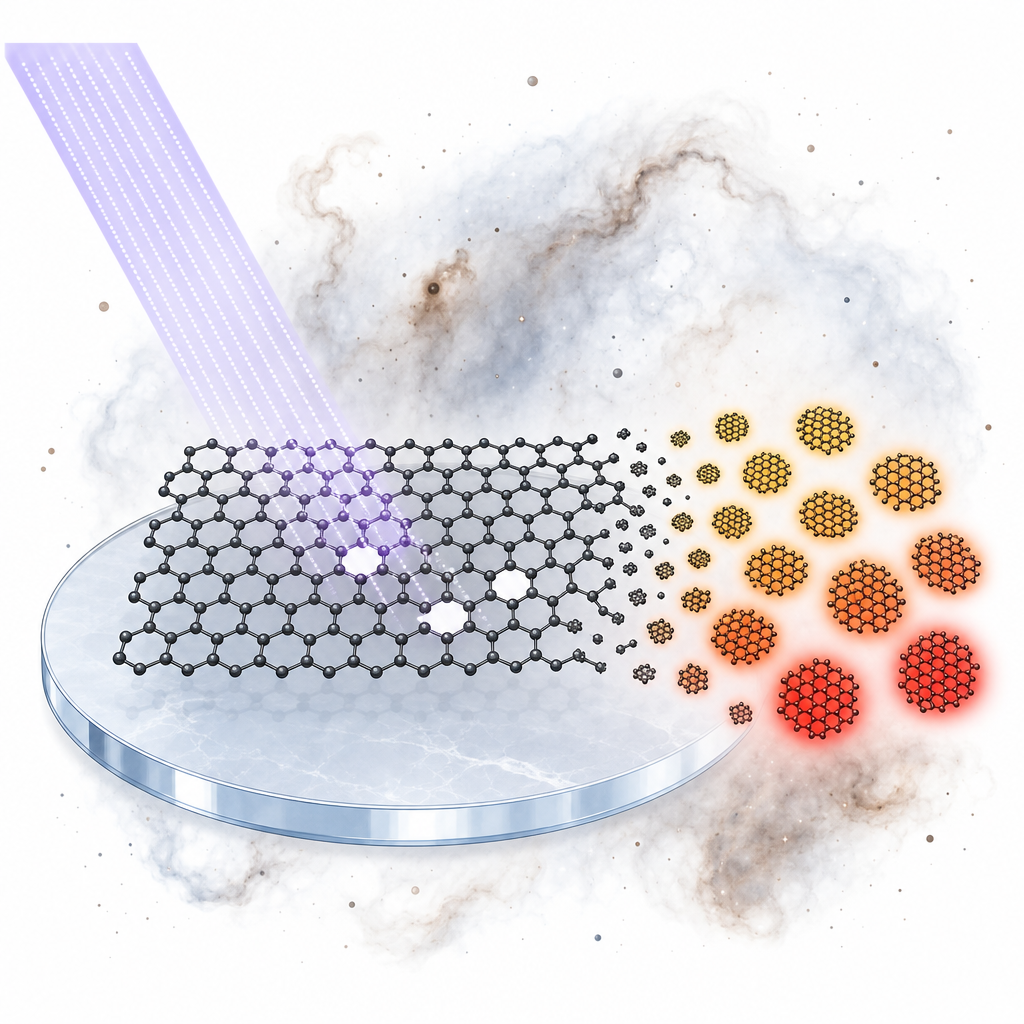
The ACS Material graphene served as the central experimental sample. Graphene samples were purchased from ACS Material and/or grown by chemical vapor deposition on copper foils, then wet-transferred onto MgF2, quartz, or sapphire substrates (25 mm diameter, 2 mm thick), with sample areas of 10 x 10 mm2. MgF2 and quartz were chosen over the LiF used in earlier work because they avoid an anomalous absorption rise and remain optically stable. Pristine single-layer quality was confirmed by Raman spectroscopy, which showed sharp G (1586 cm-1) and 2D (2670 cm-1) bands and no D band. The samples were then exposed to intense far-UV synchrotron light at 118 nm at NSRRC beamline TLS-21A2, with photon-flux densities near 5.1 x 10^15 and 1.3 x 10^15 photons cm-2 s-1 over 4 hours, and dose controlled by adjusting the beam focal spot (2.5 mm vs 5.0 mm). Photoabsorption and PL/PLE measurements at 10 K were performed at beamline TLS-03, and AFM (FSM Nanoview 1000) characterized surface morphology before and after irradiation.
The results show a clear, dose-dependent transformation. Untreated SLG at 10 K emitted near 590 nm only under excitation shorter than 150 nm, consistent with defect-free graphene's near-transparency above 170 nm. After far-UV exposure, a new photoluminescence excitation band near 250 nm appeared and overall PL intensity rose, attributed to vacancy generation; Raman spectra developed D (1343 cm-1) and D' (1622 cm-1) bands with an I(D)/I(D') ratio of about 6.2, signaling vacancy-type defects, while AFM revealed a grainy surface with holes. Under high-dose exposure (2.5 mm spot), the PL band redshifted to 750 nm with a full width at half maximum of about 78 nm, and broadened, weakened Raman bands plus a reduced I(2D)/I(G) ratio indicated conversion to few-layer GQD, with sizes estimated at 20-30 nm by Raman and 20-60 nm grains (~5 nm height) by AFM. A medium-dose (2 hr) sample peaked at 623 nm with a shoulder near 707 nm. Crucially, the photoluminescence excitation spectra extended from the far-UV through the UV-visible region, and excitation at 405 nm gave an estimated quantum yield greater than 30% at 10 K, resolving the photon-conversion-efficiency problem. Control exposures with a 265 nm LED and a D2 lamp produced no comparable changes, confirming the specific role of far-UV light. The PL spectra closely matched ERE observed in NGC 2327 and NGC 7027.
The work enables a physically grounded interpretation of an enduring astronomical mystery and connects it to controllable laboratory chemistry. Because the proposed carrier need not be limited to graphene - very large PAHs are expected to behave similarly - the model supports a top-down chemistry pathway in space where far-UV light strips hydrogen and carbon to form graphene-like flakes, quantum dots, and eventually fullerenes. The authors also report preliminary results that co-irradiating graphene with icy N2 or O2 yields N-doped or O-doped graphene with altered, further-redshifted luminescence, pointing to edge functionalization and heteroatom doping as additional tuning knobs. Follow-up studies on size, layer number, edge shape, and radiation density are proposed to refine the spectral match. Beyond astrophysics, the defect- and size-controlled PL tuning of graphene quantum dots is relevant to optoelectronics, photonics, and luminescent sensing.
For researchers, this study illustrates how a well-characterized CVD single-layer graphene can act as a clean, reproducible platform for defect engineering and photoluminescence studies, here applied to laboratory astrophysics. The single-layer CVD graphene used was sourced from ACS Material, whose CVD graphene line (graphene on copper foil and transferable graphene films) is available to groups working on 2D-materials photophysics, graphene quantum dots, and related optical investigations. The paper's value lies in its rigorous, dose-controlled demonstration rather than any claim about the product beyond serving as high-quality starting graphene.How ACS Material products were used
- Single-Layer CVD Graphene (on copper foil, wet-transferred to MgF2/quartz/sapphire) (CVD Graphene) — “Graphene samples were purchased (ACS Material, https://www.acsmaterial.com) and/or grown by chemical vapor deposition (CVD) on copper foils, followed by wet transfer onto MgF2, quartz, or sapphire”
Product Performance in this StudyThe purchased single-layer graphene was the central experimental material. Far-UV irradiation generated defects and graphene quantum dots, producing photoluminescence that reproduced the Extended Red Emission feature and its redshift, supporting the proposed two-step astrophysical model.
Related product categories
Frequently asked questionsHow does far-UV irradiation change the photoluminescence of single-layer graphene?
Far-UV light at 118 nm creates vacancy-type structural defects in single-layer graphene, confirmed by the appearance of Raman D and D' bands. With higher doses, the graphene fragments into few-layer graphene quantum dots, shifting the photoluminescence band from about 585 nm to roughly 750 nm and extending the excitation response across the far-UV to visible range.
Why is CVD single-layer graphene useful for modeling Extended Red Emission?
Single-layer graphene behaves like a very large polycyclic aromatic hydrocarbon, a likely class of interstellar ERE carrier. Its defect density and quantum-dot formation can be tuned by far-UV dose, letting researchers reproduce both the ERE band shape and its observed redshift under stronger radiation, while achieving a quantum yield above 30% that satisfies the photon-conversion-efficiency constraint.
What substrates were used for the graphene samples in this study?
The CVD single-layer graphene was wet-transferred onto MgF2, quartz, or sapphire substrates, each 25 mm in diameter and 2 mm thick, with sample areas of 10 x 10 mm2. MgF2 and quartz were preferred over LiF because LiF becomes opaque and induces an anomalous absorption rise, whereas MgF2 and quartz remained stable and transparent.