-
CVD Graphene Membranes for Water Desalination — KFUPM, 2016
Jun 16, 2026 | ACS MATERIAL LLCKafiah, F. et al. (2016). Monolayer graphene transfer onto polypropylene and polyvinylidenedifluoride microfiltration membranes for water desalination. *Desalination*.
Desalination · 2016
KFUPM and MIT researchers transferred ACS Material CVD monolayer graphene onto PP and PVDF membranes, reaching 84% KCl ion blockage after defect sealing.
About this research
Researchers at King Fahd University of Petroleum & Minerals (KFUPM), collaborating with the Massachusetts Institute of Technology and Qatar Foundation's HBKU, used ACS Material monolayer CVD graphene grown on 25 μm copper foil to fabricate composite desalination membranes, ultimately achieving 84% potassium chloride ion blockage after defect sealing by interfacial polymerization. Published in Desalination (2016), the study demonstrates a practical pathway to transfer large-area CVD graphene onto commercial polymeric microfiltration supports — polypropylene (PP, 100 nm pore) and polyvinylidenedifluoride (PVDF, 20 nm pore) — and then mitigate the tears and cracks that inevitably arise during transfer. The work bridges materials science and membrane engineering for water treatment.
Water scarcity drives intense interest in low-energy desalination, and atomically thin graphene is a leading candidate for the next generation of separation membranes because its single-atom thickness can in principle provide both high permeability and high selectivity once nanopores of controlled size are introduced. The persistent bottleneck, however, is not pore engineering but transfer: moving large-area CVD graphene from its growth catalyst (typically Cu foil) onto a porous polymeric substrate without producing tears, wrinkles, holes, or polymer residues. Such defects short-circuit selectivity, since solute ions diffuse through the defects rather than through engineered pores. The KFUPM–MIT–HBKU team specifically addresses this bottleneck, evaluating two industrially available microfiltration polymers and assessing whether interfacial polymerization can plug the remaining defects to produce an impervious starting platform suitable for subsequent nanopore introduction.
The central material in the study is monolayer CVD graphene grown on copper foil, purchased from ACS Material LLC (USA). The authors state in the Materials section that "Monolayer graphene grown on a copper (Cu) substrate (25 μm thick Cu foil) was purchased from ACS Material Company, USA. The graphene was grown using low-pressure CVD process," and Raman spectroscopy (Fig. S1) confirmed monolayer coverage on the Cu. The transfer workflow, adapted from O'Hern et al. and Regan et al., began with floating 1 × 1 cm² Cu/graphene pieces on 5 wt./vol.% ammonium persulfate (APS) etchant for 5–7 minutes to remove graphene from the back side, followed by deionized water rinsing. The remaining single-sided Cu/graphene was sandwiched against the polymer membrane between glass slides and gently roll-pressed with a glass rod to ensure conformal contact. Final Cu etching in APS released the monolayer graphene onto the polypropylene or PVDF surface, after which the composite was rinsed and air-dried. Substrate pore size, surface roughness, and hydrophobicity were highlighted as critical to transfer quality.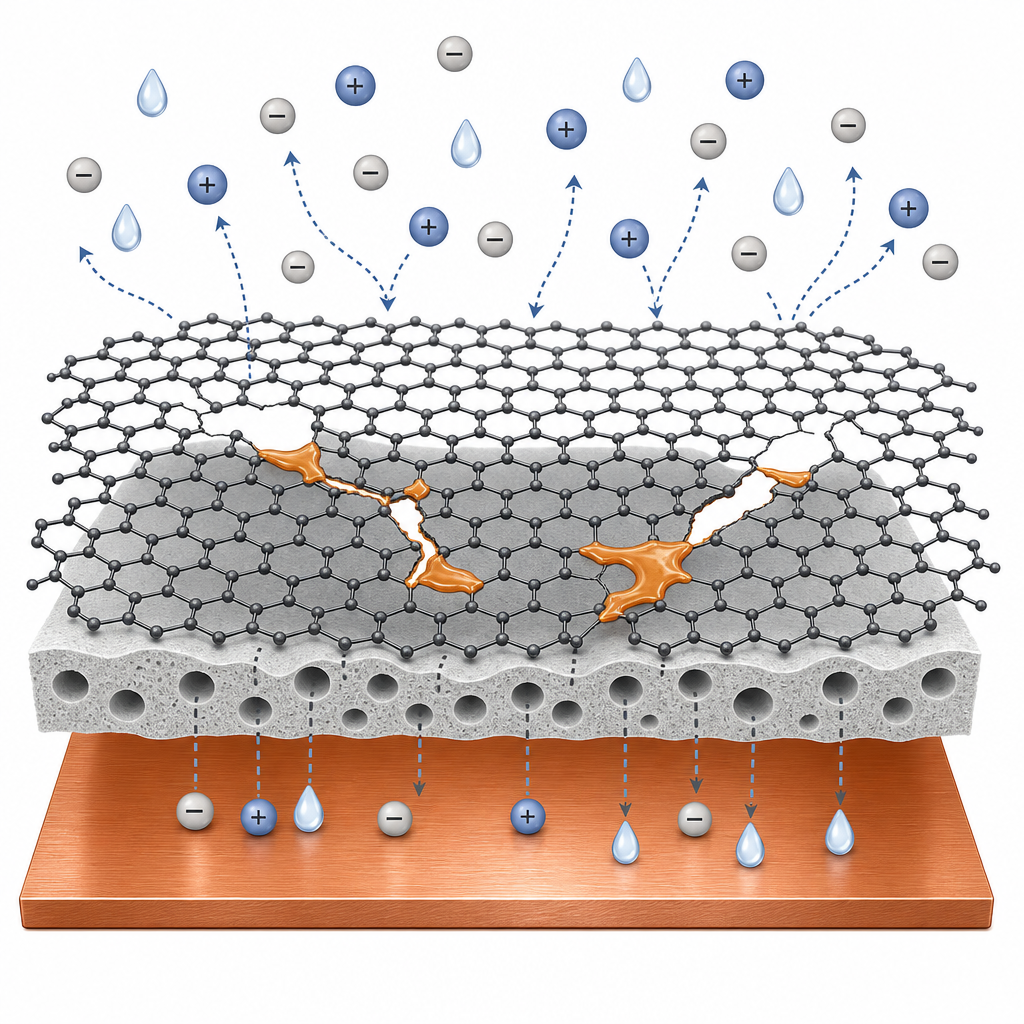
SEM imaging confirmed good surface coverage and adhesion of the graphene to both PP and PVDF supports, though transfer-induced tears and cracks were clearly visible. Ionic transport was quantified using a Side-bi-Side glass diffusion cell (Permegear) charged with 0.5 M KCl on one side and deionized water on the other, with eDAQ conductivity monitoring every 15 s for 10 minutes. The bare graphene–PP composite blocked 57% of KCl ions, while graphene–PVDF blocked 40%; the difference was attributed to the larger PP pores producing fewer torn graphene domains than the smaller, rougher PVDF support. To seal defects, the team performed interfacial polymerization (IP) of Nylon 6,6 using a Franz cell, with 27 mM adipoyl chloride in hexane on top and 45 mM hexamethylenediamine in water below (tagged with Texas Red dye for visualization). Initial IP raised the KCl blockage to 67% for both membrane types. Optimizing monomer concentrations and reaction time pushed graphene–PP performance to 84% ion blockage, a substantial improvement that demonstrates IP as a viable defect-mitigation strategy. The IP-deposited Nylon 6,6 selectively plugs micrometer-scale graphene tears while leaving the bulk of the atomically thin graphene available for subsequent nanopore drilling.
The ability to transfer CVD graphene onto commercial polymeric microfiltration membranes — rather than rigid silicon or expensive specialty supports — is directly relevant to scalable membrane manufacturing. Beyond seawater and brackish water desalination, the same platform supports research into nanofiltration, gas separation, dialysis, and pharmaceutical purification, since any process that benefits from atomically thin, mechanically supported 2D barriers can build on this transfer-and-seal methodology. The authors explicitly position the work as a stepping stone: defect-sealed graphene composites must next be perforated with size-selective nanopores (via ion bombardment, plasma, or chemical oxidation) to convert the impervious composite into a working separation membrane. Adjacent research lines — graphene oxide laminate membranes, MXene membranes, and h-BN barriers — also stand to benefit from the demonstrated transfer protocols.
For researchers pursuing similar membrane, sensor, or 2D-device work, the monolayer CVD Graphene on Copper Foil used in this study is part of ACS Material's CVD graphene catalog, alongside Trivial Transfer® Graphene and graphene-on-polymer substrates that further simplify the transfer step. The Desalination paper is a useful reference for evaluating realistic transfer yields, expected defect densities, and the quantitative ion-blockage gains achievable through post-transfer interfacial polymerization. As always, the suitability of any particular CVD graphene grade depends on substrate compatibility, etching chemistry, and the downstream characterization workflow.How ACS Material products were used
- CVD Graphene on Copper Foil (CVD Graphene) — “Monolayer graphene grown on a copper (Cu) substrate (25 μm thick Cu foil) was purchased from ACS Material Company, USA. The graphene was grown using low-pressure CVD process”
Product Performance in this StudyThe monolayer CVD graphene on Cu foil served as the active separation layer transferred onto PP and PVDF microfiltration supports. Raman confirmed monolayer coverage, and after transfer plus interfacial-polymerization defect sealing the composite achieved up to 84% KCl ion blockage, demonstrating the material's suitability for desalination membrane studies.
Related product categories
Frequently asked questionsHow is monolayer CVD graphene transferred onto polypropylene and PVDF membranes?
The graphene-on-copper film is first floated on 5 wt% ammonium persulfate to remove graphene from the back side of the Cu foil. The remaining single-sided Cu/graphene is sandwiched against the polymer membrane between glass slides and gently roll-pressed with a glass rod to ensure conformal adhesion. A second APS etching step dissolves the copper, leaving monolayer graphene bonded to the polypropylene or PVDF surface, followed by deionized water rinsing and air drying.
Why is interfacial polymerization used to seal defects in transferred graphene?
CVD graphene transfer almost always introduces tears, cracks, and pinholes that allow solutes to bypass any engineered nanopores, destroying selectivity. Interfacial polymerization of Nylon 6,6 — using adipoyl chloride in hexane and hexamethylenediamine in water — confines polymerization to the defect openings, plugging them with insoluble polyamide while leaving intact graphene regions untouched. In this study the technique raised KCl ion blockage from 57% to 84%, making the composite a viable starting point for nanopore engineering.
What ion blockage can graphene desalination membranes achieve after defect sealing?
Before defect sealing, graphene–PP membranes blocked 57% of KCl ions and graphene–PVDF membranes blocked 40%, reflecting transfer-induced defects. A single interfacial polymerization step of Nylon 6,6 raised both to 67%. After optimizing monomer concentrations and reaction time, graphene–PP composites reached 84% ion blockage. Note that these defect-sealed membranes are not yet selective desalination membranes — they form an impervious platform onto which size-controlled nanopores must be introduced.