-
CVD Graphene Membranes for Water Filtration - MIT, 2014
May 26, 2026 | ACS MATERIAL LLCKarnik, R. (2014). Ionic and Molecular Transport Through Graphene Membranes. *NATO Science for Peace and Security Series C: Environmental Security*. https://doi.org/10.1007/978-94-007-7534-3_8
NATO Science for Peace and Security Series C: Environmental Security · 2014
MIT study uses CVD graphene on copper foil from ACS Material to fabricate single-layer graphene membranes with selective ion and molecular transport.
About this research
Researchers at the Massachusetts Institute of Technology used CVD graphene on copper foil supplied by ACS Material to fabricate macroscopic single-layer graphene membranes and quantify their ionic and molecular transport behavior. The work, authored by Rohit Karnik, transferred the graphene to a polycarbonate track-etched support with 200 nm pores and then measured pressure-driven flow and diffusive transport of salts, dyes, and a 70 kDa labeled dextran. The key finding is that intrinsic nanometer-scale defects in the CVD graphene give rise to size-selective transport: the membrane blocks large molecules but leaks small ions, a behavior critical to understanding before graphene can be deployed in practical water purification membranes.
Water scarcity in arid regions and the rising global demand for clean drinking water drive interest in higher-performance desalination and filtration membranes. Conventional polymer reverse osmosis membranes couple flux and selectivity, limit throughput, and struggle to reject contaminants such as boron and arsenic. Graphene, with its atomistic thickness, mechanical robustness, and impermeability in its pristine state, offers a route to non-tortuous, ultra-thin membranes that could deliver much higher water flux at equivalent selectivity. Realizing this promise requires large-area graphene, controlled pore creation, and defect mitigation. CVD is the most scalable graphene synthesis route, so quantifying the intrinsic transport properties of as-grown CVD graphene is a prerequisite for any practical graphene-based desalination or nanofiltration membrane design.
The ACS Material CVD graphene on copper foil functioned as the active separation layer in the fabricated membrane. The graphene on the back side of the copper was first removed by floating the foil on ammonium persulfate copper etchant (APS-100, Transcene). The graphene-side face was manually pressed onto the polycarbonate support so the two adhered weakly; the assembly was then floated again on copper etchant at ~1.5 atm to fully remove the copper, leaving the graphene on the polycarbonate. The membrane was rinsed in water and a water-ethanol mixture and dried. Notably, ferric chloride etchant was avoided because it formed insoluble crystals that damaged the graphene, while ammonium persulfate produced clean transfers. The roughness of the copper foil on which the graphene was grown was identified as a determining factor for transfer quality, with smoother foil giving better conformal contact and higher coverage. STEM characterization on TEM grids was used to directly visualize the lattice and the intrinsic pore defects.
SEM imaging showed graphene suspended across the 200 nm polycarbonate pores, with an estimated 90-98% of pores covered over the 25 mm2 transferred area. Pressure-driven flow measurements, which scale with the fourth power of pore diameter and are therefore dominated by uncovered pores, showed about a 90% reduction in water flux through the graphene-coated membrane relative to the bare polycarbonate, confirming the SEM-based coverage estimate. Diffusion experiments told a different story. KCl diffusion was reduced by less than 50% by the graphene layer, indicating the graphene was clearly permeable to small ions. Tetramethylammonium chloride showed similar behavior. Allura Red (~1.2 nm) was partially blocked in one of three membranes, while tetramethylrhodamine-labeled dextran of 70 kDa (~12 nm) showed flux reduction consistent with the 90% coverage expected if graphene were impermeable. The contrast between pressure-driven and diffusive measurements arises because diffusive resistance scales much more weakly with pore size, so small pores in graphene contribute to ion diffusion but not to pressure-driven flow. STEM imaging directly resolved pore defects in the 1-15 nm size range. Exposing the graphene to APS-100 etchant for three days did not change the transport rate, demonstrating that the defects are intrinsic to the as-grown CVD graphene rather than introduced by the etch.
The results map directly to applications in water desalination, nanofiltration, and ion-selective separation. The same membrane platform - CVD graphene on a porous polymer support - is being pursued for selective gas separation, dialysis, and contaminant removal. The defect distribution measured here also informs design strategies that must either tolerate intrinsic pinholes or actively seal them, for example through interfacial polymerization or atomic layer deposition, before introducing controlled subnanometer pores for ion rejection. The paper itself points toward continued development of defect-mitigation strategies and methods to scale graphene membrane fabrication to practical module sizes.
For researchers working on 2D membranes, water purification, or selective transport, this study illustrates both the promise and the practical defect challenges of CVD graphene. ACS Material supplies CVD graphene on copper foil suitable for transfer-based membrane fabrication, along with related transfer-ready graphene and supporting characterization substrates. Use of consistent, well-characterized starting material helps groups isolate intrinsic defect effects from synthesis-to-synthesis variability when benchmarking new sealing or pore-creation approaches.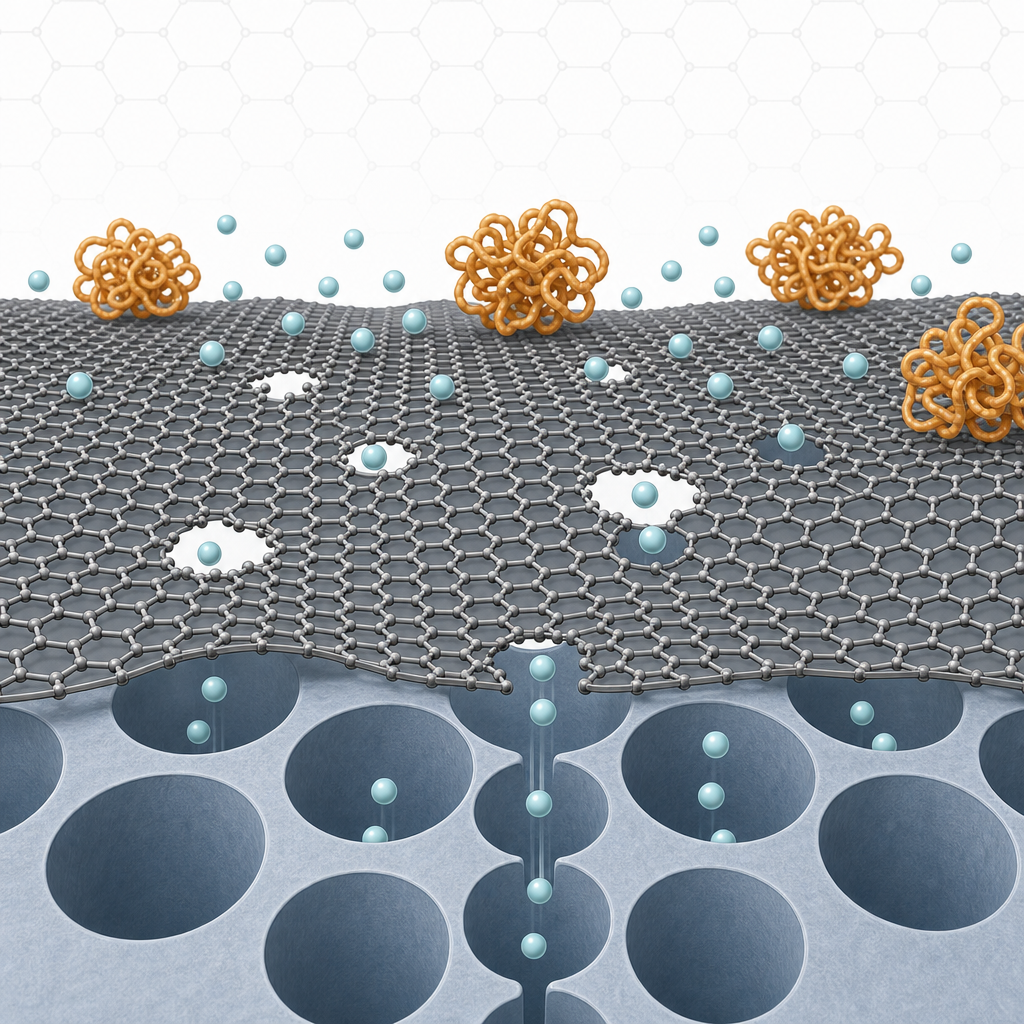
How ACS Material products were used
- CVD Graphene on Copper Foil (CVD Graphene) — “Graphene grown by CVD on copper foil (ACS Materials Inc.) was transferred to a polycarbonate track-etched membrane support”
Product Performance in this Study
The CVD graphene on copper foil from ACS Material served as the active membrane layer. After transfer to a polycarbonate support, it covered approximately 90-98% of the support pores and exhibited selective transport behavior, blocking large dextran molecules while remaining permeable to salts due to intrinsic 1-15 nm pore defects.
Related product categories
Frequently asked questions
Why is CVD graphene permeable to salts despite being atomically dense?
As-grown CVD graphene contains intrinsic nanometer-scale pore defects, primarily in the 1-15 nm size range, that form during synthesis. These defects are too small to dominate pressure-driven water flow but are large enough to allow rapid diffusive transport of ions such as KCl. STEM imaging directly resolved these pores. Because the defects are intrinsic to the synthesis and not caused by transfer etchants, they must be addressed before CVD graphene can function as an ion-selective desalination membrane.
How is CVD graphene on copper foil transferred to a porous support for membrane studies?
The graphene on the back of the copper foil is first removed by floating the foil on ammonium persulfate etchant. The graphene face is then pressed onto a polycarbonate track-etched membrane so the two adhere weakly. The assembly is floated again on copper etchant at ~1.5 atm to completely remove the copper, leaving a single layer of graphene on the polycarbonate. Rinsing with water and a water-ethanol mixture and drying completes the transfer.
Why does pressure-driven flow underestimate the defect content of CVD graphene membranes?
Pressure-driven flow through a cylindrical pore scales with the fourth power of pore diameter, so a single 200 nm uncovered support pore contributes far more flow than thousands of subnanometer to 15 nm pores in graphene. Diffusive transport, in contrast, scales much more weakly with pore size. As a result, pressure-driven measurements detect only large uncovered regions and miss the intrinsic pore defects that control ion selectivity, which diffusive transport reveals clearly.