-
CVD Graphene Microfiber Polarizer - Nanjing University, 2014
Jun 08, 2026 | ACS MATERIAL LLCKou, J. et al. (2014). Platform for enhanced light–graphene interaction length and miniaturizing fiber stereo devices. *Optica*. https://doi.org/10.1364/optica.1.000307
Optica · 2014
Nanjing University used ACS Material CVD monolayer graphene with a wrap-on-a-rod microfiber to build a broadband fiber polarizer and high-Q resonator at 1550 nm.
About this research
Researchers at Nanjing University, led by Fei Xu and Yan-qing Lu, demonstrated a new fiber-photonics platform that wraps a subwavelength microfiber around a graphene-coated rod, using ACS Material monolayer CVD graphene to achieve an extinction ratio of about 8 dB per coil and a single-polarization microresonator quality factor approaching 2×10^4 at 1550 nm. The work, published in Optica in 2014, introduces a lab-on-a-rod geometry that decouples the light–graphene interaction length from the difficulty of handling fragile microfibers. By coiling a microfiber helically on a polymer rod whose surface has been pre-coated with graphene, the team can extend the interaction length almost arbitrarily on a small graphene flake.
Why this research matters: efficient integration of graphene into photonic waveguides is one of the central challenges for graphene-based modulators, photodetectors, polarizers, and mode-locked lasers. The intrinsic absorption of a single graphene layer at normal incidence is only about 2.3%, so practical devices need long evanescent-field overlap with the graphene to accumulate appreciable phase or amplitude change. In free-space and on-chip systems this has driven the development of side-polished D-shaped fibers, slot waveguides, and microfibers, but those approaches are mechanically fragile and hard to scale in length. A robust, compact fiber platform that simultaneously delivers long interaction length, strong evanescent coupling, and the ability to form resonators would benefit telecom polarization control, fiber gyroscopes, current sensors, and emerging 2D-material photonics.
How the ACS Material product was used: the authors purchased a monolayer graphene sheet grown by chemical vapor deposition from ACS Material. As stated in the paper, "A monolayer graphene sheet (ACS Material) grown by chemical vapor deposition (CVD) was then mechanically transferred onto the surface of the Teflon coating." A PMMA rod approximately 2 mm in diameter was first dip-coated with a thin low-index Teflon AF layer (refractive index ~1.31) to suppress leakage into the high-index rod. The CVD monolayer graphene was cut to a precisely tailored length and mechanically transferred so that, after wrapping around the rod, its opposite edges met along the same axial line without overlap. A flame-drawn silica microfiber roughly 3 µm in diameter was then helically wound onto the graphene-coated rod. The number of coils (one, two, or more) and the inter-coil spacing were used as design knobs: tens of micrometers between coils produced an in-line polarizer, while close coils produced a single-polarization resonator.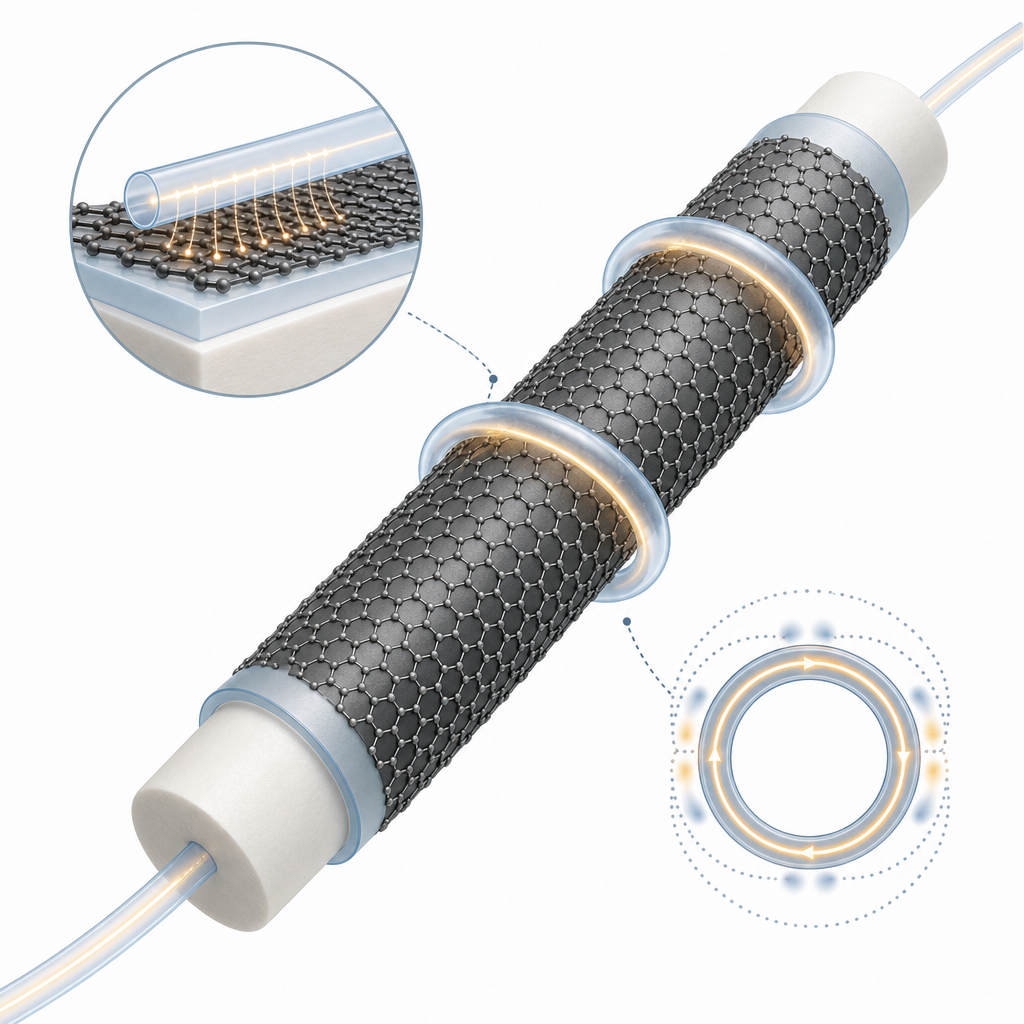
Key results: the one-coil graphene–microfiber in-line polarizer (GMF-IP) provided an extinction ratio of about 5 dB at 1310 nm and about 8 dB at 1550 nm, corresponding to a graphene–microfiber contact length near 6.3 mm. Increasing to a two-coil configuration roughly doubled the contact length to about 12.6 mm and nearly doubled the extinction ratio, reaching approximately 16 dB across a 450 nm bandwidth in the NIR. The extinction ratio rose monotonically with wavelength, consistent with finite-element calculations of the time-averaged power flow into the graphene layer for the even mode. A control microfiber wrapped on a Teflon-only rod without graphene showed no polarizing effect, isolating the function to the ACS Material graphene sheet. When two coils were brought into close proximity to form a graphene–microfiber single-polarization resonator (GMF-SR), the device exhibited a free spectral range of about 0.23 nm and a full width at half maximum of 0.08 nm near 1550 nm, yielding a quality factor approaching 2×10^4. The output-power difference between the even-mode and odd-mode dips reached approximately 11 dB, demonstrating clean single-polarization operation. A semi-theoretical transmission model with coupling coefficients 2πRκ_even = 0.15 and 2πRκ_odd = 1.0 reproduced an FSR of 0.25 nm, in good agreement with experiment.
Applications and outlook: the compact stereo geometry is attractive for fiber gyroscopes, current sensors, and other interferometric systems that benefit from intrinsic single-polarization operation without separate couplers. The authors note that the same lab-on-a-rod approach should generalize to electrical and optical modulators, fiber photodetectors, and polarization controllers, and that combining the platform with RGB fibers or endlessly single-mode photonic crystal fibers could extend operation from the visible through the NIR. They also flag the broader opportunity of integrating microfibers with other 2D materials, including transition metal dichalcogenides such as MoS2, WS2, and WSe2, on the same rod geometry.
Why this matters for researchers: the experiment shows that commercially available monolayer CVD graphene can be transferred cleanly onto a curved, polymer-coated rod and survive helical microfiber wrapping with sufficient quality to support a Q ≈ 2×10^4 resonator. Groups working on fiber-integrated 2D-material photonics, all-fiber polarization devices, or fiber sensors can source the same starting material, ACS Material CVD Graphene on Copper Foil, to reproduce or extend this platform without needing in-house graphene growth.How ACS Material products were used
- CVD Graphene on Copper Foil (monolayer) (CVD Graphene) — “A monolayer graphene sheet (ACS Material) grown by chemical vapor deposition (CVD) was then mechanically transferred onto the surface of the Teflon coating.”
Product Performance in this StudyThe ACS Material monolayer CVD graphene served as the polarization-selective absorber that enabled the in-line polarizer and single-polarization microresonator. It produced an extinction ratio of ~8 dB per coil at 1550 nm and supported a resonator Q-factor approaching 2×10^4, confirming strong, broadband evanescent-field interaction with the microfiber.
Related product categories
Frequently asked questionsHow does CVD monolayer graphene act as a fiber polarizer?
When a microfiber is wrapped around a graphene-coated rod, the evanescent field outside the microfiber overlaps with the graphene sheet. Because graphene interacts most strongly with the in-plane electric field, the mode polarized parallel to the graphene plane is absorbed more than the orthogonal mode. In this Nanjing University work, that anisotropic absorption produced an extinction ratio of about 8 dB per coil at 1550 nm.
Why is a long light–graphene interaction length important for fiber devices?
A single graphene layer absorbs only about 2.3% of normally incident light, so practical modulators, polarizers, and detectors need many millimeters of evanescent-field overlap to accumulate useful attenuation or phase change. The lab-on-a-rod platform increased the contact length from 6.3 mm in a one-coil device to 12.6 mm with two coils, nearly doubling the measured extinction ratio across the 1200–1650 nm band.
What quality factor can a graphene–microfiber resonator reach at 1550 nm?
By bringing two microfiber coils close on a graphene-coated rod, the team formed a single-polarization microresonator with a free spectral range of about 0.23 nm and a full width at half maximum of 0.08 nm near 1550 nm. This corresponds to a Q-factor approaching 2×10^4, with roughly 11 dB suppression between the even and odd polarization modes.