-
CVD Graphene Nanopores for Ionic Transport - MIT, 2015
May 26, 2026 | ACS MATERIAL LLCJain, T. et al. (2015). Heterogeneous sub-continuum ionic transport in statistically isolated graphene nanopores. *Nature Nanotechnology*. https://doi.org/10.1038/nnano.2015.222
Nature Nanotechnology · 2015
MIT researchers used ACS Material CVD graphene to isolate sub-2 nm nanopores, revealing ion-channel-like transport behaviors in Nature Nanotechnology (2015).
About this research
Researchers at the Massachusetts Institute of Technology, led by Rohit Karnik, used CVD-grown single-layer graphene purchased from ACS Material to demonstrate that statistically isolated sub-2 nm nanopores in graphene exhibit heterogeneous, ion-channel-like transport behavior, with conductances spanning three orders of magnitude from 60 pS to 20 nS in 1 M KCl. Published in Nature Nanotechnology (2015, DOI: 10.1038/nnano.2015.222), the work bridges biology-inspired patch-clamp methodology with two-dimensional materials science, showing that individual atomically thin nanopores can exhibit linear, rectified, voltage-activated, and even stochastic switching current-voltage characteristics. The findings provide one of the clearest experimental views into sub-continuum ion transport in nanopores below 2 nm.
The broader motivation lies in the long-standing challenge of building synthetic ion channels that combine the throughput of inorganic membranes with the selectivity of biological proteins. Graphene and other 2D materials are appealing because their atomic thinness yields the smallest possible pore volume, maximizing ionic permeance while enabling dehydration- and electrostatics-based selectivity. However, ensemble measurements on macroscopic graphene membranes average over thousands of pores of varying size and chemistry, hiding the rich physics of individual sub-nanometre channels. This paper resolves that limitation by adapting the patch-clamp idea: a 30-40 nm aperture in a silicon nitride support statistically isolates, on average, a single intrinsic CVD-graphene defect. The work is directly relevant to seawater desalination, selective ion separations, single-molecule biosensing, and DNA sequencing applications under active development in the membrane and nanofluidics communities.
The CVD single-layer graphene from ACS Material plays a central role. The Methods section states explicitly: "CVD-grown single-layer graphene was purchased from ACS Material." The team relied on the fact that as-grown CVD graphene already contains a population of intrinsic point defects with a substantial sub-nanometre tail in the size distribution and a mean spacing of roughly 70-100 nm. Rather than create pores by ion or electron irradiation, they exploited these native defects. The graphene was transferred onto a 50 nm thick silicon nitride membrane (TEM Windows SN100-A50Q33) carrying a single Ga+ FIB-milled 35 nm aperture using a polycarbonate-supported wet transfer. Aberration-corrected STEM imaging confirmed the presence of subnanometre vacancy defects, while leakage tests bounded any non-pore current at 110 pS. Of ten devices measured, seven exhibited conductance clearly attributable to a graphene pore, and five had upper-bound diameters below 2 nm.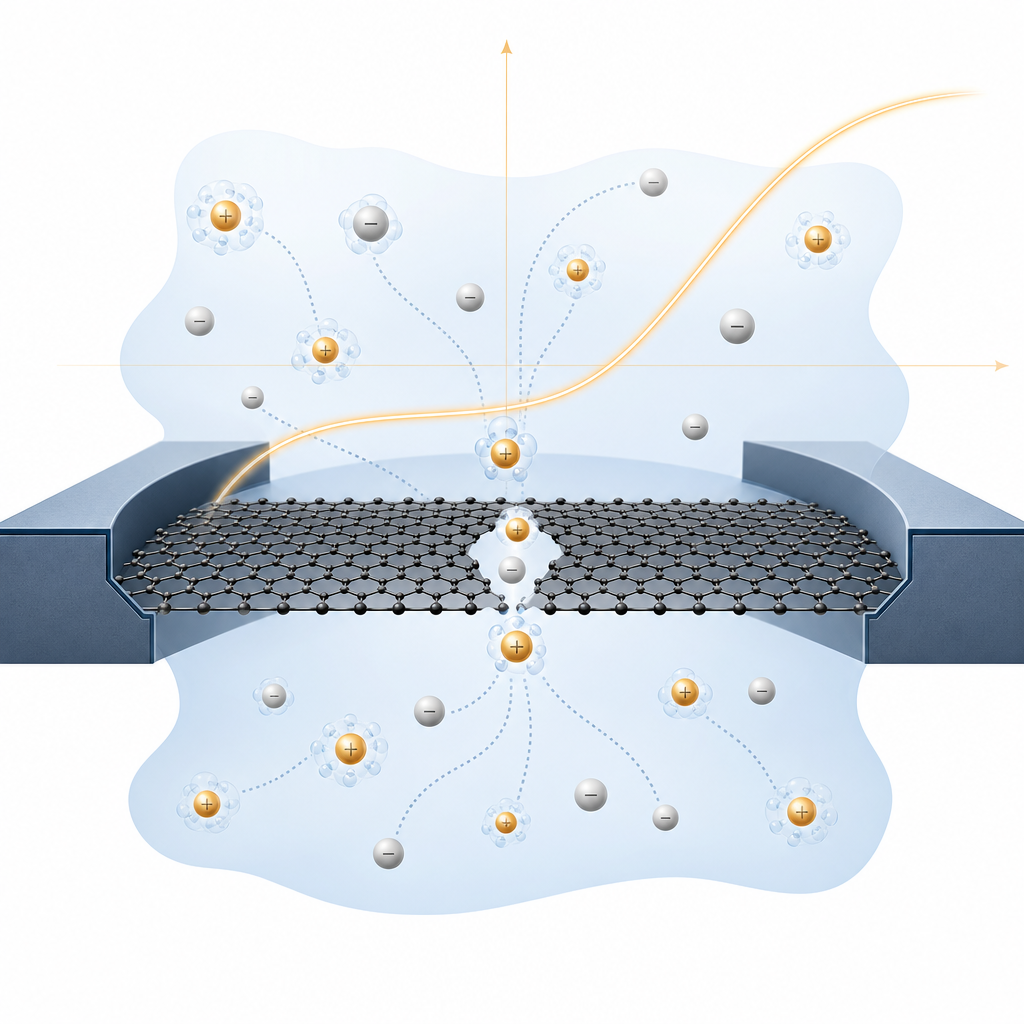
The key results paint a picture of remarkable diversity at the single-pore level. Pore conductance in 1 M KCl varied from 60 pS to 20 nS - three orders of magnitude - even though all pores came from the same CVD film. Current-voltage curves fell into three classes: linear (device 8), rectified (device 9), and voltage-activated nonlinear (device 5). A modified Nernst-Planck model incorporating ion dehydration penalties, electrostatic interactions with fixed pore charge, and the applied bias quantitatively reproduced all three behaviors with realistic pore diameters (0.7-1.0 nm) and charges (0-6e-). Selectivity measurements across KCl, LiCl, BaCl2, CaCl2, and MgCl2 at 100 mM revealed device-dependent cation preferences: device 4 favored K+ over divalents by roughly 3x after conductivity normalization, consistent with K+'s lower hydration energy. Fitted effective pore charge differed statistically (P < 10-4) between monovalent and divalent salts, indicating divalent screening. Two devices displayed rapid stochastic switching, with current jumps from 0.13 to 1.9 nA (device 10) and 1.1 to 2.2 nA (device 5) at negative bias only; power spectral analysis showed single Lorentzian timescales of 1 ms and 25 ms, consistent with single-site protonation/deprotonation.
The implications extend across several fields. For water desalination and ion separations, the work shows that sub-2 nm graphene pores access a transport regime where hydration energetics dominate, opening a design route to selectivity beyond what continuum theory predicts. For biosensing and DNA sequencing, the demonstration that single graphene pores can exhibit voltage-gated and rectified behavior - hallmarks of biological channels - suggests that 2D-material nanopores could serve as engineered synthetic ion channels with tunable response. The authors explicitly position their platform as a tool for probing sub-continuum transport at the single-pore level, an enabling step toward rational pore engineering by functionalization, edge chemistry, or controlled defect introduction. Follow-up work in nanofluidic logic, osmotic energy harvesting, and selective sieving membranes builds directly on this single-pore foundation.
For researchers pursuing similar single-pore or membrane studies, the quality of the starting graphene is decisive: a uniform CVD monolayer with a known and reproducible intrinsic defect population is what makes statistical isolation viable. The CVD single-layer graphene on copper foil available from ACS Material is the same product class used here and is suitable for nanopore membrane research, 2D-material transfer experiments, and electrochemical device fabrication. Groups working on selective ion transport, nanofluidic devices, or sequencing-grade nanopore membranes can source comparable graphene from the ACS Material CVD graphene catalog to build on the methodology demonstrated in this Nature Nanotechnology study.How ACS Material products were used
- CVD Graphene on Copper Foil (CVD Graphene) — “CVD-grown single-layer graphene was purchased from ACS Material.”
Product Performance in this StudyThe CVD single-layer graphene from ACS Material served as the atomically thin membrane whose intrinsic sub-nanometre pore defects were the object of study. Its native defect density (70-100 nm spacing) was exactly what enabled statistical isolation of single nanopores beneath a 35 nm silicon nitride aperture.
Related product categories
Frequently asked questionsWhy are sub-2 nm graphene nanopores interesting for ion transport?
Below 2 nm, ion transport through graphene nanopores enters a sub-continuum regime where partial ion dehydration and electrostatic interactions with the pore dominate over bulk diffusion. This regime enables selectivity based on hydration energy and ionic radius - properties analogous to biological ion channels - while preserving the high permeance that comes from graphene's atomic thinness. It opens design space for desalination membranes, selective separations, and single-molecule sensors.
How was a single graphene nanopore isolated for measurement?
The researchers transferred CVD single-layer graphene from ACS Material onto a 50 nm thick silicon nitride membrane patterned with a single 35 nm aperture by Ga+ focused ion beam. Because intrinsic CVD-graphene defects are spaced 70-100 nm apart on average, the small SiNx aperture statistically exposes only one nanopore. Leakage conductance was bounded at 110 pS, allowing seven of ten devices to be unambiguously attributed to single-pore transport.
What transport behaviors did individual graphene nanopores show?
Single sub-2 nm graphene pores exhibited conductances spanning three orders of magnitude (60 pS to 20 nS in 1 M KCl) and three distinct I-V shapes: linear, rectified, and voltage-activated nonlinear. Some devices also showed rapid stochastic switching between conductance states at negative bias only, with single-Lorentzian power spectra indicating well-defined relaxation timescales of 1-25 ms - signatures consistent with protonation and deprotonation of a single ionizable site.