-
CVD Graphene on Copper for Gas Separation Membranes - MIT, 2014
May 28, 2026 | ACS MATERIAL LLCBoutilier, M. S. H. et al. (2014). Implications of Permeation through Intrinsic Defects in Graphene on the Design of Defect-Tolerant Membranes for Gas Separation. *ACS Nano*. https://doi.org/10.1021/nn405537u
Massachusetts Institute of Technology · ACS Nano · 2014
MIT researchers used CVD graphene on copper foil from ACS Material to build multilayer gas separation membranes, cutting helium leakage by up to 99%.
About this research
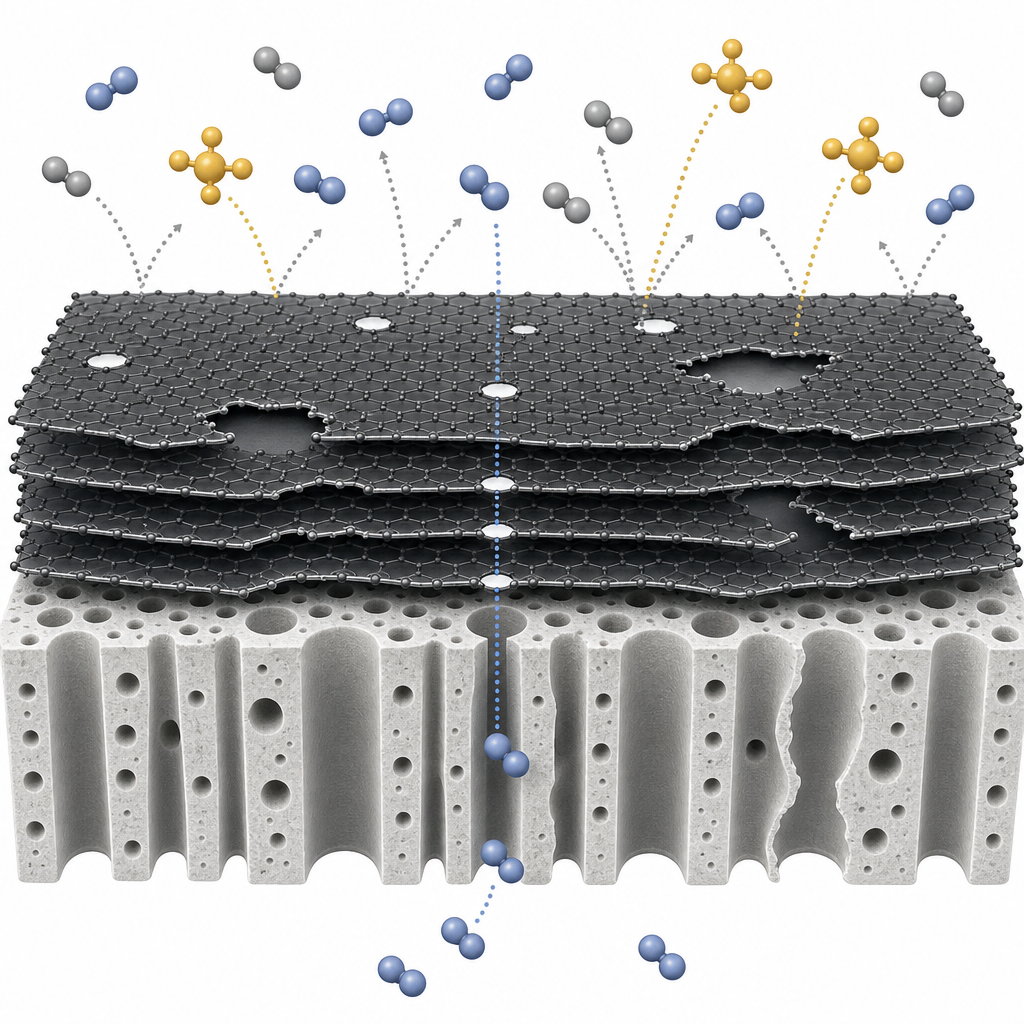
Researchers at the Massachusetts Institute of Technology used CVD graphene on copper foil supplied by ACS Material to fabricate multilayer graphene composite membranes and demonstrated that independent stacking of two to five graphene layers exponentially reduces gas leakage through intrinsic defects and tears, cutting helium permeance by up to 99% relative to the bare polycarbonate support. Published in ACS Nano in 2014 by Boutilier, Sun, O'Hern, Au, Hadjiconstantinou, and Karnik, the study delivers both an experimental demonstration and a quantitative gas transport model that separates the contributions of micrometer-scale tears and nanometer-scale intrinsic defects, providing design rules for practical, defect-tolerant graphene membranes for gas separation.
Gas separation underpins natural gas purification, hydrogen production, carbon dioxide capture, and oxy-combustion. Conventional polymer membranes face a permeability-selectivity trade-off that limits them to small-scale or impurity-removal duties. Single-atom-thick graphene with subnanometer pores has been predicted to surpass these limits by orders of magnitude, and small-area demonstrations have reached selectivities near 15,000. Translating that performance to macroscopic membranes is, however, blocked by the practical reality that large-area CVD graphene contains intrinsic nanometer-scale holes formed during growth and micrometer-scale tears introduced during transfer. Understanding how these defects govern overall permeance, and how to suppress nonselective leakage without losing the atomically thin selective layer, is the open question this paper addresses for the entire field of two-dimensional membrane science.
The team obtained CVD graphene grown on copper foil from ACS Material and used it as the starting material for every membrane in the study. The Methods section states explicitly that "graphene on copper foil (ACS Materials) grown by chemical vapor deposition (CVD) was first cut into approximately 5 mm squares" before back-etching the copper in ammonium persulfate. Each square was then mechanically pressed onto a 1 micrometer pore polycarbonate track-etched membrane (PCTEM), the remaining copper was floated off in ammonium persulfate, and the composite was rinsed and dried. To build multilayer stacks, the transfer sequence was repeated layer by layer so that defects in one graphene sheet would statistically be covered by the next. The CVD graphene quality was confirmed by Raman spectroscopy and scanning transmission electron microscopy in the team's earlier work, and SEM imaging of one-layer and five-layer composites showed that successive layers visibly reduced tear coverage.
Key results include an exponential decrease of helium flow with increasing number of graphene layers: a single layer reduced helium flux through the bare PCTEM by about 60%, and five independently stacked layers cut leakage to roughly 1% of the bare-support value, a 99% reduction. Least-squares fitting of the authors' transport model to flow rates of helium, nitrogen, and sulfur hexafluoride (kinetic diameters 2.6, 3.64, and 5.5 angstroms) yielded a graphene coverage of gamma = 0.698 and an intrinsic porosity of eta = 6.87 x 10^-3, meaning that each layer covers about 70% of the PCTEM pores and that intrinsic defects occupy 0.687% of the graphene area. Monte Carlo simulations of aligned defects across n stacked layers showed the (LIP^(n))^-2 scaling with eta^n, so each added layer reduces the density of through-going defects by a factor of eta. The model further set a conservative lower bound on interlayer transport resistance of 1.2 x 10^4 Pa s m^2/mol for helium, demonstrating that in-plane leakage between graphene sheets is negligible up to four layers.
The practical payoff is a design map for defect-tolerant graphene membranes. The authors show that selectivity emerges only when the support pore diameter DPC is smaller than the average intrinsic-defect spacing LIP, and when the support permeance approximately matches the selective-pore permeance (PPC/PS ~ 1). Under these conditions, model predictions indicate that three to five layers of CVD-quality graphene on a 10 nm pore support with 85% coverage can deliver He/SF6 selectivities on the order of 1000. These rules apply to hydrogen recovery, helium separation, carbon capture, and any process where atomically thin selective layers must be deposited on engineered porous backings, and they extend to thin isotropic support layers where film thickness replaces DPC. The work also informs related two-dimensional materials such as hexagonal boron nitride and graphene oxide laminates.
For researchers working on membrane separations, electrochemical interfaces, or 2D heterostructures, this study underscores how starting material quality and substrate engineering jointly determine device performance. ACS Material's CVD graphene on copper foil, used here as the source of every selective layer, is available to laboratories developing similar membranes, sensors, or coatings. The catalog also lists related transfer-ready formats, hexagonal boron nitride, and graphene oxide films for researchers extending these defect-tolerant membrane concepts to other 2D systems.How ACS Material products were used
- CVD Graphene on Copper Foil (CVD Graphene) — “Graphene on copper foil (ACS Materials) grown by chemical vapor deposition (CVD) was first cut into approximately 5 mm squares and the back sides of these pieces were etched for 5 min in ammonium persulfate (APS-100, Transene) to expose the copper and reduce the foil thickness.”
Product Performance in this Study
The CVD graphene on copper foil served as the source material for fabricating all single-layer and multilayer graphene composite membranes. Successful transfer of up to five independently stacked layers onto polycarbonate track-etched supports demonstrated that the material was suitable for producing macroscopic membranes whose permeance could be exponentially reduced (by up to 99%) through stacking.
Related product categories
Frequently asked questions
How does stacking multiple layers of CVD graphene reduce gas leakage in separation membranes?
Independent stacking causes the defects in one graphene layer to be statistically covered by intact regions in subsequent layers. Because each layer covers about 70% of the support pores and intrinsic defects occupy only 0.687% of the graphene area, the density of aligned through-going defects scales as eta^n. In the MIT study, this produced a 99% reduction in helium leakage when five layers of CVD graphene on copper foil were stacked on a polycarbonate track-etched support.
Why is CVD graphene on copper foil chosen as the starting material for gas separation membranes?
CVD graphene on copper foil provides a continuous, single-atom-thick selective layer over large areas, which is essential for scaling membrane fabrication beyond micrometer-scale flakes. The copper foil acts as a sacrificial growth substrate that can be etched away with ammonium persulfate, leaving the graphene supported on a porous backing. In this work, CVD graphene on copper foil from ACS Material enabled reproducible layer-by-layer transfer onto polycarbonate track-etched membranes.
What support membrane pore size is needed for defect-tolerant graphene gas separation?
The MIT model shows that selective transport is achievable only when the support pore diameter is smaller than the average spacing between intrinsic graphene defects, isolating defects to a small fraction of pores. For typical CVD graphene quality, a 10 nm pore polycarbonate support combined with about 85% graphene coverage and three layers can yield He/SF6 selectivities on the order of 1000, provided the support permeance roughly matches the selective-pore permeance.