-
CVD Graphene on PDMS Fracture Behavior - Peking University, 2016
Jun 04, 2026 | ACS MATERIAL LLCNiu, T., Cao, G., & Xiong, C. (2016). Fracture behavior of graphene mounted on stretchable substrate. *Carbon*. https://doi.org/10.1016/j.carbon.2016.08.087
Carbon · 2016
Researchers at Peking University used ACS Material CVD graphene on copper to probe graphene/PDMS fracture by AFM, measuring intrinsic strength of 112 GPa.
About this research
Researchers at Peking University investigated the fracture behavior of CVD graphene on copper foil supplied by ACS Material after transferring the monolayer onto a soft poly(dimethylsiloxane) (PDMS) substrate, reporting an intrinsic strength of 37.6 N/m (corresponding to ~112 GPa) at a breaking strain of approximately 0.23. The work, published in Carbon in 2016 by Niu, Cao and Xiong, develops an AFM-based nanoindentation framework that, unlike conventional free-standing indentation, captures how an elastomeric substrate modifies the mechanical limits of graphene. The authors combine experiments with finite-element modeling to dissect the strain distribution and interface mechanics, and they confirm that substrate-bonded graphene can still be driven all the way to failure without slippage or debonding at the graphene/PDMS interface.
Understanding how graphene behaves once it is adhered to a real device substrate is critical for emerging flexible and stretchable electronics, including electronic-skin sensors, wearable strain gauges and conformal transparent conductors. Earlier free-standing indentation measurements gave the only widely cited experimental value for intrinsic graphene strength (~42 N/m), but those tests are sensitive to boundary conditions, AFM tip–graphene van der Waals interactions and local out-of-plane curvature. Conversely, tensile or bending tests on substrate-mounted graphene typically transfer only ~1.6% strain before the interface slips, far short of the strain needed to fracture the lattice. There is therefore a gap between idealized mechanics and the high-deformation regime that flexible devices must survive. This paper closes that gap by exploiting the softness of PDMS to push the graphene to fracture under indentation, providing a realistic benchmark for device designers.
The single-layer CVD graphene on copper foil from ACS Material served as the central specimen. The team followed a standard wet-transfer route to move the graphene onto Sylgard 184 PDMS (10:1 base:curing agent, cured at 85 °C for 4 h, 10 × 10 × 2 mm coupons, lateral graphene size ~5 mm), then verified monolayer coverage by Raman spectroscopy at 532 nm and AFM imaging before and after indentation. Indentation was performed on a JPK NanoWizard 3 AFM using two diamond tips of equivalent radius R = 21 and 41 nm, loaded until graphene failure. Five samples and 20 load–displacement data sets were collected. Because PDMS is highly compliant (effective modulus Es = 1.12 ± 0.025 MPa from uniaxial tension on BOSE-3100) and the van der Waals adhesion between PDMS and graphene is strong, the indenter could impose large in-plane strains directly into the graphene without sliding the interface, an outcome enabled by the high quality and continuity of the ACS Material CVD film.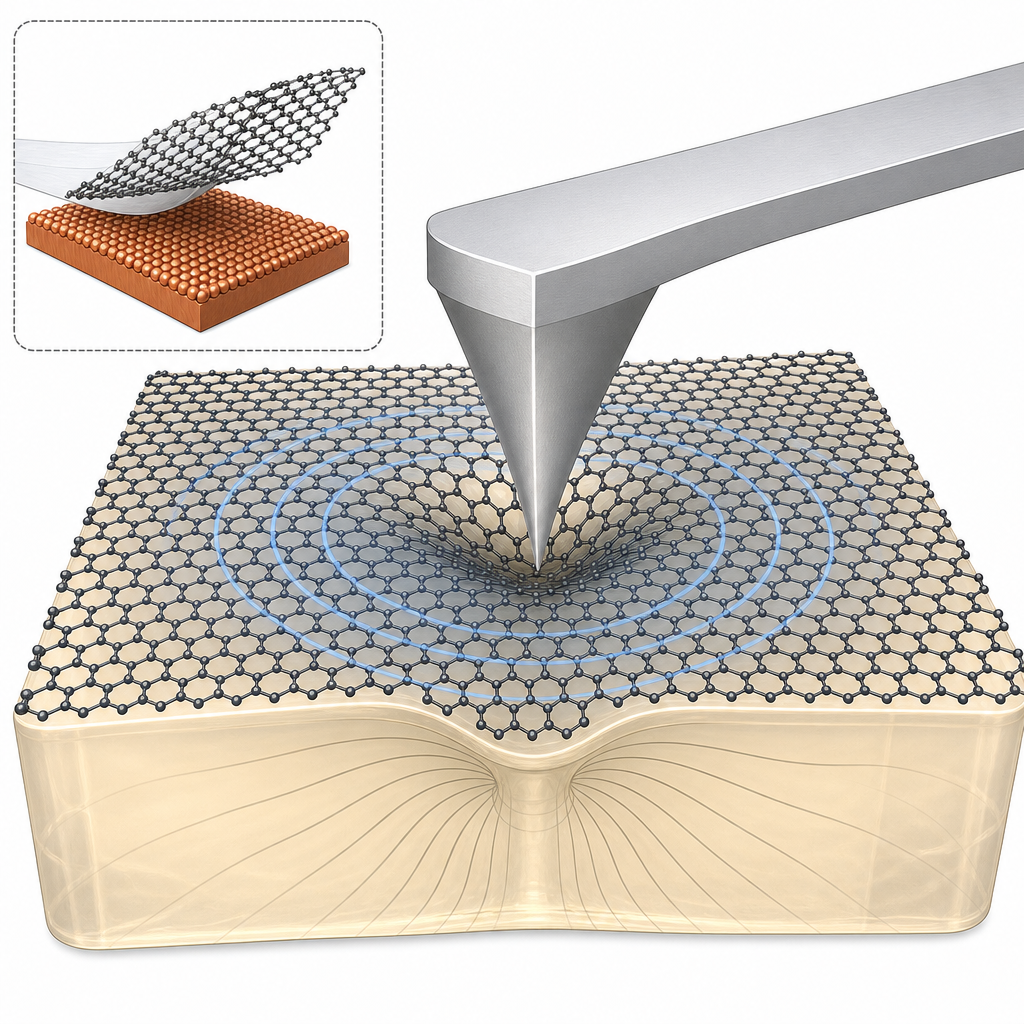
The measured load–displacement (P–δ) curves were sharp and reproducible. Breaking forces were Pb = 3.16 ± 0.21 µN for the 21 nm tip and 4.03 ± 0.27 µN for the 41 nm tip, roughly 7–15 times higher than indentation of bare PDMS at the same depth, demonstrating that the graphene dominates the composite stiffness. Standard deviations were small and the curves before fracture were smooth, indicating no slip or debonding at the graphene/PDMS interface up to failure. Finite element analysis in ABAQUS v6.10, treating graphene with its nonlinear σ = Eg ε + Dg ε² law (νg = 0.17) and PDMS with both Neo-Hookean (C10 = 0.188 MPa, D1 = 0.107 MPa⁻¹) and standard linear solid viscoelastic models, reproduced the experiments and showed that the viscous Prony parameter (g = 0.05) had negligible influence. Extracting stress and strain at fracture gave an intrinsic strength of 37.6 N/m (~112 GPa) and breaking strain ~0.23, only about 10% lower than the free-standing value and within range of DFT predictions (~31 N/m). The deformation field of graphene/PDMS under indentation closely resembled the free-standing case because the main tensile strain is delivered directly by the indenter rather than transferred through the interface, producing very low interfacial shear and explaining the absence of debonding.
This substrate-bonded fracture protocol gives device engineers a more realistic strength benchmark for graphene used in stretchable platforms. It is directly relevant to graphene-based electronic skin, flexible touch panels, transparent electrodes for foldable displays, conformal pressure or strain sensors, and graphene/elastomer nanocomposites in soft robotics. The methodology also generalizes to other 2D materials on compliant substrates (hexagonal boron nitride, MoS2, WS2), enabling mechanical screening of candidate channel and barrier layers for flexible electronics. Future work pointed to in the paper includes mapping how interface chemistry, substrate modulus and graphene defect density modulate the ~10% strength reduction observed here, and connecting these mechanical limits to electrical reliability under cyclic deformation.
For researchers building flexible devices, the practical takeaway is that high-quality CVD monolayer graphene retains close to its intrinsic strength even when fully bonded to a soft elastomer, provided the film is continuous and well transferred. The CVD graphene on copper foil used in this study is available from ACS Material in the CVD Graphene category, alongside graphene on SiO2, quartz and PET substrates suitable for similar mechanical, electrical and optical investigations on 2D materials.How ACS Material products were used
- CVD Graphene on Copper Foil (CVD Graphene) — “The single-layer graphene on copper foil grown by chemical vapor deposition (CVD) (ACS Materials, USA) is selected.”
Product Performance in this StudyACS Material's single-layer CVD graphene on copper foil was the sample under test. After transfer to PDMS, the monolayer character was confirmed by Raman spectroscopy and the film withstood AFM nanoindentation up to fracture, yielding repeatable breaking forces (3.16 ± 0.21 µN and 4.03 ± 0.27 µN for two tip radii) and supporting an intrinsic strength of 37.6 N/m (~112 GPa).
Related product categories
Frequently asked questionsWhat is the intrinsic strength of CVD graphene measured on a PDMS substrate?
Using AFM nanoindentation on CVD monolayer graphene transferred to PDMS, the intrinsic strength was measured as 37.6 N/m, corresponding to approximately 112 GPa, with a fracture strain of about 0.23. This value is only about 10% lower than the free-standing graphene benchmark of ~42 N/m, indicating that substrate binding causes only a modest reduction in graphene's mechanical limits.
Why use PDMS as the substrate for graphene fracture experiments?
PDMS has a very low elastic modulus (~1.12 MPa) and forms a strong van der Waals contact with graphene. These two features let an AFM indenter push graphene to its true fracture strain without first triggering interfacial slip. On stiffer substrates like silicon or PET, the interface slips at strains around 0.3–1.6%, well below the strain needed to break the graphene lattice.
Does the graphene/PDMS interface slip or debond during nanoindentation?
No interface slippage or debonding was observed up to graphene failure. Load–displacement curves were smooth, breaking forces were highly repeatable (3.16 µN and 4.03 µN for 21 and 41 nm tips), and finite element analysis showed that indentation strain is delivered directly by the tip rather than transferred through the interface, producing very low interfacial shear stress.