-
EPR Study of Graphene & Expanded Graphites - Università di Padova, 2014
Jun 17, 2026 | ACS MATERIAL LLCTampieri, F. et al. (2014). A comparative electron paramagnetic resonance study of expanded graphites and graphene. *J. Mater. Chem. C*. https://doi.org/10.1039/c4tc01383b
Dipartimento di Scienze Chimiche (DiSC) · J. Mater. Chem. C · 2014
Researchers at Università di Padova used ACS Material reduced graphene oxide as the EPR reference to compare expanded graphites and graphene defect states.
About this research
Researchers at the Dipartimento di Scienze Chimiche (DiSC), Università degli Studi di Padova, in collaboration with CSIRO, used ACS Material's commercial reduced graphene oxide (RGO), labelled "Single Layer Graphene," as the reference material in a comparative electron paramagnetic resonance (EPR) study of expanded graphites and graphene published in Journal of Materials Chemistry C (2014). By benchmarking three differently exfoliated graphite samples against natural Madagascar graphite on one side and the ACS Material RGO on the other, the team disentangled overlapping EPR signals into contributions from conduction electrons, edge states, and molecular-type radical defects, clarifying how preparation route shapes graphene's electronic landscape.
Understanding the magnetic and electronic fingerprints of graphene-related carbons matters because the term "graphene" today covers a spectrum of materials with widely different layer counts, lateral sizes, defect densities, and chemical residues. These differences directly influence performance in transparent conductors, composite reinforcement, electrochemical electrodes, spintronics, and sensing. EPR is uniquely sensitive to unpaired electrons, both itinerant carriers and localized paramagnetic defects, yet it has been comparatively underused for graphene characterization, and existing reports sometimes contradict each other. By performing temperature-dependent continuous-wave EPR alongside pulsed Hahn-echo decay, inversion-recovery, echo-detected EPR, and two-pulse ESEEM, this work establishes a more rigorous framework for assigning EPR features in graphene-family carbons.
ACS Material's Single Layer Graphene was received as RGO from a Hummers-type process and used as supplied, in the solid (undispersed) form, without further purification. It was sealed under vacuum inside 2–3 mm ID quartz EPR tubes after full evacuation of adsorbed gases, then measured on an X-band Bruker ELEXSYS spectrometer with a dielectric resonator and a helium-flow cryostat from 290 K down to about 10 K. The RGO sample anchored the "defective graphene" end of the comparison set, while natural Madagascar graphite anchored the bulk-graphite end. Three intermediate materials were prepared in-house: EK (potassium intercalation and ethanol-driven expansion of graphite), EH (sulfuric/nitric acid treatment followed by microwave expansion), and EHK (combined acid expansion followed by potassium intercalation). XRD and 622 nm micro-Raman measurements provided structural context for interpreting the EPR signatures of all five samples side by side.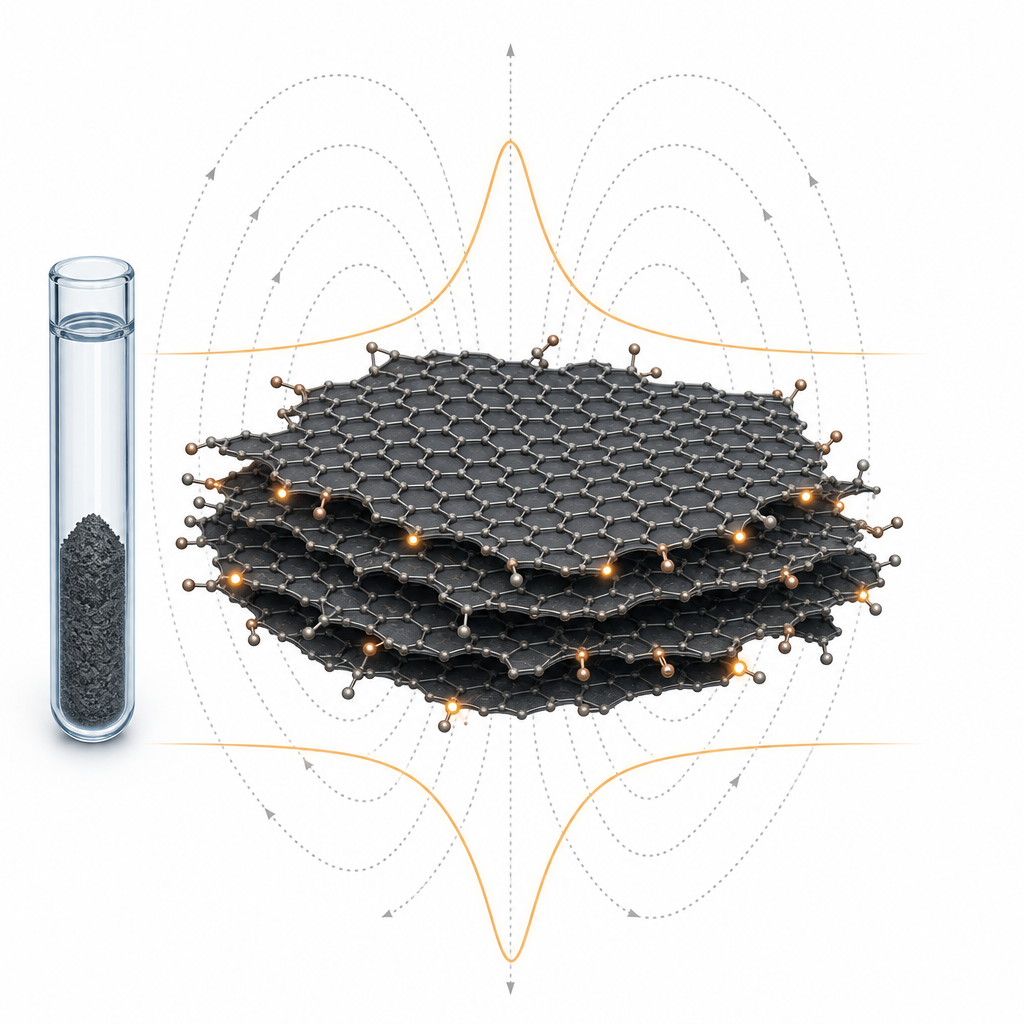
The ACS Material RGO reference showed a symmetric, isotropic Lorentzian EPR line near g = 2.0031–2.0032 with linewidths of about 4.4 G and 13.0 G for two superimposed components, decreasing in intensity from room temperature down to ~100–150 K and then rising sharply at lower temperatures with a Curie-like dependence, consistent with a highly defective graphene with abundant edge states. Pulsed echo-detected EPR at 80 K produced a single Gaussian component (g = 2.0038, 1.6 G linewidth, 100% relative weight). Hahn-echo decay returned phase-memory times of 0.466 µs and 3.897 µs; inversion-recovery yielded T1 values of 0.919 µs and 7.223 µs; and 2p-ESEEM revealed hyperfine couplings to both 1H (14.9 MHz, with the 30 MHz double-frequency peak) and 13C (3.9 MHz). The Raman A(D)/A(G) ratio for RGO was 1.78, the highest of all samples, confirming substantial sp2 defect density. Among the expanded graphites, EK most closely resembled RGO in g-value, lineshape, and low-temperature Curie behavior, while the acid-expanded EH retained a Dysonian, graphite-like profile (g-component ~2.0036, 17.3 G) indicating large conductive flakes exceeding the microwave skin depth.
These findings have direct implications for industrial selection of graphene materials. The authors conclude that potassium intercalation followed by ethanol exfoliation produces graphene-like material electronically closer to true few-layer graphene than acid expansion does, while Hummers-method RGO remains the most defective. For applications in conductive inks, polymer composites, electrochemical electrodes, electromagnetic-interference shielding, and spin-based sensing, EPR fingerprints of edge states, conduction electrons, and trapped radicals offer a quantitative tool to match material grade to device requirement. Follow-up work pointed to by the paper includes deeper investigation of the unusual sub-ge g-values seen in bent graphitic systems, hyperfine mapping of hydrogen incorporated during strongly reductive exfoliation, and correlation of EPR-detected defects with charge-transport metrics.
For researchers building on this work, ACS Material's Single Layer Graphene (reduced graphene oxide) is available as a consistent, commercially sourced reference standard suitable for comparative spectroscopy of defect chemistry in carbon nanomaterials. The same Graphene Series catalog also offers higher-conductivity rGO, large-flake graphene oxide, and low-defect graphene oxide for studies in which defect density must be tuned rather than maximized. Reliable, characterized reference materials reduce ambiguity in EPR, Raman, and XRD comparisons and make multi-laboratory results easier to reconcile.How ACS Material products were used
- Single Layer Graphene (reduced graphene oxide, Hummers method) (Graphene Series) — “RGO was received from ACS Materials (MA, USA), labelled 'Single layer Graphene' and used in the solid form without further purification.”
Product Performance in this StudyThe ACS Material 'Single Layer Graphene' served as the commercial reduced graphene oxide reference against which expanded graphite samples were benchmarked. It exhibited a Lorentzian EPR line near g = 2.003–2.004 with a strong Curie-like rise at low temperature, characteristic of a highly defective Hummers-method graphene and providing a reliable internal standard for the comparative EPR study.
Related product categories
Frequently asked questionsWhy use reduced graphene oxide as a reference in EPR studies of graphene materials?
Hummers-method reduced graphene oxide is widely available, batch-consistent, and rich in edge states and defect-related paramagnetic centers, which produces strong, well-characterized EPR signals. This makes it an excellent benchmark for comparing other graphene preparations. In this study, ACS Material's Single Layer Graphene provided a stable Lorentzian line near g = 2.003 with a clear Curie-like low-temperature rise, anchoring the defective end of the comparison.
What does the EPR g-value near 2.003 reveal about graphene defects?
A g-value close to the free electron value of 2.0023 indicates unpaired electrons in carbon π-systems with weak spin-orbit coupling, typical of organic aromatic radicals and graphene edge states. Slight deviations and lineshape (Lorentzian, Gaussian, or Dysonian) help distinguish localized edge electrons, molecular-type radicals, and itinerant conduction electrons in conductive graphitic flakes larger than the microwave skin depth.
How does exfoliation method affect the electronic properties of graphene?
Acid expansion (sulfuric/nitric) tends to preserve large conductive flakes with graphite-like Dysonian EPR lineshapes, while potassium intercalation followed by ethanol exfoliation produces thinner, more separated layers whose EPR signatures resemble Hummers-method reduced graphene oxide. Defect density, edge-state population, and conduction-electron mobility therefore depend strongly on the chemical route used to separate the graphene sheets.