-
GO for Mg Hydrogen Storage - Lawrence Berkeley National Laboratory, 2022
Jun 09, 2026 | ACS MATERIAL LLCDun, C. et al. (2022). Hydrogen storage performance of preferentially oriented Mg/rGO hybrids. *Chemistry of Materials*. https://doi.org/10.1021/acs.chemmater.1c03714
Chemistry of Materials · 2022
Lawrence Berkeley researchers used ACS Material single-layer graphene oxide to grow {2116}-oriented Mg/rGO hybrids that absorb 6.2 wt% hydrogen.
About this research
Researchers at Lawrence Berkeley National Laboratory, working with collaborators at Lawrence Livermore National Laboratory, Sandia National Laboratories, and the Korea Institute of Science and Technology, used single-layer graphene oxide purchased from ACS Material to fabricate magnesium/reduced graphene oxide (Mg/rGO) hybrids with controlled crystallographic orientation. By selecting methylnaphthalene as the reducing agent, they grew Mg nanosheets that preferentially expose the non-close-packed {2116} facet, achieving 6.2 wt% hydrogen absorption at 250 °C and 15 bar - a significant gain over the 5.1 wt% obtained from hybrids without preferential orientation. The work, published in Chemistry of Materials in 2022, links facet engineering directly to improved hydrogenation kinetics in lightweight metal hydrides.
Hydrogen is widely viewed as a clean energy carrier, but on-board storage in solid-state media remains the bottleneck for transportation and stationary power. Magnesium is attractive because it is abundant, non-toxic, and offers a theoretical gravimetric capacity of 7.6 wt%, yet its high thermodynamic stability and slow hydrogenation kinetics have historically required heavy catalysts or aggressive nanostructuring. Prior studies on palladium and nickel showed that hydrogen uptake depends strongly on which crystal facets are exposed, suggesting that controlling Mg surface orientation could unlock faster kinetics without sacrificing capacity. This paper translates that facet-engineering concept to a wet-chemical synthesis compatible with practical hydride composites.
The ACS Material single-layer graphene oxide was central to the synthesis. It was dispersed in tetrahydrofuran, mixed with bis(cyclopentadienyl)magnesium precursor, and then co-reduced by a lithium aromatic radical anion solution to yield Mg nanocrystals supported on rGO. Three reducing agents - methylnaphthalene, phenanthrene, and pyrene - were compared, producing the hybrids MMr, PhMr, and PMr respectively. The GO acts both as a nucleation substrate that templates Mg growth and as a selective barrier: prior work in this group established that rGO layers block O2 and H2O while permitting H2 diffusion, protecting reactive Mg without adding catalytic dead mass. XPS confirmed a higher degree of GO reduction when methylnaphthalene was used, correlating with the appearance of high-index {2116} Mg facets in TEM, SAED, and FFT analyses.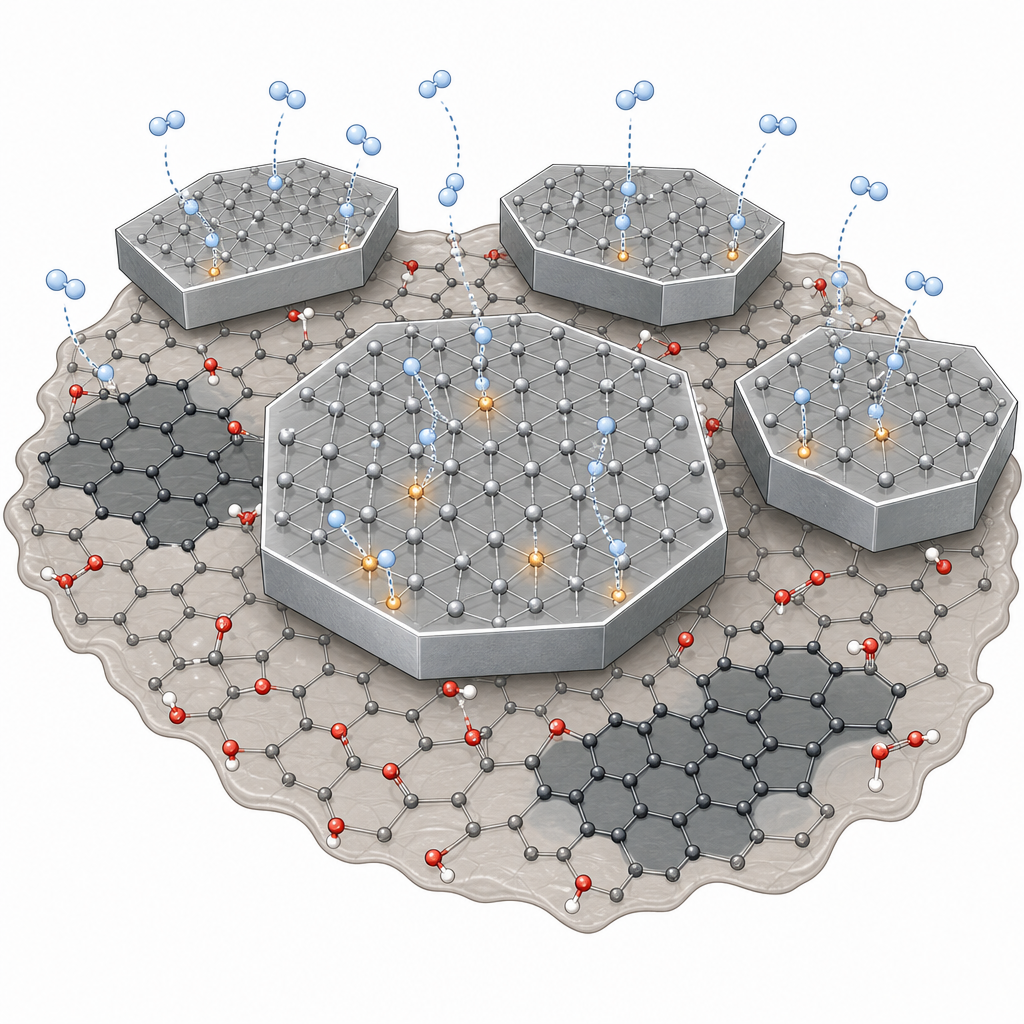
Key results center on the relationship between crystal facet and hydrogen uptake. PMr (pyrene-reduced, polycrystalline disks with random orientation) absorbed only 3.5 wt% H2; PhMr (mixed morphology) reached 5.1 wt%; and MMr, dominated by single-grain Mg sheets with {2116} surfaces, reached 6.2 wt% within two hours. XRD after hydrogenation showed complete conversion to MgH2 only in MMr, while residual Mg persisted in PhMr and PMr - direct evidence that {2116}-textured surfaces accelerate hydrogen penetration into the particle interior. Temperature-dependent kinetics fit to the Johnson-Mehl-Avrami model gave an activation energy of 45.99 kJ/mol for MMr, substantially lower than the ~60.8 kJ/mol previously reported for naphthalenide-reduced Mg and competitive with transition-metal-catalyzed bulk hydrides. First-principles DFT calculations rationalized the observation: on the {2116} surface, H2 dissociation barriers fall to 0.63-1.11 eV with adsorption energies as low as -0.12 eV, and the hydrogen penetration barrier from surface to subsurface drops to 0.23-0.43 eV, versus 0.46-0.78 eV on the {0001} basal plane. The lower atomic packing density of {2116} creates an uneven energy landscape with facile diffusion pathways below 0.2-0.3 eV.
The implications extend across hydrogen energy research. Demonstrating that a solution-phase synthesis can deliberately bias Mg toward high-index, non-close-packed facets - and that this facet control reduces activation energies into the range achievable with heavy-metal catalysts - opens a route to lightweight, catalyst-free hydrogen storage materials suitable for on-board fuel applications. The approach is also broadly relevant to other metal hydride systems where facet-dependent kinetics matter, and to catalysis communities where selective faceting governs activity. Future work pointed to by the authors includes extending this redox-controlled growth strategy to Mg alloys and exploring the synergy between facet engineering and confinement in rGO multilaminates for cycling stability.
For researchers working on metal hydrides, 2D-supported nanocomposites, or facet-controlled nanocrystal synthesis, the single-layer graphene oxide used here is available from ACS Material in the Graphene Series catalog. Its uniform single-layer character was essential to providing the atomically thin, chemically tunable support that templated the {2116}-oriented Mg growth reported in this study. The paper exemplifies how a carefully chosen GO precursor, combined with rational selection of organic reducing agents, can deliver measurable, reproducible gains in hydrogen storage performance.How ACS Material products were used
- Single Layer Graphene Oxide (Graphene Series) — “Single layer graphene oxide was purchased from ACS Material.”
Product Performance in this StudySingle-layer graphene oxide from ACS Material served as the precursor that was reduced in situ to rGO and acted as the atomically thin support for crystallographically oriented Mg nanoparticles. The rGO encapsulation preserved Mg phase purity, allowed selective H2 permeation while blocking O2/H2O, and confined Mg particle growth - enabling the {2116}-textured Mg/rGO hybrid that achieved 6.2 wt% hydrogen uptake.
Related product categories
Frequently asked questionsHow does graphene oxide improve magnesium hydrogen storage performance?
Graphene oxide, after in-situ reduction to rGO, serves as an atomically thin support that templates magnesium nanocrystal growth, confines particle size, and acts as a selective gas barrier. The rGO layers block oxygen and water from oxidizing the reactive Mg surface while still allowing H2 to diffuse through, enabling a 6.2 wt% hydrogen absorption capacity in the Mg/rGO hybrid without the need for heavy-metal catalysts.
Why is the Mg {2116} crystal facet better for hydrogen absorption than {0001}?
The {2116} surface is non-close-packed, meaning it has a lower density of Mg atoms and more dangling bonds. DFT calculations show this facet offers lower H2 dissociation barriers, more stable hydrogen adsorption energies down to -0.12 eV, and dramatically reduced penetration barriers of 0.23-0.43 eV versus 0.46-0.78 eV for {0001}. These advantages translate to faster hydrogenation kinetics and complete conversion to MgH2.
What activation energy does the Mg/rGO hybrid achieve for hydrogen uptake?
Fitting variable-temperature uptake isotherms to the Johnson-Mehl-Avrami model gave an activation energy of approximately 45.99 kJ/mol for the methylnaphthalene-reduced MMr sample with {2116} preferential orientation. This is substantially lower than the ~60.8 kJ/mol reported for naphthalenide-reduced Mg without facet control, and is competitive with transition-metal-catalyzed bulk magnesium hydride systems despite using no heavy-metal catalyst.