-
GO-Templated MnO2 Nanosheets for Li–S Batteries - University of Waterloo, 2015
May 26, 2026 | ACS MATERIAL LLCLiang, X. et al. (2015). A highly efficient polysulfide mediator for lithium–sulfur batteries. *Nature Communications*. https://doi.org/10.1038/ncomms6682
Nature Communications · 2015
University of Waterloo researchers used ACS Material single-layer graphene oxide to template MnO2 nanosheets that mediate polysulfides in Li–S batteries.
About this research
Researchers at the University of Waterloo, working with BASF SE, used single-layer graphene oxide supplied by ACS Material as the synthetic template to grow ultra-thin δ-MnO2 nanosheets, producing a sulfur/MnO2 cathode that delivered approximately 1,300 mAh/g and an exceptionally low capacity fade of 0.036% per cycle over 2,000 cycles in a lithium–sulfur cell. Published in Nature Communications in 2015, the work introduces a new chemical mechanism for trapping lithium polysulfides: in situ formation of thiosulfate groups that catenate higher polysulfides into insoluble polythionate complexes. The team further showed that ACS Material graphene oxide, used directly as a host, exhibits the same chemistry, suggesting the mediator concept is broadly applicable.
Lithium–sulfur batteries promise a theoretical energy density of 2,500 Wh/kg—several times greater than current lithium-ion cells—at much lower raw-material cost because sulfur is abundant. The persistent obstacle is the polysulfide shuttle: soluble Li2Sx (4≤x≤8) intermediates diffuse out of the cathode, parasitically reduce at the lithium anode, and cause rapid capacity loss and low Coulombic efficiency. Prior strategies have relied on physical encapsulation in porous carbons or polymer coatings, or on simple adsorption to polar oxides. These work only partially because the sulfur cathode undergoes an 80% volume change on discharge, and physical barriers degrade over time. A chemical mechanism that actively converts polysulfides on the host surface would offer a more durable solution—exactly what this paper provides.
The ACS Material single-layer graphene oxide played two distinct roles. First, 20 mg of GO was dispersed in 100 mL deionized water by sonication and combined with 160 mg KMnO4, then heated at 80 °C for 24 h to yield monoclinic birnessite (δ-MnO2) nanosheets templated by the GO basal plane. The resulting two-dimensional MnO2 lamellae, confirmed by TEM, SEM, selected-area electron diffraction, and XRD, exhibited a 0.25 nm lattice spacing corresponding to the (100) plane. Sulfur was then loaded by melt diffusion at 155 °C to give a uniform 75 wt% S/MnO2 composite. Second, the authors used ACS Material GO and ACS Material single-layer graphene as independent reference hosts in XPS experiments with Li2S4. GO produced the same thiosulfate (S2p3/2 at 167.2 eV) and polythionate (168.2 eV) surface species observed on MnO2, whereas pristine graphene showed no interaction—proving that the surface oxygen functionalities of GO, not the carbon network alone, drive polysulfide mediation.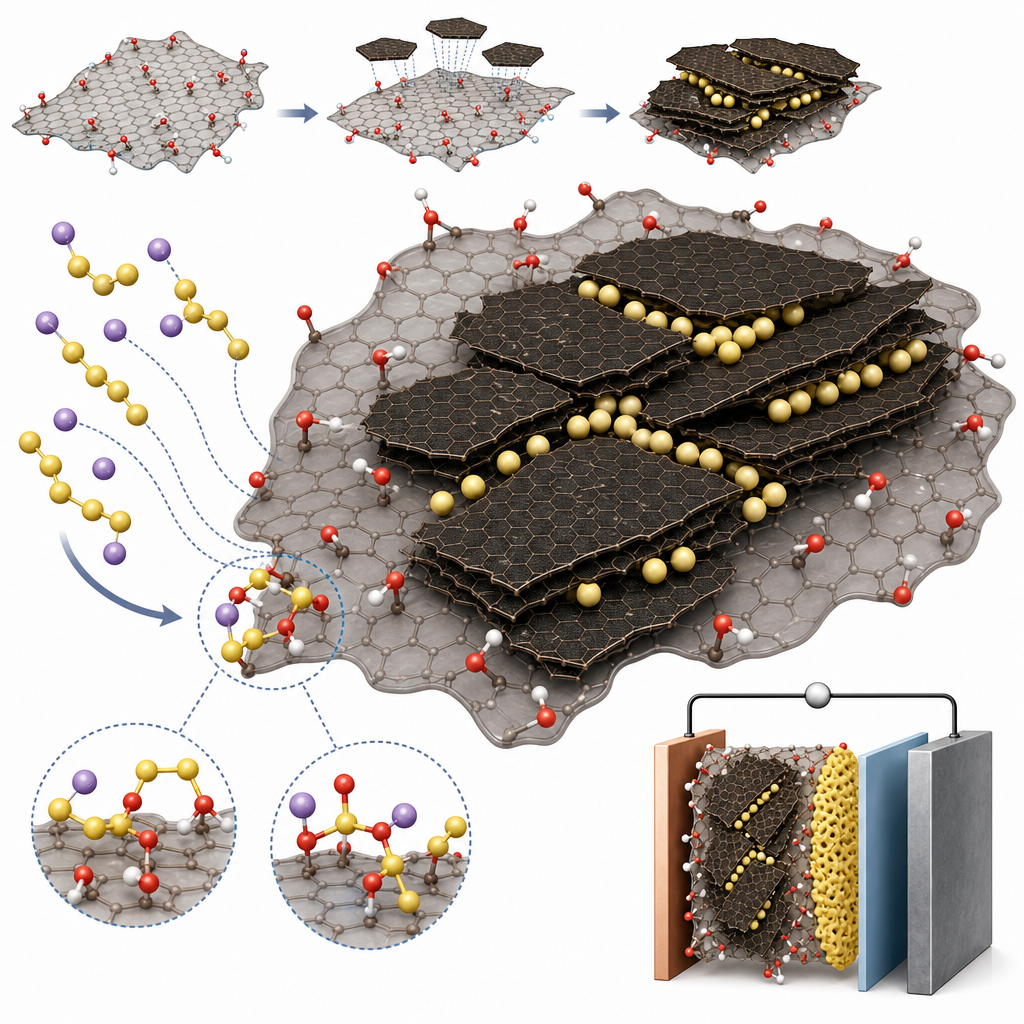
Electrochemical testing of the 75S/MnO2 cathode produced standout numbers. At C/20, the composite delivered approximately 1,300 mAh/g; at a 20-fold higher rate (1C), capacity dropped only modestly to 950 mAh/g, indicating fast kinetics. At C/5, initial capacity of 1,120 mAh/g retained 1,030 mAh/g after 200 cycles, corresponding to 92% capacity retention or 0.04% fade per cycle. Long-term cycling at C/2 sustained performance over 1,500 cycles. Most strikingly, at 2C the cell completed 2,000 cycles with a fade rate of just 0.036% per cycle and Coulombic efficiency above 98.5%, retaining 245 mAh/g. Even after 2,000 cycles at 2C, switching to C/20 recovered 460 mAh/g of reversible capacity, demonstrating that active material was preserved rather than lost. In an optically transparent cell, the electrolyte in a 75S/MnO2 cathode remained nearly colorless throughout discharge, while a control 75S/Ketjen Black cell turned bright yellow–green from dissolved polysulfides. XPS at successive discharge depths confirmed the proposed mechanism: thiosulfate (167.2 eV) forms first, then converts to polythionate complexes (168.2 eV) by catenating bridging S(0) atoms of higher polysulfides, ultimately yielding insoluble Li2S/Li2S2.
The implications extend across the lithium–sulfur field and to adjacent energy-storage chemistries. By identifying a transferable surface-mediator chemistry—not unique to MnO2 but operative on any oxygen-functionalized polar host including graphene oxide—the work points to a rational design rule for sulfur cathode supports. Researchers can now screen candidate hosts for thiosulfate-forming capacity and apply the same logic to related conversion-type cathodes. Compatible electrolyte engineering (DOL/DME with LiTFSI/LiNO3) and lithium-anode protection strategies could push Li–S cells closer to commercial deployment in electric vehicles, grid storage, and aerospace applications, where high gravimetric energy density is prized. Beyond batteries, the surface redox chemistry described here is relevant to electrocatalysis, sulfur capture, and selective sorption.
For researchers exploring polysulfide-trapping cathode hosts, 2D-templated metal oxides, or graphene-based composites, the single-layer graphene oxide from ACS Material used in this study is available in dispersion and powder forms suitable for templating, hydrothermal synthesis, and host fabrication. Likewise, ACS Material single-layer graphene serves as a useful inert reference when assessing whether observed host activity arises from carbon structure or from surface oxygen functionalities. The Nature Communications results stand as an independent benchmark of material quality: the ACS Material GO produced consistent δ-MnO2 nanosheets and reproducible electrochemistry across hundreds and thousands of cycles.How ACS Material products were used
- Single Layer Graphene (ACS Material) (Graphene Series) — “we investigated the interaction of LiPS with other sulfur hosts—GO (ACS Material, USA) and graphene (ACS Material, single layer).”
- Single Layer Graphene Oxide (ACS Material) (Graphene Series) — “20 mg of single-layer GO (ACS Materials) were dispersed in 100 ml deionized (DI) water by sonication.”
Product Performance in this StudySingle-layer graphene oxide from ACS Material served as the structural template for synthesizing the δ-MnO2 nanosheets via reaction with KMnO4. GO was also independently investigated as a sulfur host and shown to form the same thiosulfate/polythionate surface species that mediate polysulfide redox, supporting the generality of the mechanism.
Related product categories
Frequently asked questionsHow does graphene oxide help suppress the polysulfide shuttle in lithium–sulfur batteries?
Graphene oxide carries surface oxygen functionalities that react with initially formed lithium polysulfides to generate insoluble thiosulfate species. These thiosulfate groups then catenate higher polysulfides into polythionate complexes and convert them to insoluble Li2S/Li2S2. This chemical mechanism, demonstrated by Waterloo researchers in Nature Communications, traps active sulfur on the cathode and stops the shuttle far more effectively than physical encapsulation alone.
Why is single-layer graphene oxide useful as a template for MnO2 nanosheets?
Single-layer graphene oxide provides an atomically thin, oxygen-rich two-dimensional substrate on which KMnO4 can reduce to form δ-MnO2 with the same lamellar morphology. The hydroxyl and epoxide groups on GO act as nucleation sites, yielding birnessite nanosheets with a 0.25 nm (100) lattice spacing. The resulting ultra-thin MnO2 maximizes exposed surface area, which is essential for efficient polysulfide redox mediation in Li–S cathodes.
What capacity retention can sulfur–MnO2 nanosheet cathodes achieve?
In the Waterloo study, a 75 wt% sulfur–MnO2 nanosheet composite delivered around 1,300 mAh/g at C/20 and retained 92% of its initial capacity after 200 cycles at C/5. At a 2C rate, the cell ran for 2,000 cycles with a fade rate of only 0.036% per cycle while keeping Coulombic efficiency above 98.5%. These figures are among the best reported for lithium–sulfur batteries using a conventional DOL/DME electrolyte.