-
Graphene Additive for High-Loading Li–S Cathodes - University of Waterloo, 2016
May 28, 2026 | ACS MATERIAL LLCPang, Q., & Nazar, L. F. (2016). Long-life and high-areal-capacity Li–S batteries enabled by a light-weight polar host with intrinsic polysulfide adsorption. *ACS Nano*. https://doi.org/10.1021/acsnano.5b07347
University of Waterloo · ACS Nano · 2016
University of Waterloo researchers used ACS Material graphene in g-C3N4/S cathodes, achieving 4.27 mAh cm⁻² areal capacity and 0.04% fade per cycle over 1500 cycles.
About this research
Researchers at the University of Waterloo, led by Quan Pang and Linda F. Nazar, used graphene supplied by ACS Material as a conductive additive in high-loading sulfur cathodes built on a light-weight nanoporous graphitic carbon nitride (g-C3N4) host, achieving an ultralow capacity fade rate of 0.04% per cycle over 1500 cycles at C/2 and stable areal capacities up to 4.27 mAh cm⁻². Published in ACS Nano in 2016, the study demonstrates that combining an intrinsically polar polysulfide-trapping host with a graphene-based conductive network can deliver long-life lithium–sulfur batteries at practically relevant sulfur loadings between 3 and 5 mg cm⁻².
Lithium–sulfur (Li–S) batteries are attractive next-generation energy storage candidates because sulfur offers a theoretical specific capacity of 1675 mAh g⁻¹ and a gravimetric energy density near 2600 Wh kg⁻¹, well above conventional lithium-ion chemistries. However, soluble lithium polysulfide (LiPS) intermediates shuttle between electrodes, causing rapid capacity fade, low Coulombic efficiency, and poor performance at the high sulfur loadings required for commercial viability. Non-polar carbon hosts trap LiPS only weakly. Nitrogen-doped carbons help but rarely exceed 5 atom% N, limiting active-site density. Heavy polar oxides bind LiPS strongly but penalize gravimetric energy. A light-weight, intrinsically polar host with abundant chemisorption sites is therefore highly desirable, which motivated the authors to evaluate g-C3N4, a polymeric material containing 53.5 atom% nitrogen with abundant pyridinic sites.
The g-C3N4 was synthesized by polycondensation of cyanamide on a colloidal silica hard template, yielding a mesoporous powder with a BET surface area of 615 m² g⁻¹ and a pore volume of 0.97 cm³ g⁻¹. Sulfur was loaded by melt diffusion at 155 °C to give a 75 wt% S composite (g-C3N4/S75). For the standard 1.5 mg cm⁻² loading, electrodes were formulated with Super P and PVDF on carbon paper. For thick, high-loading electrodes (3–5 mg cm⁻², 90–150 µm thick), the authors used a water/DMF slurry containing Super P, styrene butadiene rubber, carboxymethyl cellulose, and 5 wt% graphene supplied by ACS Material. The graphene additive was specifically introduced to create a 3D electron-conducting pathway through the thick monolithic g-C3N4 matrix and to promote electrolyte wetting across the cathode cross-section. Its role is supporting but enabling: without an effective percolating conductor, the modestly semiconducting g-C3N4 host could not sustain the high current densities required at multi-milliamp-per-square-centimeter loadings.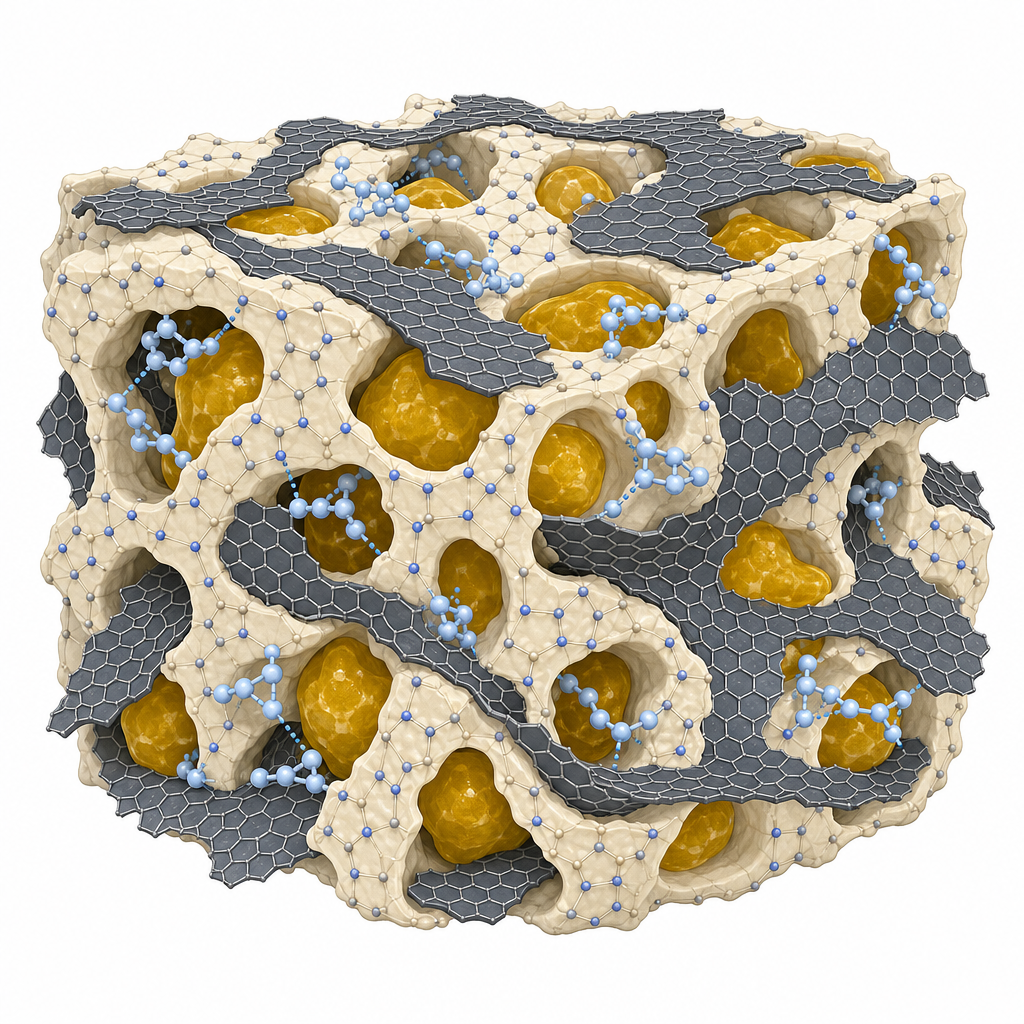
Quantitative results highlight both the polysulfide-trapping chemistry of g-C3N4 and the practical impact of the graphene-containing thick electrode. Potentiostatic titration showed g-C3N4 adsorbs roughly 4.25 mg of Li2S4 per 10 mg of host, nearly twice the uptake of an analogous N-doped carbon and about 40 times that of Vulcan carbon. DFT calculations gave Li2S2 binding energies of 1.73 eV on g-C3N4 versus 0.51 eV on pristine carbon, with Li2S binding reaching 4.08 eV. Electrochemically, the standard 1.5 mg cm⁻² g-C3N4/S75 electrode delivered initial capacities of 1170, 900, 855, and 785 mAh g⁻¹ at C/20, C/5, C/2, and 1C, respectively, retained 93% of its capacity over 200 cycles at 1C, and showed only 0.04% capacity fade per cycle over 1500 cycles at C/2 across three months of testing. With the graphene-containing thick electrodes, areal discharge capacities reached 3.15 mAh cm⁻² at 3.0 mg cm⁻² and 4.27 mAh cm⁻² at 5.0 mg cm⁻² at C/20, and a 3.0 mg cm⁻² electrode cycled stably at C/5 (1.0 mA cm⁻²) for 175 cycles. Polarization remained essentially identical across loadings, evidencing the effectiveness of the graphene-enabled percolating network.
These findings have direct implications for practical lithium–sulfur cell engineering, where achieving >3 mAh cm⁻² with long cycle life remains a benchmark for displacing lithium-ion in electric-vehicle and grid-scale storage. The work suggests a general design rule: pair a light-weight, intrinsically polar polysulfide-trapping host with a conductive carbon additive (graphene, CNTs, or related nanocarbons) to balance chemical binding, electronic transport, and mass loading. Follow-up directions noted by the authors include integrating g-C3N4 into smarter composite architectures that better accommodate sulfur’s volumetric expansion, and exploring related polar polymeric or 2D nitrides. Adjacent applications include lithium–selenium batteries, redox-flow systems, and any electrochemical interface that must chemisorb soluble intermediates while maintaining electronic conductivity.
For researchers developing thick, high-loading battery electrodes, the ACS Material graphene used here is representative of the Graphene Series products available for slurry formulations, conductive networks in composite cathodes, and electrochemical research more broadly. ACS Material offers a range of graphene grades, including dispersions and nanoplatelets, suitable for similar Li–S, Li-ion, and supercapacitor electrode work, supporting reproducible studies of polysulfide trapping, conductivity engineering, and high-areal-capacity cell design.How ACS Material products were used
- Graphene (conductive additive for thick Li–S electrodes) (Graphene Series) — “sulfur composites with Super P, graphene (ACS Materials), styrene butadiene rubber aqueous binder, and carboxymethyl cellulose binder were dispersed in a mixture solvent of deionized water and dimethylformamide”
Product Performance in this StudyGraphene from ACS Material was used as a 5 wt% conductive additive in slurry-cast high-loading (3–5 mg cm⁻²) sulfur cathodes. It established a 3D electron-conducting network and improved electrolyte wetting, enabling negligible voltage polarization differences across electrodes up to 5 mg cm⁻² sulfur loading and stable areal capacities up to 4.27 mAh cm⁻².
Related product categories
Frequently asked questionsWhy is graphene added to thick lithium–sulfur cathodes?
In thick Li–S cathodes with sulfur loadings of 3–5 mg cm⁻² and thicknesses of 90–150 µm, the main host material often has limited electronic conductivity. Adding around 5 wt% graphene creates a percolating three-dimensional electron-conducting network through the electrode and improves electrolyte wetting, so that voltage polarization stays nearly constant as sulfur loading increases and the electrode can deliver high areal capacity with stable cycling.
How does graphitic carbon nitride (g-C3N4) trap lithium polysulfides?
Graphitic carbon nitride contains roughly 53.5 atom% nitrogen, with abundant pyridinic N sites that carry partial negative charge. These electron-rich nitrogen atoms form favorable Li+–Nδ− bonds with lithium polysulfides, as shown by XPS shifts and DFT binding energies of 1.73 eV for Li2S2 and 4.08 eV for Li2S, far higher than on pristine carbon. This chemisorption suppresses the polysulfide shuttle and stabilizes long-term cycling.
What areal capacity is achievable with g-C3N4/graphene sulfur cathodes?
Slurry-cast g-C3N4 sulfur cathodes containing 5 wt% graphene delivered areal capacities of 3.15 mAh cm⁻² at 3.0 mg cm⁻² sulfur loading and 4.27 mAh cm⁻² at 5.0 mg cm⁻² loading at C/20. At C/5 (1.0 mA cm⁻²) a 3.0 mg cm⁻² electrode maintained around 3.35 mAh cm⁻² over more than 175 cycles, demonstrating that graphene-enabled conductive networks support practical high-loading Li–S operation.