-
Graphene & Carboxyl CNTs for Al/Zn Battery Anodes - Cornell University, 2021
May 26, 2026 | ACS MATERIAL LLCZheng, J. et al. (2021). Regulating electrodeposition morphology in high-capacity aluminium and zinc battery anodes using interfacial metal–substrate bonding. *Nature Energy*.
Nature Energy · 2021
Cornell researchers use ACS Material graphene dispersions and carboxylated carbon nanotubes to enable 99.6–99.8% reversible Al and Zn battery anodes.
About this research
Researchers at Cornell University, in collaboration with Brookhaven National Laboratory and Stony Brook University, used graphene dispersion in NMP and carboxylic-functionalized carbon nanotubes purchased from ACS Material to demonstrate that interfacial metal–substrate chemical bonding can regulate the electrodeposition morphology of aluminium and zinc battery anodes, achieving 99.6–99.8% Coulombic efficiency over more than 3,600 hours of cycling at areal capacities up to 8 mAh cm⁻² — roughly two orders of magnitude higher than previously reported values. The study, published in Nature Energy in 2021, identifies oxygen-mediated Al–O–C covalent bonds as the key driver of uniform, compact deposition and translates the concept to Zn anodes using a graphene interphase.
The broader challenge addressed is the unreliable reversibility of post-Li metal anodes such as Al and Zn. Although Al is intrinsically safe, low cost and energy-dense, prior Al batteries operated only at impractically low areal capacities (0.01–0.18 mAh cm⁻²) because rapid non-planar growth shorts cells in under 20 hours at practical loadings. Conventional planar stainless steel and even 3D Ni foam substrates fail to prevent dendritic Al growth into the glass-fibre separator via the 4Al + 3SiO₂ → 2Al₂O₃ + 3Si reaction. Solving this requires a fundamentally new way to anchor the depositing metal, with direct implications for grid-scale energy storage where cost and cycle life dominate the economics of renewable integration.
ACS Material products entered the work in two roles. First, graphene dispersion (4 wt% in NMP) and few-layer graphene in water were explicitly purchased from ACS Material, as stated in the Methods section. The aqueous graphene was combined with carboxymethyl cellulose to form a viscoelastic ink that was strain-infused into interwoven carbon-fibre matrices, producing high-areal-capacity graphite-based cathodes (~1 mAh cm⁻²). The graphene was also deployed as an interphase coating on carbon-fibre Zn anodes, where it provides the epitaxial registry that minimises Zn–substrate interfacial energy. Second, carboxylic-functionalized carbon nanotubes (and graphitized CNTs as a negative control) were purchased from ACS Material and coated onto planar stainless-steel substrates to test whether oxygen-bearing surface groups could induce the same Al–O–C bonding observed on activated carbon fibres in a more conventional planar battery format.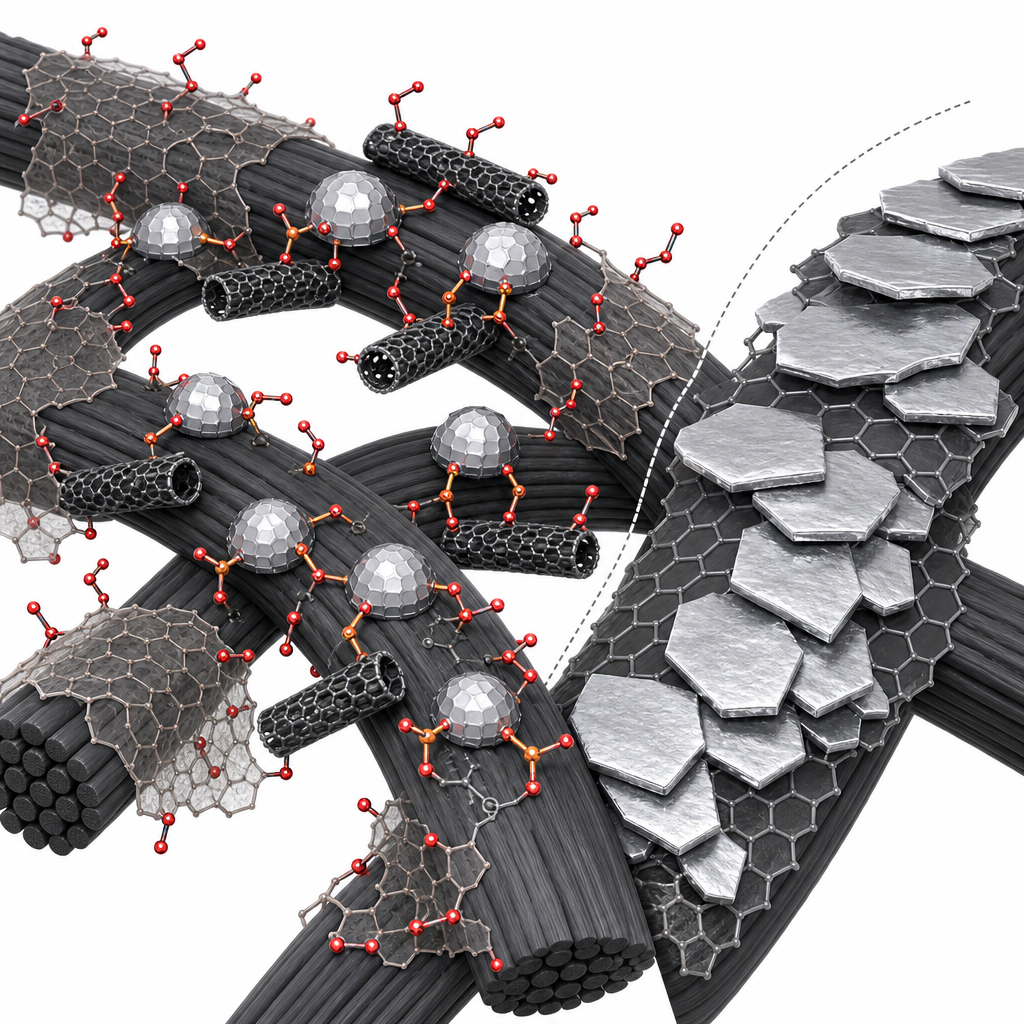
The quantitative results are striking. On bare planar stainless steel, Al cells short-circuited in under 20 hours and exhibited a Coulombic efficiency of only ~85%. In contrast, Al deposited on ionic-liquid/AlCl₃-treated carbon fibres formed ~139 nm nuclei (versus 20–50 µm on stainless steel) and grew laterally into a conformal ~160 nm compact layer before transitioning to micron-scale fill at higher capacities. The resulting cells achieved 99.4–99.8% Coulombic efficiency across 0.8, 3.2 and 8 mAh cm⁻² loadings and sustained over 2,000 hours of stable plating/stripping, with one cell running 3,600 hours and 360 cycles at 8 mAh cm⁻² without overpotential growth. At an extreme current density of 40 mA cm⁻², the carbon-fibre electrodes maintained 99.96% Coulombic efficiency over 60,000 cycles. XPS confirmed Al–O–C bonding (C 1s 283.5 eV, Al 2p 74.7–74.9 eV, O 1s 531.9 eV) only on the carbon-fibre substrates and not on stainless steel or Ni foam controls. For Zn, the graphene-coated carbon-fibre anode produced nanoscale plate-like Zn deposits, while CNT-COOH coatings on planar steel reproduced the stable, high-CE behaviour at the planar device level.
These findings open practical pathways to anode-free Al pouch cells, durable aqueous Zn batteries and other post-Li chemistries that have stalled at low areal capacities. The work demonstrates that rationally designed metal–substrate interphases — whether ionic-liquid-activated oxygen sites, carboxylated CNT coatings, or graphene epitaxial layers — can replace expensive 3D foams as a generic morphology-control strategy. Adjacent application areas include grid-scale stationary storage, low-cost backup power for intermittent renewables, and next-generation safe rechargeable batteries that avoid the cost and supply constraints of lithium. The authors explicitly propose that the concept can be extended to additional electrodeposition systems by engineering artificial interphases with strong metal–substrate interactions.
For researchers working on metal anodes, nanostructured electrodes, or 2D-material interphases, the graphene NMP dispersions and carboxyl-functionalized carbon nanotubes used here are available from ACS Material in research- and pilot-scale quantities. The same materials are widely applicable to electrocatalysis, transparent conductors and composite electrode inks, making them a useful starting point for groups translating the bonding-regulation concept to other chemistries.How ACS Material products were used
- Carboxylic-functionalized Single/Multi-Walled Carbon Nanotubes (Carbon Series) — “We evaluated the electrochemical plating/stripping of Al on stainless steel coated by carbon nanotubes with and without carboxylic side groups... carboxylic-functionalized carbon nanotubes and graphitized carbon nanotubes were purchased from ACS Material.”
- Graphene Dispersion in NMP (Graphene Series) — “Graphene dispersion in N-methyl-2-pyrrolidone (4 wt%), few-layer graphene dispersion in water (4 wt%), carboxylic-functionalized carbon nanotubes and graphitized carbon nanotubes were purchased from ACS Material.”
Product Performance in this StudyGraphene dispersions were used as an interfacial coating that strongly coordinates with Zn (epitaxial mechanism), markedly improving Zn plating/stripping reversibility and lifetime versus bare carbon fibres. Few-layer aqueous graphene was also infused into carbon-fibre cathodes to enable high-areal-capacity full cells.
Related product categories
Frequently asked questionsHow does interfacial metal–substrate bonding improve aluminium battery anode reversibility?
Strong Al–O–C covalent bonds formed between deposited Al and oxygen-enriched carbon fibre surfaces lower the critical nucleus size, producing uniform ~139 nm Al nuclei that grow laterally into a compact ~160 nm conformal layer. This shortens the electron transport length by roughly four orders of magnitude compared to dendritic Al, eliminates dead metal, and raises Coulombic efficiency from ~85% on stainless steel to 99.6–99.8% on bonded carbon-fibre substrates.
What role do carboxylated carbon nanotubes play in regulating Al electrodeposition?
Carboxyl groups on the nanotube surface introduce oxygen-rich sites that bond covalently with depositing Al through Al–O–C linkages, the same chemistry that controls morphology on activated carbon fibres. When coated onto planar stainless steel, carboxylated CNTs translate the morphology-regulation effect to a conventional flat geometry and deliver stable cycling and high Coulombic efficiency, whereas graphitized CNTs without these groups do not.
Why is graphene dispersion useful for zinc battery anodes?
Coating interwoven carbon fibres with graphene from a 4 wt% NMP dispersion creates an epitaxial interphase that minimises the Zn-substrate interfacial energy. Zn then nucleates as uniform nanoscale plate-like deposits with a short electron transport length, instead of forming the micron-scale particles seen on bare carbon fibres. The graphene interphase markedly improves Zn plating/stripping reversibility and extends cycle life in aqueous ZnSO₄ electrolyte.